Show full transcriptHide transcript
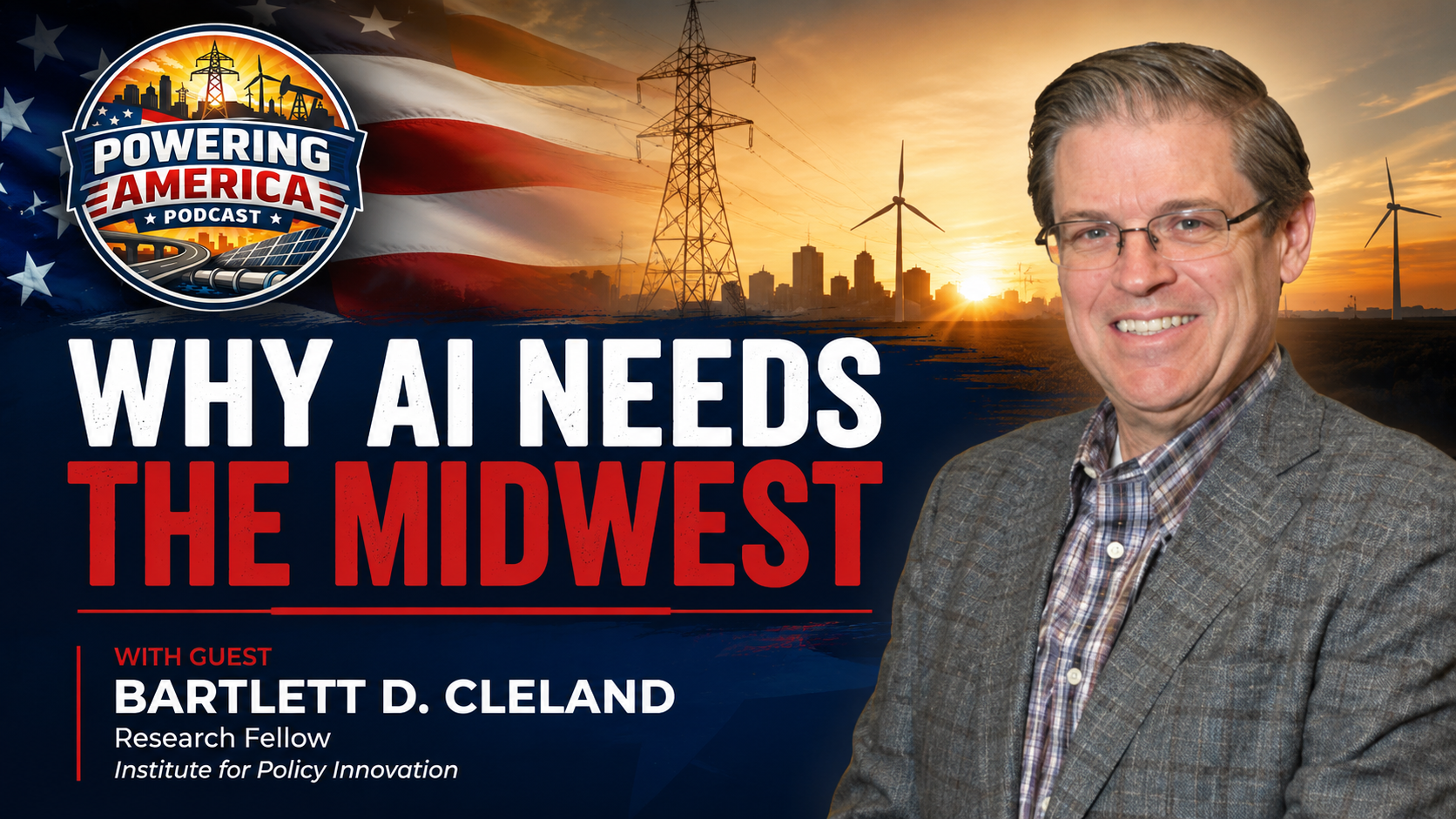
[00:00:00] Welcome to the Powering America podcast. I'm Bryan Hyde, and today I'm joined by Bartlett Cleland. He is a research, senior research fellow with the, uh, Institute for Policy Innovation. And Bartlett, it's wonderful to have you on the program. Take a moment and tell us a little bit about your background.
Sure. First, thank you for having me. I really appreciate your outreach. Um, my, I actually shocked myself when just the other day I said, um, I've been doing technology public policy for 30 years as of this year. So gulp. Um, which is amazing since I'm only 39. Um, but, but yeah, 30 years in technology public policy, starting on Capitol Hill.
I've, uh, been in a couple think tanks, uh, worked for a couple trade associations along the way. Um, and so have witnessed technology public policy from just about every angle. And you've probably seen a lot in the last 30 years. I mean, it's not like technology has been pretty static in that time. [00:01:00] What are some of the biggest shifts that you have seen during that time?
Well, without a doubt, I've gotta say were my years on Capitol Hill because we were, uh, creating the framework for the way technology, uh, works in the public policy space, uh, today. So things like the Telecom Act, uh, things like en- uh, protecting, uh, the ability to encrypt our, uh, to keep our encryption software, um, internet tax, which ultimately gets overturned, but, uh, that was a big deal.
The Digital Millennium Copyright Act, which advanced copyright, uh, laws into the digital millennium, um, are just a few of the, the big pieces that passed when I was on Capitol Hill. Um, and so that was an enormous shift because it created the infra- or the, the structure for how policy was gonna work. Um, but when it comes to technology, i- if you can believe it, and at some, at some level this is almost embarrassing to talk about 'cause it really makes me feel old, but, [00:02:00] uh, you know, back in the mid-'90s the, the web had just started.
Um, if you can remember the very old Amazon logo, for example, um, with, with the big, uh, swerve in the middle, looked like a river. Um, and that was brand new, and they were selling books. Um, some of their competition came along that they, they bought up. They were selling CDs online. Um, and so just from the, from the, uh, citizens, from the consumer's interface, things have completely changed.
We don't call it the World Wide Web anymore as distinct from the internet, even though those things are still distinct. They've all smushed together in this great thing we call internet. And I would say the number one piece that, that occurs to me, and we're doing it again with AI, is that the internet really moved from being a thing that, uh, where the media was the message.
Um, and so that if you're on the internet, that was a big deal. If you had .com, that was a big deal. Now that's table stakes. It's like electricity. [00:03:00] Like, of course, if you don't have electricity in your house, you, you've got a challenge. And I think the internet has become the same way, and we're, uh... And mobility has become the same way.
That's another big shift, and now we're about to go through another one with AI. Yeah. Let's... And what a perfect transition to AI and data centers. I, it doesn't matter where I turn, people are talking about this, and, you know, I see a lot of fear. And, and I'll give you an example. Um, Kevin, uh, O'Leary from Shark Tank announced that he's gonna be partnering with some folks to build, I think it's the biggest, you know, data center in the country in northern Utah, and people turned out to a town meeting, and, you know, th- they're very frightened.
They're upset. They wanted to be heard. And, and it got to the point where their county commissioners actually walked out of the meeting, uh, because the, the crowd was getting hostile. Um- Yeah ... so I'm gonna ask, let's... Can we take a step back and just kinda gain some perspective from the 30,000-foot view?
Why is AI infrastructure so essential [00:04:00] to what comes next? What do people need to know about t- the importance of... We, we can't just, you know, you know, say, "No, we, we don't want it." Um, tell me about why, why it's a, a necessary part of our future. Yeah. Let me talk about the, the positive side first 'cause I don't feel like that gets airplay, uh, hardly at all.
Um, that has nothing to do with you. I just mean generally, that, that, that part of the conversation rarely gets explored. Um, and so AI, so let's start at AI, and then I'm gonna walk the cat backwards a little bit. But, uh, the promise of AI for tomorrow is a kind of the same promise that neural networks, which is what AI used to be called, uh, back in 19- the 1950s, 1953.
Um, and so it's been around a long time. It has definitely taken huge leaps forward as computing power and speed have taken huge leaps forward. Um, and why is that? Because often, um, as opposed to doing a, a Google search, let's say, you type in a search, it does, um, [00:05:00] to dumb this down, kind of one hit. It says, "Oh, I'm looking for dogs with, uh, that don't shed," and it goes out and finds a bunch of pages where they've said some combination of those words, um, and they return that to you.
AI is going over that same search multiple iterations, trying to figure out exactly the best thing to deliver to you, just like that search does, but it's doing it in a much more refined way. So if you have a brain like some over thinkers, uh, you, where you sit in bed at night and you're going over the conversation again, that's kind of what AI is, is doing to give you a crisper answer.
Um, so what does that, what can that do then? Well, if it can compute that quickly, the advances in, I'll just pick one, in health, um, are not only are we already seeing those advances, the... We are now getting well on our way down a road where individualized medicines- Uh, can become a real thing. There's still plenty of distance to go here.
But, uh, just in the pharmaceutical space, [00:06:00] the time that is lopped off developing a new pharmaceutical because of all of the, um, the... I'm gonna forget the words, but it's ultimately the efficacy of putting different molecules together. There are billions of combinations. Well, a computer can start running those, um, i- in a matter of days as opposed to a matter of, well, geez, you'd need a whole room of people for years and years, which is one reason it takes so long to develop new drugs.
So, uh, that's one example. There's all kinds of examples for people who are, with disabilities, um, uh, helping with PTSD, helping, uh, people who have some kind of limited mobility being able to speak, um, uh, researches. So AI today, uh, is great. It's interesting. It's kind of fun to play with, honestly. Tomorrow it's gonna be fascinating.
And a- again, for, uh, y- your listeners who, um, are of the age that they remember the internet coming online, remember when the internet was a toy, and we hopped on and like, "Ooh, look, I can, I can send a [00:07:00] book to myself." And now it has become baked into everything we do. That, that's where we're going. Okay, one step back then.
What creates AI? AI is merely computing power plus data. That's it. Um, and what does it take for computing power, uh, power? Electricity. So as you walk backwards from AI, you need the data center. Why? 'Cause that's gonna be where all the information is stored and where, uh, uh, the compute happens. The compute doesn't happen on your phone.
The compute happens down the street, um, and then is sent back to you very rapidly. Um, and then it takes the electricity, which is why we have discussions about electricity, because that combines with the data and then outputs your, your result. I, I'm looking at an article that you recently had published on The Institute for Policy Innovation's website and, and you describe, um, artificial intelligence and that data center infrastructure as the economic opportunity of this generation.
And I'd like to ask you, can you expand a little bit on, on what does this mean in [00:08:00] terms of jobs, in terms of industries, in terms of how wealth is going to be created over the next 50 years? So I am a, a diehard Midwesterner. Um, and I would... Uh, as I've looked over the years, and I, I've loved innovation and technology, um, r- really my whole life.
Um, I grew up with The Jetsons and, uh, I've always thought Rosie the Robot was kind of the, the, where we should head. So it's always been fascinating to me. But what I watched growing up and, uh, certainly in later years, was that the coasts tend to get a lot of the technology attention. Pharmaceuticals, uh, if you think about it going out east.
Out west you've got, uh, computer technologies and internet. Uh, Mae East and Mae West, the hubs are on the East and West Coast. Um, and a lot of the middle of the country- They tried, they called things like Silicon Valley and, I mean, Silicon Prairie and whatnot. It, it, it never really happened. Um, now we have an opportunity with this next wave of [00:09:00] infrastructure building that will support all these advanced technologies, where it turns out the Midwest is actually a pretty good place to go.
Um, and so there-- And these are in areas that have been economically left behind is a, a, a tragic exaggeration, but that have not been quite as cutting edge, let's say. Um, and now they have a chance to bring their economies up to where a lot of other, the coastal states might be. Um, and so I think there's even an amplifying effect to the potential economic boom.
And what does that look like? Well, first of all, it, uh, the first phase of a data center is about the size of a, a aircraft carrier. Um, and that's about a billion-dollar investment, and that will support, as it's being built, ar-around fifteen hundred, two thousand, think, think labor union jobs. That's typically what we're talking about.
Electricians, carpenters, pipe fitters, et cetera. Um, then once it's up and running, you end up with about a hundred and fifty to two hundred company-badged [00:10:00] employees who are making six figures with a high school diploma. So we're talking about people being able to stay living in their communities the rest of their lives, rural-ish communities, and, and where they can be-- uh, they have the opportunity, if they want it, to have a sole income household, which means kids are getting a lot more attention, et cetera.
So to me, it's great from that level. And then secondly, and I, I, I put some stock in this because you can observe it, I don't really have numbers, um, and that is that if you have all that going, and then you have security services, janitorial services, et cetera, that support that. The last thing I'll say on this piece is rarely do hyperscale builders build that one.
They build three or four, and so you have construction jobs that are lasting eight to ten years. And as we all know, construction people move around, right? They, they go build a building, building's done, they move on. So they don't lose their jobs, but they don't get to stay in the same place. And some great testimony [00:11:00] out of Minnesota f-by an electrician who was a family guy, and he said, "You know, working in this data center is the first time in my career I've been able to go home every night, um, and not have to drive across the state or whatnot."
And so I was blown away by that. It really resonated with me, um, how cool that is. So okay, now once they're built, what happens? Well, they become the hub of other technology, uh, infrastructure-related items, not least of which is, of course, you need broadband build-out because you have to have a big fat pipe, otherwise a lot of good all that information in that building is.
Um, and so once that's there, other companies want to connect into that. Pipe, and so you end up building community out of, uh, of pretty advanced companies. Um, and there have been a couple places in the country where we've seen this happen already. So it really is the beginning, uh, the, the rebuilding block, I should say, of tomorrow's technology.
Now, Bartlett, talk to me about foreign funding that [00:12:00] is coming into the US and for the purpose of, you know, stirring up, uh, you know, activism against these data centers. Um, who's sending the money? Why, why would, why would they not wanna, want to the US to be, you know, building this kind of infrastructure?
Clever questions. Um, so, um, yeah, this is the disturbing part. So as much as I'm all excited about this economic opportunity, um, others around the world are as well. Um, and they, um, you know, a little bit have to crawl in their heads, but they apparently don't want us... Uh, maybe that's the best way to put it.
They don't want us to have all of this new boom. So whereas I see this could be, uh, you know, potential new boom for places that have otherwise not been part of the tech advance in this country, they say, "Oh, wait, our country hasn't been part of the tech advance globally. Let's have this here." Uh, but what does that interference look like?
Well, th- been ma- many articles, and I basically linked to these [00:13:00] articles in the piece I wrote. Um, there is a, uh, billionaire, uh, quite liberal individual in Switzerland who is spending literally tens of millions of dollars funding organizations to turn out people to these county commission, like you mentioned in Utah, uh, to protest.
Uh, what is interesting is their arguments, um, it, it's, uh, you could be generous and say it's fear-based. It is mythology. Um, a lot of their arguments are just simply asserted with no undergirding of s- And, and they don't have any other talking points. Um, they are, if not paid to be there, they're strongly encouraged to be there, organized by these groups that tend to come in in matching T-shirts, and they, they have, uh, interesting sounding names like Citizens Against Data Centers from XXX County, whatever that county is.
Um, but they're... It, it's not organic at all. Uh, and so what [00:14:00] is, what does this mean for these rural areas? Uh, for example, this happened in a, a very rural county in Kentucky, um, that had used to be coal mining, um, as you can imagine how desolate, uh, could really benefit from this kind of investment. And folks showed up from across Kentucky.
People called it NIMBY. I'm like, "Well, it's... That's not NIMBY. Uh, NIMBY is my backyard. This is across the state." Um- And it was- that's what started us looking into, uh, wh- why is this happening? Um, and it was all about just not having the development happen at all, and that has happened in many localities lately, in Texas, Utah, there have been several.
So why wouldn't they want them developed here? Well, there is a theory, I can't say that I have seen proof in writing yet, that China is also part of this funding, and China very much wants to be the data center hub of tomorrow. And what does that look like for you and me? It means [00:15:00] our data would all be stored in China, um, on their servers.
And some people say, "Oh, is that even possible?" The answer is yes, that this, th- th- the data centers could be anywhere in the world, and with the speed of, uh, telecommunications, broadband today can get to us in fractions of seconds. Um, depending on where you're sitting, what state, most states don't have data centers, so you're probably being served from out of state already.
But probably served by the United States, um, and we certainly don't wanna lose that economic development, we don't wanna lose control of our information. And frankly, part of this is, it just kinda chaps my hide that somebody sitting in another country is spending millions of dollars trying to harm the US, and they're, the, they have convinced scores of left and right, conservatives and liberals, um, to take their side in this fight.
And I'm thinking, "I thought we were here fighting for the US." It- it's puzzling to me. Okay, so this is for my [00:16:00] own curiosity. If I wanted to recognize their talking points, what are, what are the common talking points they use to try to either delay or flat out stop, you know, the development of these data centers?
What, what are the, what is the excuse they use? So some of them are crazy. Um, and they, and again, they will offer no proof, and then I'll get to the legit ones. But, uh, some of them I saw, uh, uh, data centers kill bees, data centers cause diabetes, uh, data centers cause mental health issues. Um, on diabetes, I wonder if maybe it's the Twinkies weed, that might have something to do with it.
But apparently it's the- the computers sitting across the field. I don't... It's very odd to me. Uh, the- the more legitimate arguments, um, are water usage, electricity price, well, elec- depending on the argument, electricity usage or the price of electricity going up for l- uh, local citizens. Um, I, eh, I'd say those.
May- maybe it's a, an aesthetic argument, I would say. Some people say, "Well, I [00:17:00] just don't want a development out in the middle of what used to be corn or soybean fields." Um, and I'd say those are probably their three best arguments. Now, you make the argument in this article that, uh, this is not just an environmental- Um, argument or this, this shouldn't just be framed in environmental terms.
You talk about the... This is civilizational, and I'd, I'd like you to expand on that a little bit. What happens when, um, even if it's just delaying or putting moratoriums on the development of these data centers, every time that we delay, what happens? Sure. So, uh, I mean, the easy answer is just exactly what would happen if you were experiencing the delay as an individual.
Companies start getting skeptical about locating somewhere. Um, I think what you will hear most of the companies say, in fact, this is not true just for data center companies, it's true for kind of any company, we want to go where we are welcome. Um, and if they are not welcome, and not welcome looks like a lot of different things at times, [00:18:00] uh, but certainly if people are protesting, um, why build there if you don't need to?
Um, and so what does that do over time? Well, it takes away the economic opportunity, and other places look more attractive, uh, wherever that place might be. Okay. So, um, we're, we're coming up fast on the end of our segment here. For people who want to become better informed, it sounds like you have a lot of great information, um, through, you know, through the, uh, Institute for, uh, Policy Innovation.
Where can people find your website? Are there other resources you would direct them to as well? Sure. So, uh, ipi.org, ipi.org is, uh, the institute's website. You will see more... You, you will see a ton of technology work that we've done over the years. You'll see that continue. Um, I would also say there are two groups out there who are, um, who are pretty on top of this stuff.
One is the Data Center Coalition. I'm sorry, I don't know their website URL off the top of my head . [00:19:00] And another is NetChoice, um, who has a lot of information on data centers on their site as well. Um, and then j- uh, the last thing I'd say is be careful, if people are looking for information, be careful of the Facebook groups.
These tend to be what get stood up by the foreign actors, and so just be careful of the data. Research it yourself. This is easy to find. Um, y- you can look at studies. Virginia's done a study. The US government has done a study on, like, price of electricity. It goes down when data centers are there. It doesn't go up.
Uh, but just do a little bit of research. And then finally, if you have other questions, always feel free to contact me. I, I think there's a link to my information right on the website, so always feel free to reach out. Again, we're talking with Bartlett Cleland. He is a senior research fellow with the Institute for Policy Inf- Innovation.
And Bartlett, thank you so much for joining us today on the Powering America podcast. Thank you