Show full transcriptHide transcript
PAP May 20 David Clement
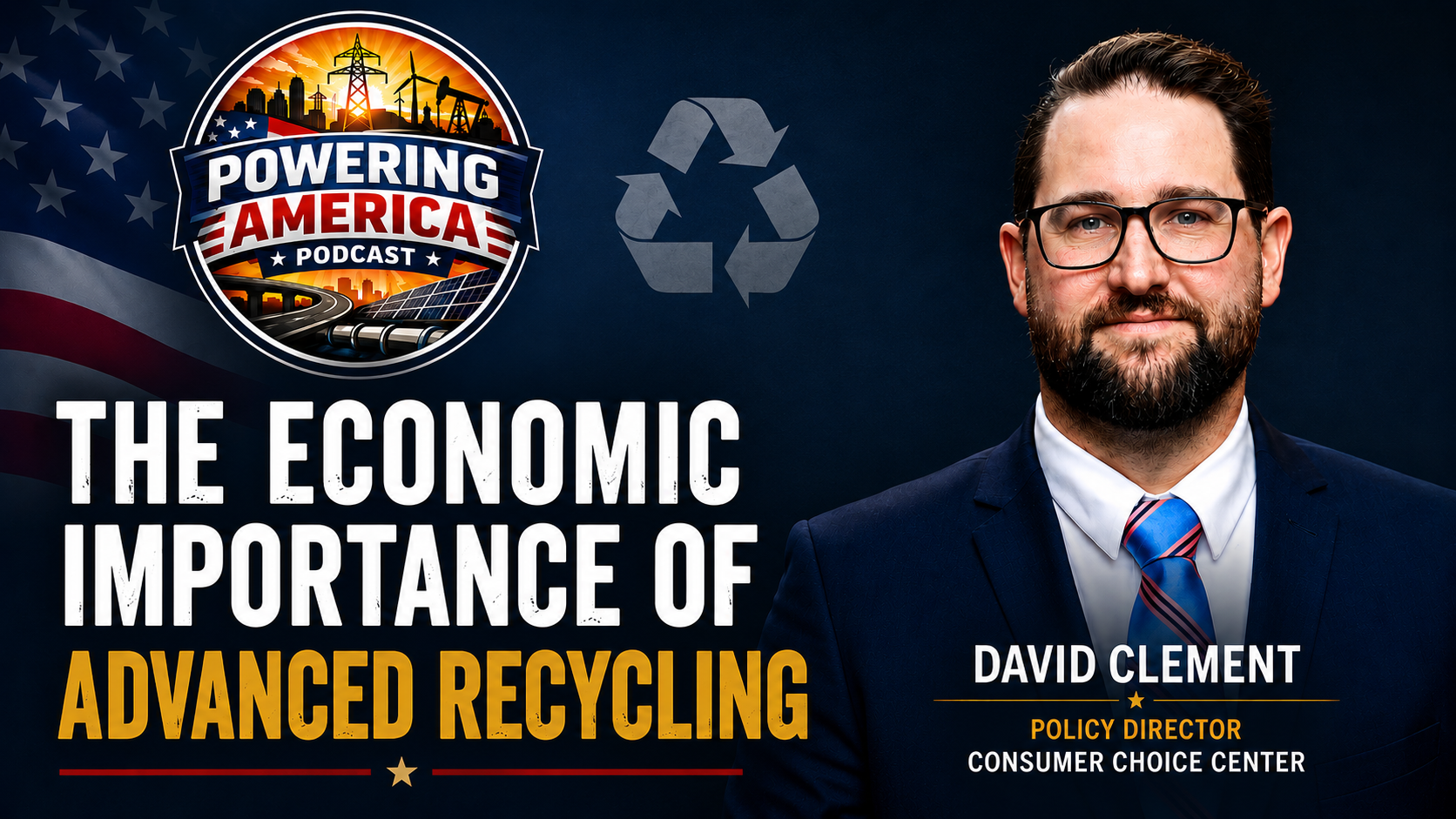
[00:00:00] Welcome to the Powering America podcast. I'm Bryan Hyde. Today I am joined by David Clement. David is with the Consumer Choice Center. And David, you're the North American Affairs Manager, but can you kinda tell us a little bit about, uh, who you are and, and what you do, and then, then let's dive into a very timely topic.
Yeah. So, um, I'm with the Consumer Choice Center, which is now 10 years old, um, which is a US-based, um, NGO that defends, uh, the rights of consumers when governments overstep. And that can include everything from ride sharing at the local level, to free trade policy, to what we're talking about today, uh, which is plastics.
Uh, because for the better part of five years, I would say, uh, maybe even longer, plastics were kinda deemed as public enemy number one. And what I did in both Canada and the United States is a lot [00:01:00] of, uh, I guess the easiest way to describe it would be education for policymakers and the public on the reality of why we use plastic, why it's important economically, but also, and I really emphasize this, why it's important environmentally.
Because the framing of the debate was always seen as plastic bad, alternatives good. And I spent a lot of time, both in Canada and the United States, um, going through the numbers and the life cycle analysis, comparing, let's say, something like a plastic bag to paper. Uh, most people don't realize that a paper bag, according to Denmark's environment ministry, has to be reused 43 times in order to be as environmentally advantageous as a single-use plastic bag.
And once people start to see the data, then they realize, "Oh, okay, maybe we were actually sold, um, [00:02:00] some bad information and, and we need to reevaluate this," which is some of the progress we're seeing in the United States in a, a, um, kinda retooling or rethinking of plastics, um, in the US, which is a positive development.
I have to admit, I, I'm, I'm not normally contrarian, but, um, there have been times I've raised or I've rolled my eyes or raised my eyebrows at, at recycling simply because, um, it kinda brought out the woke scold in some people. "Ah, you didn't put that in the right container," or, "You didn't sort this according to that."
And I was kinda like, "Oh my gosh, it's all going to the same place." But clearly, you know, I, I have, I have not delved deeply into the issue. Talk to me a little bit about, uh... W- when it comes to, to recycling, um, what kind of, uh, what kind of movement is there on the legislative front? Yeah. So just to rewind a little bit, there is now new technology and new processes called advanced recycling or chemical depolymerization, and the easiest way to explain that in [00:03:00] layman terms is basically breaking down the plastic into its original building blocks so you can turn it into anything.
Um, and there are all sorts of innovative, um, uh, examples, both from Canada and the United States, where people take The plastics that we generally thought were maybe not recyclable, um, that someone would maybe give you a hard time for putting in the garbage. Um, and they're able to break it down to its core components and turn it into everything from lawn chairs to, uh, an additive into asphalt in cold climates that makes the road durable.
Uh, so like where I'm from, uh, incredibly cold in the winter. You have the snow plows, they run all winter, and then the highways look like a war zone, uh, come April and May, and they have to repave and all of that. So some person much smarter than I, um, thought, "Well, why don't we take what was otherwise [00:04:00] waste and infuse that into the asphalt and create more durable roads that don't need to be repaved at the same frequency?"
Um, which is a huge environmental net benefit on, and also the convenience of not having lane closures and things like that. Um, so advanced recycling is really kinda the, the next step in the recycling conversation. There is a bill, uh, currently, the Recycling Technology Innovation Act, um, which is looking to expand, um, on US capabilities to do this type of stuff.
Um, right now, I believe it has been introduced and referred to committee. There hasn't been any progress, uh, as of right now, but it is still in play. Um, and it would be a big step forward in terms of the US being a leader in, in extending the life cycle of all of the things that we would otherwise think sh- would just get thrown away and sit in a landfill and, and, and whatnot.
[00:05:00] So, um, it's a huge step in the right direction because it means that you can actually have those throwaway items turned into more durable, um, additional items down the road, and you extend the life cycle. Um, which whether you're Republican or Democrat, progressive or libertarian, that is a big win for the economy, uh, obviously because there's commerce and jobs involved in that.
But beyond that, it's a, it's a win for the environment because you are able to reuse in the most basic sense, um, so many of the things we otherwise just throw away. I, I have to say it is encouraging to, to hear that, you know, people have been thinking outside the box and, and coming up with new and better ways to- Mm-hmm
to recycle things. Mm-hmm. Now, I also know there are some people who believe that, you know, "Hey, recycling is the panacea, it's gonna solve every problem." Are there myths that, that sometimes come along with this advanced recycling? Are there, are there some, uh, [00:06:00] are there some people who put a little too much faith in it?
Um, well, I mean, there's certainly opposition from the environmentalists. Um, but they've kind of lined up in opposition to every solution, and it's g- it's getting tiring, right? So whether we're, we're talking nuclear power, relatively green, um, reliable, the groups who spent the better part of decades talking about emissions and global warming are also against nuclear power and that.
And then, and then you have these same groups and these same members of Congress whom want us to have less waste, noble goal, and then somebody comes along with a new process to do exactly that, and they go, "Wait a second, I didn't mean that." And it's like, well, come on guys. You gotta, like... The, the, the market is providing all of these, uh, economically beneficial and environmentally beneficial [00:07:00] solutions, and you have the same kind of, um, I call them the fun police.
Uh, whenever something new and exciting comes along, they're the ones who wanna interject themselves to stop it, um, who, who do exactly that. They interject themselves to try and stop it, and it's a shame. Are there myths attached to it? Um, there could be. I mean, it really depends on, um, your power grid and power source 'cause they're energy intensive.
But again, it's worth it if you're extending the life cycle of things that are otherwise being thrown away and end up in a landfill. Um, and so that's a big, a big positive that a lot of the, the antis, uh, or degrowthers, uh, another word I like to call them, um- fail to recognize is like the power of extending the lifecycle c- s- li- lifecycle here is, is super important I mean, I, I get it.
There, there are some folks who wouldn't be happy unless we were all, [00:08:00] you know, living in a cave with one set of homespun clothing that we wash on a rock- ... down by the river. Yeah. But, but it sounds like there, there are... There, there's nuance here, meaning, uh, you know, a person doesn't have to be a crunchy environmentalist to understand, "No, I want to live in a clean place," or at least I don't wanna- Mm-hmm
I don't wanna clutter up and litter or otherwise damage the environment around me. But at the same time- Yep ... as you describe, the people, the, the fun police, I don't like to be ordered around by them either and, and, you know, barked at because you dropped that bottle in the wrong, you know, trash container.
Yeah. And so just imagine a scenario where all of that can be collected and sorted, and the stuff that can be depolymerized turned into new items, right? The, the, um, the multiplier effect there is orders of magnitude in terms of value. That's, that's fantastic. So right now, the fight is, uh, fighting the, the fun police or the degrowthers or however, however we frame them, the people who don't like [00:09:00] new, innovative stuff, the people who are against the idea of abundance.
And what makes this debate about advanced recycling so interesting is because you can have abundance and economic growth That actually runs in, and complements environmental, uh, concerns. And like I said before, it doesn't really matter whether you're a Republican or Democrat. Nobody wants litter. Nobody wants garbage around the community.
There are ways to collect it and turn it into something else. Well, you know what? That seems, or it should seem, like a win for everybody. And I, I'm still kind of stuck a little bit on what you'd mentioned earlier about, was it the Danish government- Mm-hmm ... that talked about the, you know, plastic bags versus paper bags?
Yeah. I mean, you know, paper bags were, were the norm growing up and, and, um, it was interesting to see them phased out, but, uh, I really had no idea that, you know, the- Yeah ... the costs were, were so significant. So yeah, just to, just to give you [00:10:00] some perspective. So when the government of Canada, um, w- went the direction of trying to ban single-use plastic bags and straws and cutlery and all of those things, so by their own estimate, the alternatives were about two to three times more expensive.
Um, so that was a, a... In Canada, that could not have come at a worse time because it was hitting the food, food service industry as they were trying to pick up the pieces post-pandemic. Um, the government in Canada actually lost, um, that, that case, uh, and is appealing. Uh, but sanity, it looks like, will prevail, uh, in the long run.
Um, but when you look at the, the comparisons across the board, so people will say, "Well, what about the other... Okay, so paper isn't necessarily a great environmental option. What about those kind of cloth reusable bags?" Um, so that has to be reused, again, according to the Danish Environment Ministry, um, and I emphasize that because [00:11:00] the Danes are not, um, careless when it comes to environmental protection.
They take it very... They're very Scandinavian about it. They take it very seriously. Um, the cloth bag has to be reused around 7,000 times To be as environmentally advantageous. And so 7,000 times is, like, bi-weekly or, uh, twice-a-week grocery store trips for, like, 200 years. Wow. So again, it's, it's... And this is the problem with the way in which the plastic debate was framed for so long.
It was, it was almost all symbolism, right? It made people feel good. It made people think that they were doing something beneficial for the environment, but at the end of the day, all it was was increasing emissions and being really irritating at the grocery store when you realize you forgot a bag, and then you had to buy one of the reusable bags.
And then you factor [00:12:00] in how much it needs to be reused, and it's just, it's costlier, it's incredibly irritating, and it's exponentially worse for the environment. I know this is subjective, but I, I have to ask, you know, as, as you look at, uh, the ways that various countries, you know, handle advanced recycling, is there any that, that really stand out?
I mean, y- of course, you mentioned Denmark. Um, are, are... Who's, who's doing the best job or basically showing the other countries, you know, here is a more productive or more, um, efficient way of doing this? Well, this is where, where the US is, for the most part, leading the charge, um, and could continue to lead the charge because, uh, one of the aspects of the act is actually redefining advanced recycling or chemical depolymerization as a manufacturing, uh, facility, which would give it...
It's super in the weeds, but it would give it the regulatory certainty for investment to be made and for expansion to [00:13:00] happen. And that's why the asp- that aspect of this bill is so important, because the United States could be a world leader on this, on this front, uh, and really chart the course for the rest of the world.
And the reason why that matters beyond being star-spangled awesome a- and creating something cool and building on it, right? Think about what that capacity has when you apply it to a country like India with a billion people or China with a billion people, um, or you apply it to... I'll give you the example of, um, a lot of people who are environmentally conscious or familiar with the Great Garbage Patch in the Pacific.
Uh, and it was framed that we need to get rid of the straws because it was ending up in the Pacific Ocean and killing the turtles. Well, the reality of it is that it was mostly discarded, uh, plastic fishing gear- Mostly from developing countries, um, not from developed countries like [00:14:00] Canada or the US. Uh, in fact, most of the plastic waste in, uh, in waterways around the world comes from nine rivers, which are all in the developed world.
These are places where they have weak property rights, where garbage is just plowed into, um, bodies of water. Imagine what this capacity or capability could look like globally if the US can lead the way and then show countries like India or China or Indonesia how it's done. That's where you really would see a massive change in terms of where plastic waste ends up.
Um, and again, nobody likes the fact that there's a giant patch of garbage in the Pacific. So how do we prevent that? Well, you give, one, you-- in the US, you make, um, it possible to expand and develop this technology, and then two, you export it to the rest of the world because they have these problems [00:15:00] too, and on a much larger scale.
And that's where you start to see something where if I were to snap my fingers and fast-forward thirty years, imagine a scenario where it's like, wow, that was a real turning point because in, in five, ten years, this is what the Chinese started doing, this is what the Indians started doing, and then all of a sudden we didn't have the same global waste problem that we had before So I, I'm just curious, um, concerning the bill that, that is, uh, you know, moving through Congress, um, who are the, who are the primary opponents of this?
I, I, I just, I'd be curious, you know, what it reveals about who would be against this and, and who, who pushes back? Yeah. So there are some Democrats who are opposed. It's, uh, it was co-sponsored by seven Republicans. Um, there are some Democrats who are opposed, but they're opposed m- mostly on the same kind of degrowth or fund police.
Um, they don't want an increase in American manufacturing. Manu- for them, manufacturing equals emissions, [00:16:00] therefore it's bad. Um, there are some, uh, there is some pushback on the waste management side, uh, so the companies who have entrenched themselves in the old way of doing things. But this is not, uh, uncommon.
We see this, right, I, I think back to, um, the, the horse and, and buggy carriage drivers being irritated about the automobile, um, the candle makers being irritated about the light bulb. Um, now, is advanced recycling like the light bulb? No. Um, but it is an example of you have old entrenched industries built on the way things were, um, and so they will oppose some of these changes because they know that they've built their business model on a very narrow view of, uh, how waste collection and waste management should work.
But They need to get with the times, and so do, so do members of Congress. As [00:17:00] things change, rules need to change, uh, innovation needs to be, um, accepted and encouraged, and that's how we solve, uh, our modern problems. And, and final question here. Um, would this advanced recycling bill, um, would it increase or, or lighten the regulatory, um, burden?
I think it would lighten the regulatory burden in terms of consistency, right? And so if you're dealing with the EPA and there's different rules and they change all the time, under the manufacturing bucket, it's a little more clear-cut, and the rules are less likely to shift with the political winds. And so lighten the regulatory burden by virtue of creating more certainty, right?
'Cause you can have whatever rules you want, but, uh, uh, from a business perspective, if the rules can shift [00:18:00] every f- with every shift of Congress or a new president between the Trump's fir- Trump's first term and the Biden administration, it makes it really hard to wanna put capital into expanding something, because with the stroke of a pen, it could be erased.
In the manufacturing bucket, in terms of the regulations, they exist, right? It's not the Wild West. Um, but it's certainly more certain, and that certainty is what allows for things to move forward, um, from, like, a business capital perspective. And where can people find your organization's website? Yeah, consumerchoicecenter.org, where you will see all of our work, um, on a variety of issues, plastics being one of them, but certainly not limited to that.
Again, our guest is David Clement. He's the North American affairs manager for the Consumer Choice Center. David, thank you so much for joining us today on the Powering America podcast. Thank you.