Wednesday, December 31, 1969 · The Powering America Podcast
Powering America Podcast logo

Receive new episodes in your inbox.

← Powering America Podcast

2026-09-15 · The Goldwater Institute

Data Centers and AI: Insights from Domenico Ferraro on Hype vs. Reality

with Domenico Ferraro, Associate Professor — The Goldwater Institute
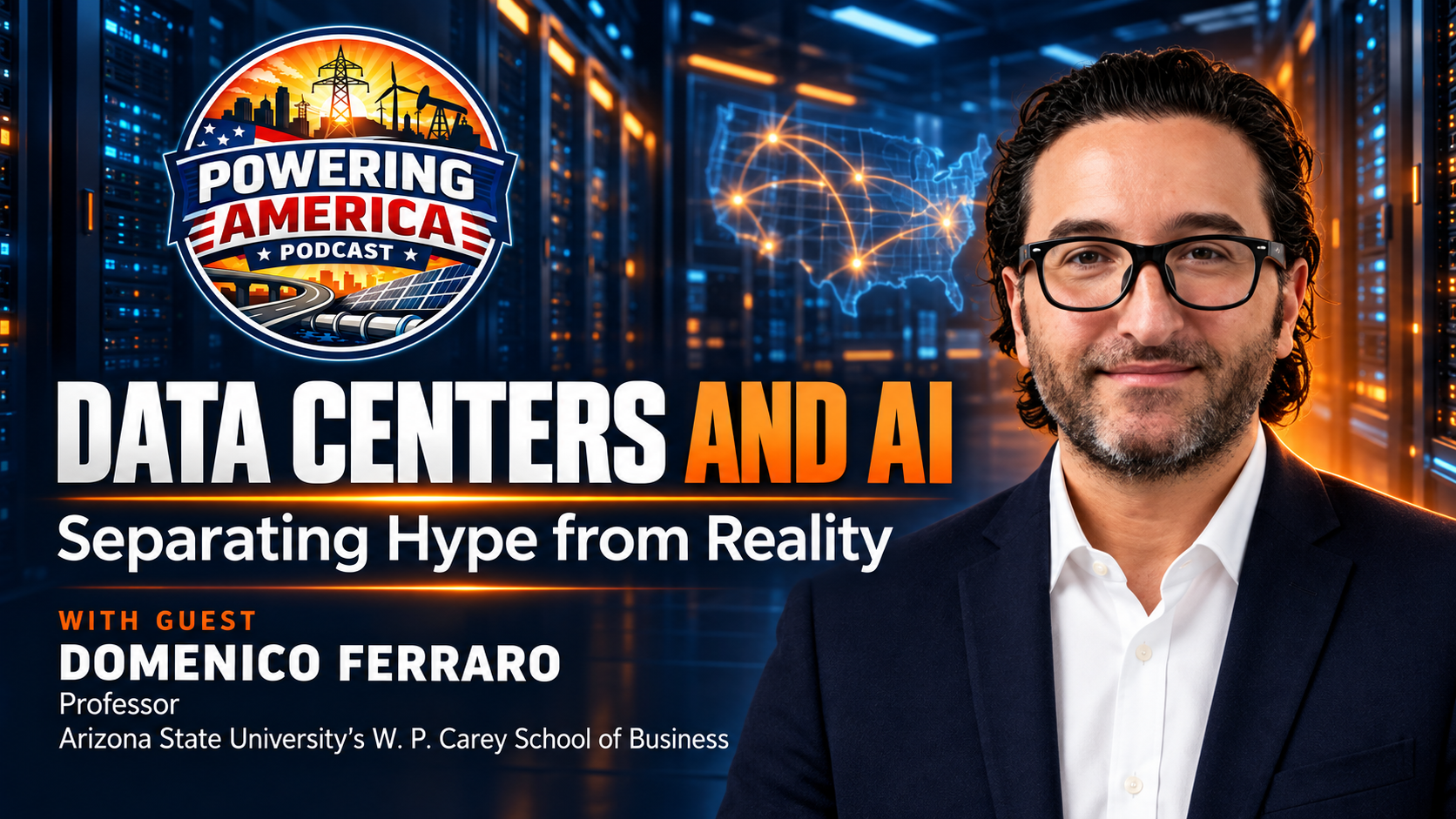
Powering America Podcast episode featuring Domenico Ferraro discussing Data Centers and AI: Insights from Domenico Ferraro on Hype vs. Reality — The Goldwate…

In the latest episode of the Powering America Podcast, Bryan Hyde interviews Domenico Ferraro, an Associate Professor at Arizona State University's W.P. Carey School of Business. The discussion focuses on the implications of data centers and artificial intelligence, highlighting the balance between their potential benefits and the associated costs, particularly regarding electricity demand and labor market disruptions. Ferraro emphasizes the need for strategic investment and stakeholder coordination to harness the value of these technologies while addressing the economic challenges they present.

Data Centers and AI: Separating Hype from Reality with Domenico Ferraro

0:00 / 0:00

Data Centers and AI: Separating Hype from Reality with Domenico Ferraro

Data Centers and AI: Navigating the Future of Technology and Energy

Domenico Ferraro, an associate professor at Arizona State University's W.P. Carey School of Business, discussed the intersection of data centers and artificial intelligence (AI) during a recent episode of the "Powering America Podcast." Ferraro's insights stem from his research and three reports published by the Goldwater Institute, where he examines the economic implications of these technologies.

Ferraro emphasized the transformative potential of AI and data centers, which he believes will significantly impact both the labor market and daily life over the next decade. "There is no doubt that AI and the data centers that power them are going to have enormous value in the future," he said. However, he cautioned that with this value comes costs that society must address.

The professor noted that technological revolutions often provoke fears of disruption in the labor market. "Historically, this type of reaction has been the norm," he said, acknowledging that while technology can create winners and losers, it is crucial to approach these changes thoughtfully. Ferraro argued that the focus should be on how to harness the benefits of AI while managing the associated risks.

Ferraro's reports delve into the dual aspects of value and cost related to data centers. He highlighted that while AI can enhance productivity in the workplace, it also offers significant benefits in home production. For instance, he cited the convenience of using AI tools like ChatGPT for everyday tasks, such as cooking. "Artificial intelligence has the power to transform our lives in the workplace and at home," he stated.

Despite the potential for job displacement, Ferraro pointed out that current data do not indicate major disruptions in the labor market. He believes that the value of AI is already evident and will continue to grow. "If you look at the data now, I don't see any of that," he said, referring to fears of widespread unemployment due to AI.

However, Ferraro underscored the importance of addressing the costs associated with expanding data centers, particularly in terms of energy consumption. He noted that the demand for electricity is increasing significantly, driven in part by the growth of data centers. "We need to expand the capacity of the U.S. economy to produce electricity," he said, emphasizing the need for substantial investment in energy generation.

The challenge lies in the upfront costs and regulatory uncertainties surrounding energy investments. Ferraro explained that the high cost of capital and the need for coordination among stakeholders complicate the situation. "Investment in electricity requires a lot of coordination among several stakeholders," he said, highlighting the roles of data centers, energy producers, and regulators.

As the conversation shifted to policy considerations, Ferraro outlined several key principles for the responsible deployment of data centers. He warned that increased electricity demand could lead to higher prices for consumers, particularly those with lower willingness to pay. "The risk is that this increased demand is going to congest the grid," he cautioned.

To mitigate these risks, Ferraro suggested that pricing systems should reflect the willingness to pay, allowing larger consumers, such as data centers, to negotiate their electricity supply. He argued that this approach would prevent smaller consumers from bearing the brunt of rising costs.

In conclusion, Ferraro's insights underscore the need for a balanced approach to the integration of AI and data centers into society. While the potential benefits are significant, careful consideration of the associated costs and regulatory frameworks is essential to ensure a smooth transition into this new technological era. As Ferraro aptly noted, "If you believe that there is enormous value, investment must come."

Interview Q&A

Q&A: Data Centers and AI: Separating Hype from Reality with Domenico Ferraro

Data Centers and AI: Separating Hype from Reality

Q: Can you introduce yourself and your background?

A: I am Domenico Ferraro, a professor at the W.P. Carey School of Business at Arizona State University. My professional focus has been on understanding economic growth and the functioning of the U.S. labor market. Recently, I became interested in data centers and their connection to artificial intelligence.

Q: What is the relationship between data centers and AI?

A: Data centers are the physical infrastructure that powers artificial intelligence and all computing activities. They require significant energy, which is essential for running servers and cloud computing.

Q: What are some common concerns regarding data centers and AI?

A: There are valid concerns about potential disruptions in the labor market due to technological advancements. Historically, new technologies create both winners and losers, and society must navigate these challenges to adopt technology effectively.

Q: What are the key findings from your reports for the Goldwater Institute?

A: My three reports focus on the value and costs associated with data centers and AI. The first report emphasizes the transformative potential of AI in both the workplace and home. The other two reports address the costs related to expanding electricity capacity to meet increased demand from data centers.

Q: How does AI create value in the workplace and at home?

A: AI enhances productivity in the workplace and also adds value at home. For example, AI can assist with tasks like cooking by providing recipes, which simplifies daily activities and improves quality of life.

Q: What are the costs associated with expanding data centers?

A: Expanding data centers requires significant investment in electricity generation and infrastructure. This includes building new power generation facilities and updating transmission lines, which involves high upfront costs.

Q: Why is investment in electricity generation challenging?

A: Investment in electricity generation is complicated by high fixed costs and uncertainty regarding future demand and regulations. Stakeholders must coordinate to ensure that investments align with future electricity needs.

Q: What policy objectives should be considered for responsible AI deployment?

A: Key policy objectives include ensuring that electricity pricing reflects willingness to pay, encouraging investment in energy capacity, and coordinating among stakeholders to manage increased demand without disproportionately affecting small consumers.

Q: What are the potential economic implications of increased demand for electricity?

A: Increased demand for electricity may lead to higher prices, which could impact all consumers. It is essential to consider the distributional consequences of these price increases to avoid unfair burdens on smaller consumers.

Q: How can stakeholders create a conducive environment for investment in electricity?

A: Stakeholders need to work together to establish clear regulations and pricing structures that encourage investment in electricity generation, while also considering the varying willingness to pay among different consumers.

Q: What is your overall perspective on the future of AI and data centers?

A: While there are valid concerns about potential disruptions, I believe the value of AI and data centers is significant and will continue to grow. The focus should be on addressing challenges while recognizing the transformative potential of these technologies.

Key takeaways

  • I'm very skeptical of doomsday scenarios, but I also am aware that historically this type of reaction has been the norm.
  • Concerns are valid because historically it remains true that technology can create winners and losers.
  • If there is an asset, if there is value, most likely in order for us to grab this value, we need to incur a cost.
  • The demand for electricity is substantially larger than it used to be.
  • Investment in electricity requires a lot of coordination among several stakeholders.

About the guest

Domenico Ferraro

Associate ProfessorThe Goldwater Institute

Full transcript

Show full transcript
[00:00] Bryan Hyde: Welcome to the Powering America Podcast. I'm Brian Hyde. Today I'm joined by, by Domenico Ferraro. He is a professor at Arizona State University, the W.P. Carey School of Business. And this is only scratching the surface, though. And Domenico, take a moment, if you would. First of all, welcome to the show. Take a moment to tell us a little bit about yourself and who you are and what you do. [00:21] Domenico Ferraro: Hi, Brian. It's great to be here. Thank you for having me. As you said, I'm a professor at the W.B. Kerr School of Business at Arizona State University. And I spend most of my professional career trying to understand economic growth and the functioning of the labor market, mostly the US labor market. But over the last year, I got interested in the question of data centers And as you know, of course, there is a lot of debate about it. So it's, you know, I like to paraphrase a famous economist, Robert Lucas, when he say, when you start thinking about the data centers and AI, you can't stop doing it. Okay, so here we are. I started one year ago, I got interested into it, and I wrote the 3 reports for the Goldwater Institute. And I'm really glad we can talk about them today here. [01:22] Bryan Hyde: Let's— before we dive into those reports, like you, I hear a lot of people talking about data centers and sometimes connect— they connect it with AI. But there's so much talk about these data centers and I hear a lot of fear. In fact, I hear so much fear, I'm not really sure what to believe sometimes. There's some really stark predictions being made. Could you just kind of set the stage for us about Let's just kind of give the thumbnail sketch of when we're talking about data centers and AI. Let's have kind of a working definition of what we're talking about. Then we can get to whether there's reason to be concerned or whether these are being overblown, who's benefiting, and so forth. [02:05] Domenico Ferraro: Look, I'm very skeptical of doomsday scenarios, but I also am aware that historically this type of reaction has been the norm. You know, at the outset of technological revolution, there is always a concern that this technology, while could have lots of value, it could have some disruptions in the labor market. And how society are going to deal with these disruptions can create further problems, which instead of creating an environment which is conducive to the appropriate adoption of technology, actually it gets to social conflict. So in that sense, concerns are valid because historically it remains true that technology can create winners and losers. However, My stand is let's think coherently about what is perhaps the better way ahead. Okay. So we have a technology like AI and the data centers that power them, that there is no doubt is going to have enormous value in the future. I think we have only seen part of this value today. But the most of the value, how it's going to change our life, every facet of our life, I think is going to be 5 or 10 years from now. Okay. So there is enormous value. Now, basic economics tells us that if there is an asset, if there is value, most likely in order for us to grab this value, we need to incur a cost. Okay. Now, what is the cost? The cost is we need to buy equipment. We need to retrain ourselves and we need electricity because ultimately computers, service servers, cloud computing, they need energy. They need to be powered. And that's where the data centers comes in because data center is the physical infrastructure that enables artificial intelligence, but not only artificial intelligence, everything that has to do with computing power. Is needs electricity, needs to be energy. And that's where data centers come in. And then of course, as I said, if there is a cost, then the questions that I think we can ask is that who is incurring this cost? Who are the people that are going to be facing the risk of displacement in the labor market, if any? Who are the people that are going to pay this energy costs, so on and so forth. So in that sense, concerns are valid in a sense that when we talk about cost, most likely there are going to be people that are going to face a larger part of this cost. But doomsday scenario, I think they, instead of thinking in a coherent way about the challenges and opportunities, they only focus, they only zoom in on the challenges. Forgetting these enormous values ahead of us. So that's the way I think about it. [05:31] Bryan Hyde: I think that's a really healthy way to approach it. And for those people who are really prone to look at, well, here's the bad that could happen, I like to imagine, what if you could bring someone from 1,000 years ago and just give them a glimpse of what we have? If you took them into a supermarket, they would probably think they had died and gone to heaven, you know, based on what they're seeing there. And so we have to be open to, there could be some very good things. And I'm with you, I think this is opening up some great possibilities. But we have to navigate a few tricky areas first. Now, you've written 3 reports for the Goldwater Institute. Let's touch on those reports. And, and I'm going to, I'm going to leave it up to you to just kind of give us a summary. We don't have time to go into great depth, but I would love to hear what you have found and what you have written on. [06:19] Domenico Ferraro: Yeah. So these 3 reports, of course, they're all related, but each one of them focuses on a specific aspect of what I think are the criticalities of artificial intelligence, computing, and data centers. They all point to the value that data centers are likely to bring to society, but they also touch upon in a, I would say, serious way about the cost associated with data centers and improved computing in the future. So one of the reports really zooms in on the value of computing artificial intelligence. Now, so what is the value? I think most commentators really focus on the value that AI and associated data centers powering them are going to bring to the labor market. Okay. And of course, I understand why, because the analogy— think about computers, for instance, right? Computers had effects on the labor market. Why? Because computers made most workers, not all workers, better at doing what they do. Okay, so this is improvements in productivity, wages go up. We are all good. Okay. Now, this is only part of the value, though. Now, most of the debate is about how this new technology is going to affect the marketplace, how it's going to affect the production of goods and services that we buy every day. Now, this makes sense because most commentators think about a technology that now we have grown accustomed to, which, which are Computers, right? Computers was a major transformation of the way we work. [08:28] Bryan Hyde: Okay. [08:29] Domenico Ferraro: Now, part of this report on the value AI also points out that there is also value at home, home production. Okay. Some of our activity, actually a non-trivial part of our time in a day, is spent creating goods and services that are not sold in the market, but they're sold in the household. Okay. For instance, just a concrete example. First of all, we are doing a podcast and we are using a computer, and most likely we are using the power coming from a server that is sitting in some data centers. Okay. So here we go with this one example. The second example is that suppose I like eating pasta. Okay, unfortunately, I don't know how to cook pasta. Now, if a few years ago I would have asked somebody who is an expert in cooking pasta, I would ask for a recipe, perhaps made a phone call to make sure that I would cook the pasta the right way. Right now I can ask ChatGPT, I can ask Claude, I can ask Gemini. I want to cook this type of pasta. Please give me some recipe, some suggestion of what to do and what not to do. It's more like having a grandmother, a digital grandmother. Okay. And that's very valuable. It is very valuable if you think about it, because to the extent that I really like eating pasta, as I do, for me, having this resource that is easily accessible on my iPhone or my computer creates a lot of value for me. Okay, so the punchline of the first report then is really to point out that artificial intelligence has the power to transform our lives in the workplace and at home. Okay, now, yes, of course, if you think about the workplace, there are valid concerns about whether some people are going to lose their job. Whether there's going to be a retransform, restructuring of entire sectors of the economy, which requires a few people to be unemployed for a while. Those are all valid concerns. But my point is that if you look at the data now, if you if you look at the evidence now, there seems to be no major disruption in the labor market. Okay, someone could say well. But we have not seen it all. And that's fair. That's a valid concern. Perhaps this disruption, I doubt it, perhaps the disruption is gonna be 5 years, 10 years from now. But if I look at the data now, I don't see any of that. I know that the value of artificial intelligence and AI is big now for me because I use it every day. I know that the value at home is large because I have my digital grandmother and digital grandfather that can help me. Right? [11:38] Bryan Hyde: Yep. [11:39] Domenico Ferraro: So my premise is that, okay, there is a value right now. We can quibble about how big it is, but my understanding through the use of it seems to be this is a transformative technology. Okay. And I even think that a bigger chunk of this value is ahead of us. Okay. So, that's the premise. The premise is there is value there. Now, economics tells me that there is no— nothing is for free. We would all hope to live in a world where there is a great technology with enormous value, but there is no cost. This is not the real world. So, the real world is one in which if there is an investment opportunity, if there is a technology that has the transformative power as artificial intelligence and the data centers associated with, then we need to do something in order to grab those benefits, in order to reap that value ahead of us. And we call it cost. Now, the other 2 reports are the tackles the cost side. of the data center problem or the economics of data centers. Okay. So what are the costs? Now, I think there is no doubt that we need to expand the capacity of the US economy to produce electricity. So we used to live in a world where the system overall was able to generate enough electricity to all activities that we daily engage with, there are signs of strained grids and regional electricity markets that tell us that we are about to enter in a new era, in a new regime. The new regime is one in which the demand for electricity is substantially larger than it used to be. Part of it is coming from data centers. But again, data center is just a conduit. It's the way we power improved computing. It's the way we power our digital Grandmother and grandfathers. Okay, so that's the premise. Now, how you expand capacity? Well, you need investment. There is no way around it, right? There is no magic wand or no trick. There is no tactics, if you wish, right? We need strategy, right? We need to expand The ability of the U.S. to produce energy, produce electricity at fair prices. Okay, this requires large investment in electricity generation. Now, how we do that, how we achieve that—that's not easy. Why is not easy? Because investment in electricity require big fixed cost upfront, right? You need to build new generation from scratch, new transmission lines, new distribution lines. And the investment is today, It's going to take time to produce this new generation. So, if you think about it, think about someone who's trying to decide whether to invest or not in new generation, you say, well, I invest lots of money today. But the demand for new electricity is going to come 5 years from now or 10 years from now. Well, should I really do it? Then you start some calculations, and you say, well, what is the interest rate now? Now, we live in a period of higher than average interest rate. So, the cost of capital is high. And then you start also asking yourself, well, are the regulations in place clear enough of what's going to happen 5 or 10 years from now? To the extent that I perceive some uncertainty about regulations, That even further reduces my willingness to invest. In that sense, investment in electricity more than in other sectors requires a lot of coordination among several stakeholders, requires coordination between the data centers that are demanding electricity, coordination with those that are in charge of investment and producing new electricity, new generation. And then there are the regulators that participate in this relationship in setting the rules of the game. Now, you can see that this becomes complicated fairly— these calculations become complicated fairly easily So in that sense, one would need a lot of coordination among stakeholders to create an environment that is conducive to large investment, which are needed to expand the capacity. [17:42] Bryan Hyde: Yeah. So we're down to our last few moments here in the segment, but are there any must-have policy objectives that need to be in consideration? I know I've just asked a question that you could probably talk about for a a very long time. But when it comes to moving forward and doing so in an informed and productive way, what are some of the top policy objectives that have to be considered with responsible AI deployment? [18:11] Domenico Ferraro: So that's a great question and it's also a difficult one. So to me, I see clear principles that one should keep in mind when thinking about safe deployment of data centers, where I'm using safe in the following sense. There is a risk that large load, demand load of electricity come in. The system in the short run does not have enough capacity to meet this increased demand. And this implies that the price of electricity must go up. There is no other way around. Okay. Now, there is a risk that the increase in the cost coming from this increased demand is going to be sustained also by those consumers that demand very little energy. Okay. So the risk is that this increased demand is going to congest the grid. The price of electricity has to go up to equate the demand and supply. But then the question becomes, what are the distributional consequences of this increase in price? Now, there are different ways to go about it. One would say, well, Domenico, you told me that the price has to go up. The price is going up. But the risk that I envision here is that the price is going to go up for everybody. And this is not good economics because good economics implies that we should think of willingness to pay. If there is a big data center that comes in that needs a large load, then this also implies that the willingness to pay of this data center arguably is larger, if not much larger, than the willingness to pay of Domenico, who is a small consumer of electricity. Therefore, an appropriate pricing system should take this in account and price electricity based on willingness to pay. Now, some electricity markets don't fully take this in account. Some others are completely predicated on a different logic where prices are set for everybody in the same way. So in that sense, the principle that I want to convey here today is that one, if you believe that there is enormous value, investment must come. In order to have this investment, some coordination among stakeholders is needed. Including giving the ability to data centers to arrange their own electricity supply and electricity generation with private contracting with independent producer of electricity. 3, be aware that the way we get to increased capacity is can be tricky because there could be small consumers of electricity that end up bearing the cost of this increased demand. And that is not what good economics would tell you to do. Willingness to pay is key here. [21:51] Bryan Hyde: All right. That's the note where we're going to go ahead and pump the brakes. I hope we get a chance to pick up this conversation again in the future. Again, we're talking with Domenico Ferraro, He is an associate professor in the Department of Economics at Arizona State University's W.P. Carey School of Business. And thank you so much for joining us today on the Powering America Podcast.

Filed under