Show full transcriptHide transcript
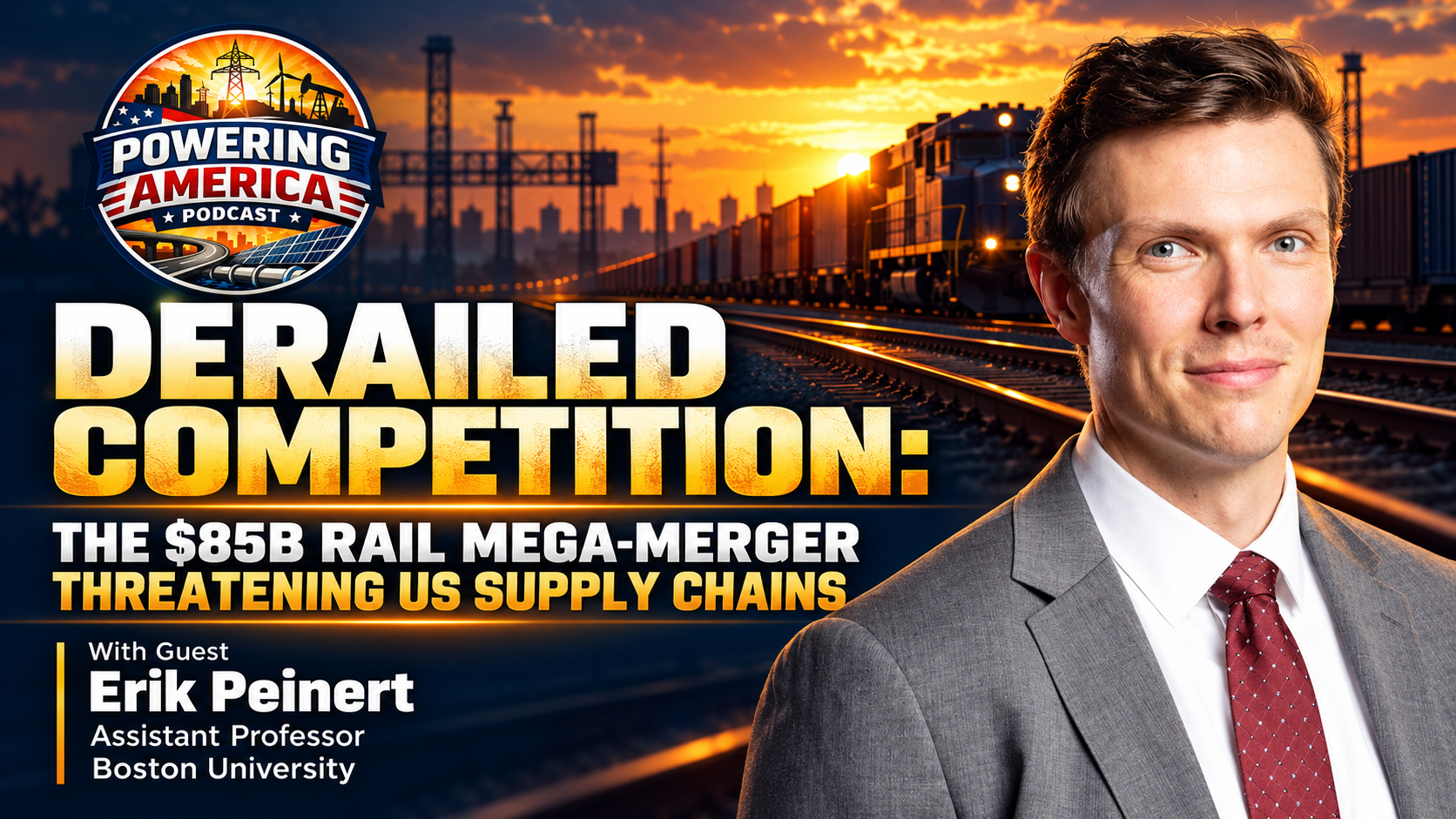
[00:00] Bryan Hyde: Welcome to the Powering America Podcast. I'm Bryan Hyde, and today I'm joined by Eric Peinert. He is an assistant professor at Boston University as well as a senior fellow at the American Economics Liberty Project. Eric, welcome to the program. Would you mind taking just a moment to just give us a little bit about your background, about who you are, as well as what you do?
[00:19] Erik Peinert: Yeah, thanks, Bryan, and thanks for having me on here. So as you said, I'm an assistant professor at BU and a senior fellow at the American Economic Liberties Project. Broadly, I am a political economist focused on antitrust, monopoly, economic power, and a lot of the policy and political areas therein. So I have a book out last year about the sort of evolution of these policy areas in the United States and France over the 20th century. But also, along with working at the Economic Liberties Project, I've worked for a couple of years in DC on advocacy around these issues in the United States. It's very concentrated economy.
[01:01] Bryan Hyde: And we have you here today to talk about the Union Pacific Norfolk Southern railroad merger. And let's, first of all, for people who may be hearing about it for the first time, let's talk about railroad mergers in general. This is a big deal. What is it about these 2 railroads that makes this kind of an unprecedented sort of merger?
[01:23] Erik Peinert: Yeah, of course, Bryan. So I'll give the top-line points before we go into a little bit more detail so that people can understand what the consequences of are. So Union Pacific, one of the main 4 railroads in the United States, Class 1 railroads, and Norfolk Southern, another one of those 4, are attempting to merge in what's estimated to be about an $85 billion transaction. The, the top-line points that I'd really put forward and the consequences that people should be worried about here are: one, there is going to be a very large and substantial loss in competition in the railroad market. The consequences of this will be, on one hand, for labor. Railroad workers will find that they are living in a market where about half of the employment is for one company that will have an enormous amount of power over their working conditions, their wages, et cetera. The second is that with that loss of competition, shipping will become more expensive. Service might be degraded. And it's really hard to know exactly who's going to be what the price changes will be, but that's all going to be passed through to shippers, to companies, to manufacturers, and ultimately to all of us as consumers. And the last top-line point I really want to say, because as you said, this is a really big deal and it's hard to convey to people who don't follow these things, this is unprecedented. And the merger on its own merits is relatively outrageous on its own terms. And I can relatively confidently say these companies would never have tried to propose and execute such a merger if it weren't for the perception that that the Trump administration were at some level politically manipulable by cozying up to them in the way that Union Pacific in particular has.
[03:06] Bryan Hyde: So Eric, what are some of the positives that they're trying to sell? The 2 companies that want to merge, what are they saying the ultimate benefit would be, whether it's to them or to the public in general?
[03:18] Erik Peinert: Yeah, great question. And that's important to— it's a good frame of reference to understand what the problems with the merger are. And it involves explaining what the current state of the American rail market looks like. So first of all, as I'd said, there are 4 main firms for Class 1, so national-scale freight railroads in the United States. And they're broadly split into 2 regional markets. Union Pacific and BNSF are the 2 Western railroads. Everything west of the Mississippi largely is between those 2 railroads. And on the East Coast of the United States, Norfolk Southern and CSX are the 2 main railroads. And within those regions, each of those 2 railroads compete with each other over price for shipments, etc. There are 2 other railroads, but they're Canadian. They sort of serve different markets and have different purposes, so we can just bracket those for the moment. Now, the thing is, is that because the 2 merging railroads are Union Pacific and Norfolk Southern, who don't operate in the same region, this isn't 2 competing railroads directly merging with each other. It's what the merging railroads are calling, and generally is called, an end-to-end merger. So rather than having tracks right next to each other competing, they're stacking the 2 sets of railroads next to each other. And this is where they're saying the benefits come from. They're like saying that this is the first transcontinental single US railroad, and if the merger goes through, it would be. And they're saying there's some efficiencies to go with this. Because there's, you know, you have to switch railroads somewhere around the Mississippi. There's all this holdup of having to load and reload trains at all these transfer points outside of Chicago and St. Louis and a couple other cities in the Midwest. And so they're saying without that, they're gonna be able to offer more streamlined service, like less wait times, faster, cheaper, et cetera, for all these shippers. And because they don't directly compete, there's a little bit of overlap, but not a huge amount. And that overlap is a real concern. But I moreover want to say that that is the conversation that these companies want to have. There's this tiny little bit of competitive overlap, but we can address that by divesting or offering to provide service competitively in those regions. But overall, we're providing this like continental efficient railroad that'll reduce costs. And so that's the main positive story they're trying to sell here.
[05:48] Bryan Hyde: And with all those positives, we have to ask, why hasn't someone proposed doing something like this before?
[05:55] Erik Peinert: Yeah. And that's where we need to do a little bit of rewind to consider both the history of rail mergers in the United States since deregulation in the early 1980s, as well as what this specific merger actually looks like, And I guess what it looks like in a general competition standpoint relative to a lot of other mergers that many people will have heard of at this point. So the first one is that the US rail network was deregulated around the 1980s. And at that time, railroads were struggling. You know, people preferred driving for the most part, huge loss in business. Trucking was shipping a lot of freight. And with that, a lot of railroads started merging up a lot. So the 4 very large rail networks that we have as all the Class 1 railroads today were constructed out of this chain of mergers over the course of the 1980s and 1990s. And when in the late '90s— and this started to create a number of problems, some of them logistical. Merging railroads is a mess logistically. It led to service backups. There were a lot of layoffs to go with this. Um, and also there was a noticeable loss of competition that a lot of, uh, shippers started noticing. So in the late 1990s, one of these two— so BNSF proposed merging with Canadian National, one of the Canadian railroads, and the Surface Transportation Board, the regulator in charge of the railroad— freight railroads, paused and said, absolutely not. We are gonna put in a 15-month moratorium on any mergers at all. These, these recent mergers have been such a disaster. while we come up with new guidelines to have a more reasonable way of thinking about these mergers. And so that was blocked by that moratorium. And then in 2001, they, they created these new merger guidelines that put a much, much higher bar on being allowed to merge as a Class I railroad. And one of those things they required is that the merger has to actively increase competition. But the big point here is that since then, No Class 1 railroad has tried to merge under these guidelines. There was a merger a couple years ago with Kansas City Southern, but that merger was exempt from those guidelines because there's very literally a little clause in the 2001 guidelines that said that they were exempt from it. So no merger has ever gotten through these guidelines, and the perception for the last 25 years is that basically these guidelines make further Class 1 mergers illegal. This merger was exactly the type of thing those guidelines were meant to prohibit. And now, so that's the background. And now where are we now? And I'm gonna like go through a little bit of what may seem boring bargaining theory stuff, but it helps to understand the current situation of why shippers like and prefer the current situation to what the merger's proposing. Right now, if I have a freight car of stuff in New York or Baltimore or whatever, and I want to get it to the West Coast, I go to the 2 East Coast railroads and I play them off against each other to get a low price. And they have to— and they like want to, you know, offer lower prices, better service, or whatever to get my business. And then I do the same thing, you know, with the 2 West Coast railroads. I play BNSF and Union Pacific off against each other, and I can get a decent price from both. There are some problems with that, but like, it's still only for companies, but like, whatever. There's a competitive market for both. Now the problem is, is if, if the one of the systems on each side of the country merges, you now have one system covering the entire country that is competing separately with 2 little systems, one on each side. So when a shipper goes to bargain With, say, the new merged system and CSX in the merged side, the merged system doesn't necessarily need to give you that great of a deal because it can use the fact— it can hold out the promise of its better prices on the other side of the country in return for giving you a good deal here. It can use its bargaining power on one side of the country against you on the first half. And in competing with either one of the, like, more isolated regional systems, it can walk away from negotiations and still get business. It is now an unavoidable negotiating partner no matter where you're shipping to. Whereas right now, like CSX or any one of these 4 systems, they need that business whenever they're negotiating with someone. So like, that's the real loss in competition and the conversation that in the merger proceedings these railroads generally don't want to have. The other big thing is the labor part I mentioned. Regardless of competitive overlap or whatnot, railroad is a relatively— railroad employment is a relatively technical, like technically skilled and specific job. And so the people who are railroad conductors and, and whatnot, and rail yard workers, um, it is good for them to have multiple employers that they can go work for. They can negotiate better wages by threatening to leave, getting a better job offer. But if now Most of the employment in the industry is just like one railroad, that will push wages down. There's an enormous amount of economic research on that across the board. And the last thing I would say, sort of to reinforce these points, is that this is something that everybody around this merger knows. The opposition to this merger includes all of the merging parties' competitors, most of their shippers. most major labor groups involved in the industry. And so if this merger, as they say, we're going to make things so efficient, so much cheaper, so much more competitive for their shippers, then why are all their customers opposed to the merger?
[12:01] Bryan Hyde: Now, that makes sense. And you anticipated, you know, I was going to ask, where do the unions come down on this? Because I know the railroad industry is fairly heavily unionized. It sounds like they're not too keen on this possible merger either.
[12:17] Erik Peinert: Yeah. So, I mean, I probably should detail that a little bit more because I will say the union response has been somewhat mixed because organized labor these days is in a really tough position. There are several unions that have come down pretty strongly against the merger, others that have come out in support. And it's a really hard negotiating position when merging companies start trying to offer promises that they aren't going to cut jobs, they aren't going to like make wages worse, they aren't going to worsen working standards. And if that's— that those sort of offers are on the table in return for merging, then it's really tempting for a union, even if they might otherwise be opposed to the merger in general, to take that deal. Organized labor has been on the back foot for 30, 40 years here, so I'm not begrudging any, any like position on that sort. But at the end of the day, this is offering the employer side of the equation at the bargaining table substantially more economic power. And that economic power stays well after those promises have expired, and regardless of whether those promises were actually met. And I think people who are familiar with union negotiations when it comes to mergers are very familiar with companies having a lot of ways to follow the letter of those promises and not meet them in practice. So, for example, one of the things that railroad workers are often concerned about is sure, we're not going to cut your job; we're just going to transfer your job to the middle and. Nowhere where your family doesn't live and sort of like cut the jobs through attrition as people decide that that's not worth it for the sake of their lives.
[13:54] Bryan Hyde: What about, you had mentioned the shipping costs. I know the costs of fuel have gone up. Everybody has felt that. The railroads, I'm sure, have felt it as well. Has that caused a significant ripple effect in terms of the competitiveness of pricing? on shipping? And would this just exacerbate, you know, the potential for those higher shipping prices?
[14:18] Erik Peinert: I'll admit I don't exactly know whether that would play through. It would raise costs presumably for everyone in the railroad industry. I think the main thing I would see as plausible was advantaging rail maybe in terms of cost over trucking, which relies pretty heavily on gas, diesel, etc., which is much more in shortage today. But it does highlight the broader point that some of the dynamics and the importance of maintaining a competitive rail network is that rail is simply fuel cost-wise per pound substantially more efficient than trucking and other forms of shipment. And it's really important at some level to maintain a competitive market to keep that cost advantage.
[15:00] Bryan Hyde: So as far as this merger, who has the final say? as to whether or not it takes place? And let's just go ahead and include, and what should they do regarding this proposed merger?
[15:14] Erik Peinert: Great. So I'll describe the formal answer and then also describe some of the broader politics around this, because in the current period of the 2020s, that's become a little bit enmeshed in a way that we might otherwise think isn't the case. So the Surface Transportation Board is the bureaucracy. It's the independent agency that is responsible for regulating the Class 1 railroads. And unlike in most other industries, even mergers of railroads are decided by the Surface Transportation Board. In almost other— every other industry you think of, the Department of Justice and/or the Federal Trade Commission is responsible for deciding whether mergers are okay. They will have a say, they'll give recommendations to the Surface Transportation Board, but it's the STB who decides at the end of the day. And that process is ongoing. Final comments to the STB are due on November 18th. Their public hearing will be late in the spring, and I think sometime next summer is when they're anticipated to make a final decision about whether this merger will be allowed to go through. That's the formal process. It's, it's quasi-judicial in the sense of court pleadings and whatnot, but it is still before an independent agency rather than a federal court. Now, the informal process has become a lot more complicated here because, as I'd said, there is a certain degree to which the Union Pacific in particular is attempting to use political influence with the Trump administration to push this merger through. So Union Pacific was initially one of the largest contributors to the White House Ballroom Project, along with a number of big tech firms. Shortly after the merger case fell before the Surface Transportation Court, board, Jim Vena, the Union Pacific CEO, like constantly was trying to get White House meetings to cozy up to Trump. And there's many aspects of that that look like, correct or not, they are attempting to illegitimately influence the outcome of this merger decisions, in part because it's an independent agency like the FTC or the SEC. These are supposed to be independent experts making decisions based on the merits of the case. Is this good for competition? Is this in the public interest, etc.? So that's the sort of informal process, and I can't speculate too much on what part of that's going to be the most influential, other than the White House has clearly attempted to put their thumb on the scales here. So Robert Primus, one of the board members of the Surface Transportation Board, was fired, I think, the day after this merger fell on the docket of the Surface Transportation Board. He is the only board member to have voted against the previous Class One rail merger a couple years ago. So take that as you will. Now, that being said, there's still the formal independent process going forward. They're still considering evidence, and I think it probably goes without saying, but I think this merger should be blocked. Full stop. No questions. No tinkering around with the details of trying to make the merger okay with certain remedies, or having them divest certain routes, or trying to make them come to an agreement where they'll still offer competitive service even as a merged, merged system. Um, speaking from broader antitrust monopoly and competition experience, those sorts of remedies are exactly what merging parties usually want to have the conversation about. Please let our gigantic mega merger through, and we'll fix the tiny little detailed, like, competitive concerns by selling this or selling that or having an agreement with this other competitor to maintain competition in the market. And that perspective, you know, you can follow through the reasoning, but at the end of the day, what you're doing is handing an enormous amount of organizational, economic, and political power to the merged system that you can't take back later. And those— the violations of those sorts of remedies tend to not be punished. They tend to not be enforced. And companies, presumably including these, these railroads attempting to merge, are well aware that the costs of those conditions are much smaller than getting the merger through in the first place and then largely ignoring those requirements.
[19:33] Bryan Hyde: Again, we are talking with Eric Peinert. He is an assistant professor at Boston University and also a senior fellow at the American Economic Liberties Project. Eric, you have given us some great information to work with today. Thank you so much for joining us on the Powering America podcast.
[19:48] Erik Peinert: Thanks for having me, Brian.