Show full transcriptHide transcript
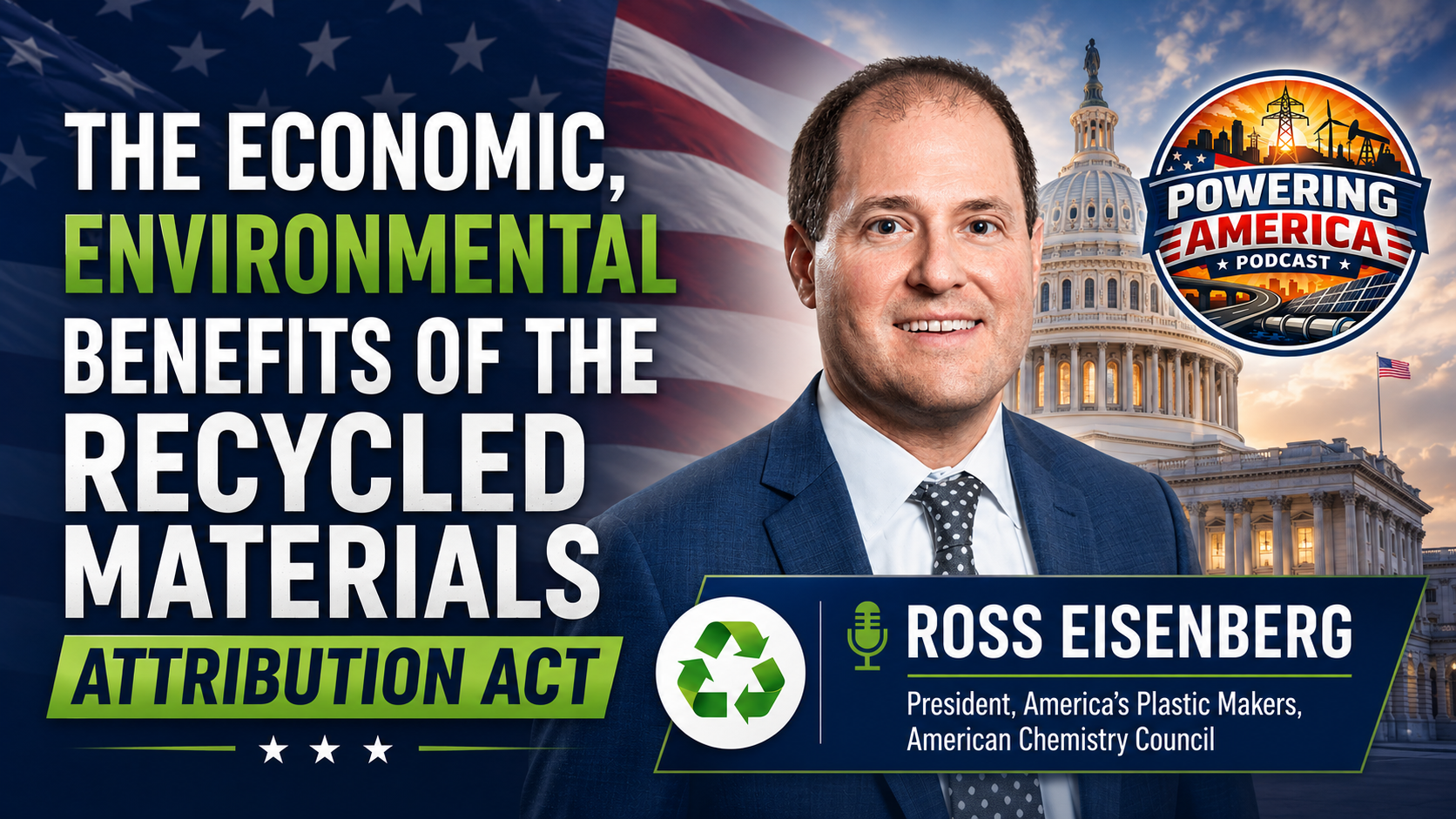
[00:00:00] Welcome to the Powering America podcast. I'm Bryan Hyde. Today I'm joined by Ross Eisenberg. Ross is the president of America's Plastic Makers at the American Chemistry Council. And Ross, great to have you on the program. Take a moment, if you would, to tell us just a little bit about who you are and what you do.
Sure. So I am president of America's Plastic Makers. you've probably seen our advertisements on television. We are the, essentially the association that represents the plastic manufacturing industry. So the companies that take it from raw material, essential na- essentially natural gas, and turn it into the plastic pellets, which then send it to, you know, sell it to everybody else that turns it into all of the things that you can make plastic with.
So we represent the companies that make the materials used across pretty much every part of the American economy. Plastic goes in everything, whether it's construction materials, electronics, energy infrastructure, packaging, vehicles, medical devices, you name it, that's us. and so we are the trade association that represents them in Washington and across the country.
Our job is to make this the best [00:01:00] place in the world to make plastic. You know, when you say that, I stop and think for just a moment and, and start to realize just how many things in my life involve plastics, and yet, you know, where I hear mostly about plastics, it's, it's in the, the form of recycling.
And this is... That's my, my 90-year-old mother, you know, is always making sure she's getting the plastics in the right bin and so forth. you're here today to talk a little bit about the future of recycling plastics in the US. My understanding is there is a piece of legislation before Congress that is really timely.
Tell me about it. Yes. So, so yeah, so backing up a bit, our, our industry, we make the plastic, and we have for years, for decades, you know, for as long as we've done it, been, had what's called a linear model, right? We make the plastic, you use the plastic, you dispose of the plastic. And in the case of something durable like a car, that stays in the car for a pretty long time, right?
But eventually then is, is discarded. if it's a bag, you know, or packaging or something like that, [00:02:00] very different story, right? Some of these things have very short lifespans. and so what we as an industry, are actively trying to do is to turn that linear model into, into a circular model and, and, and essentially, you know, bend the curve for, for, you know, for better or for worse.
so a- and, and circular in the sense that because of existing and new recycling technologies, because of the capabilities that we have, and because of the fact that we can actually take used plastic and turn it into new plastic in a variety of different ways, that plastic doesn't have to go to a landfill anymore, and it certainly doesn't belong in the environment, right?
So, so let's make it circular. Let's have the policies in place to make it circular so that we're not worrying about trash in the environment anymore. We're not worrying about it in our rivers. We're not worrying about it in those places. we're not worrying about landfills that are overcrowding and that are, that are reaching capacity in places that, that really can't, can't deal with that.
and that we as an industry have a dedicated feedstock going [00:03:00] forward to actually make plastic out of, right? We can take the used plastic and make it into plastic. So everybody wins. and that really is the, the mindset behind what we're trying to accomplish in Congress at the state level and elsewhere, which is modernizing this recycling system.
- Our recycling system was set up in the 1970s. It was set up for, you know, very, you know, for 1970s stuff, right? For aluminum cans and, and for bottles and things like that. the nature of the way that we make and use a lot of materials, but specifically plastics, in 2026 is very, very different. those potato chip bags are actually seven very different layers of plastics all kind of put together with a layer of, of foil on the inside to keep the, the chips, you know, for, for being fresh.
So every plastic is different, they're handled different, and as a result, recycling them is very, very different. And, and there are technologies to handle it, but the infrastructure never kept pace with the advancement on how we make plastics. And so now we as an industry have been trying very, very hard [00:04:00] to get Congress, to get states, to get anybody, get the executive branch, to help move, move policies forward, to help modernize all that infrastructure.
And that's what some of this legislation... It's a long-winded way of getting to this legislation, but that's what this legislation would do. So, there's a number of pieces of legislation that we are actively pushing, in support of, that are, that are, in some cases very bipartisan, in some cases more partisan.
But both-- but they would all do this, similar things, which is help get our recycling infrastructure upgraded, whether it's the collections, the stuff, the curbside collections, and figuring out a way to do that better and get more access for people. the sortation, right? When it goes to a sortation facility, getting the right resources in place so that you can actually put new technologies in to sort some of these things better, and that they, you know, you don't have gears jammed up and, and that the plastics don't get discarded in that situation.
and then, then they're recycled so that, that some of these new or we call advanced recycling, facilities are able to be brought online and, and, and you can [00:05:00] start to actually recycle the plastics that typically don't get recycled today. and then finally, the retailers and brands and companies that can put them in their product actually do.
And, you know, 'cause the customers are asking for them, but if the brands put them in their product, they wanna get credit for it, right? Otherwise, there's really no reason not, you know, no reason to do it. And there's a bunch of different bills out there, that I'm, I'm looking forward to talking about with you today that, that do all of these things and, and we think would be a real leap forward for our pathway to circularity and actually making sure that we're not in a linear model anymore, and that that plastic actually can be made and remade all over again, you know, as long as we can do it.
Ross, as you're describing th- that history, and by the way, thank you, that, that really gives us some context here. It, it sounds like d- plastic's kind of got a bum rap 'cause it seems like- ... for, for a long time, you know, well, plastics, you know, you don't wanna send these plastics out to the landfill. It'll never, ever degrade.
But it sounds like, as you mentioned, the technology has changed, and, and [00:06:00] with that technology, not just, there's not just environmental, advantages here, but it sounds like there might be some economic advantages that come along, too. Yeah. You know, we, it- What gets lost in the conversation is that plastics, plastics are as ubiquitous as they are because they are, they're generally the sustainable choice.
You can do more with less of them. And so, you know, there's a number of studies that, that everybody's done for decades now, whether it's McKinsey or the University of whoever, and, and almost everyone's the same, which says, you know, the pl- the plastic pouch versus the tin can is gonna be much less energy intensive to make with less materials to make the plastic pouch.
So, you know, it typically will have a lower environmental footprint, and it'll be cheaper to make, right? And, and, and it's not always like that, but certainly, you know, the, the, the, the milk-- the, the big glass milk jug is gonna be more energy intensive and, and h- and heavier to transport than the, than the plastic, you know, the plastic bottle version, things like that.
So, [00:07:00] so typically the, it is the sustainable choice because you can generally do more with less of it, and it has a lower sort of... It costs less to make it, it takes less energy to make it, it takes less water resources to make it, and all these things. The flip side of it is we have an end-of-life problem.
The, the, you know, we, we are a linear industry for the time being. And so, so, you know, much of the attention, as you said, has been a focus on that. but as an industry, we are a tremendous industry in the, in the United States. we, we, the plastics industry has been-- we, we've spent a lot of time over the past couple decades talking about the shell revolution, the energy rev-revolution, and, and that has made the US, and US manufacturing in particular, considerably more competitive.
The place that it has made the most competitive is the chemicals and plastics industries, because that shale gas, is a feedstock for making chemicals, but in, for particularly making plastics. and so as we have, you know, this tremendous [00:08:00] resource in the United States that really the rest of the world doesn't have, that has made us much more competitive across the board in terms of energy, we use it not only as energy to make plastics, but we use it as a feedstock.
And so it has made making plastics here in the United States considerably more competitive than anywhere else in the world. And so, you know, in twenty-- two thousand eight, two thousand ten, we were an industry that was much smaller than we are today. We have grown exponentially over the past twenty years in the US specifically because of the natural resources that we have.
And so along with that has come significant jobs, right? You know, hundreds of thousands of jobs, you know, massive economic impa- impact in places like, you know, the South and in the Pennsylvania sort of Rust Belt region and Michigan and, you know, in places like that where we're building up new capacity.
and so, as an industry just writ large, we are a big one. we actually have a twenty-two billion dollar trade surplus when it comes to plastics, meaning we make more here than we can use. So we supply [00:09:00] the rest of the world as well. which is a really interesting place to be, and not all industries are like that.
what, what's very interesting on top of that, so just as a baseline, we're a big industry. It's pretty clear, right? lots of, lots of jobs, lots of people, you know, in, you know, employed. Driver of the economy. If we can then add the recycling piece to that, if we can, if we can accomplish the recycling, the circularity piece of that, that will, that will take an industry that's already a major driver of our economic progress in the United States and just supercharge it, right?
So we did a study here, at ACC, that said, okay, let's say fifty percent of the plastics that would otherwise go to landfills, let's say we can recycle them by any means necessary, right? Mechanical recycling, which is the technology that's largely out there today, advanced recycling, which is what I was talking about earlier, the, the newer stuff, however you want to do it.
But if fifty percent of those plastics get recycled instead of going to the landfill, what does that mean? It's obviously great environmentally, but what does that mean economically? [00:10:00] And economically, it means some pretty big things. It means that it would be a hundred and seventy-three thousand two hundred new jobs nationwide.
Forty-three thousand of them would be direct jobs at recycling facilities, so, you know, blue-collar jobs, right? it would be twelve point eight billion dollars in additional annual payroll across, direct and indirect jobs. it's, it's equi-- it's the equivalent of, it's like forty-eight point seven billion dollars in annual economic ou-ou-output.
And those numbers in perspective are like the entire size of the milk industry in the United States. So it's like creating like a whole other industry, and a, and a tremendous economic impact in addition to that. So the, I think the big takeaway here is that at, look, just from a purely manufacturing standpoint, we are a big driver of economic, progress in the United States.
If we can, if we can solve this, this recycling issue and the end-of-life issue for pra- plastics, it will not only help us environmentally, it will be a tremendous [00:11:00] economic driver, economic stimulus in a lot of ways, for the US economy as well. Ross, what can you tell us about the Recycled Materials Attribution Act?
So that's the bill that I mentioned earlier, and, it's one of them. And this one, this one gets to the issue of the brands wanting to basically get credit for, putting it in products. So, so, I should back up a bit and explain the two different types of, of recycling. So, for plastics. So there's mechanical recycling, which is, it, it is the way that we've been doing it forever.
and it works very, very well. It is essentially, it's a fairly dir- you know, linear... It, it's pretty, not simple process. It's, it's manufacturing, but it's, it's essentially grinding up the plastics, cleaning them, washing them very, very well, and then re-melting them and re-extruding them into plastic pellets.
And you can do that for certain types of plastics. milk jugs, detergent bottles, you [00:12:00] know, soft drink bottles, rigid plastics that are all pretty similar and are largely clear. but e- even if they're not, you can take the colors out and the dyes and things like that. But those rigid plastics work really, really well with mechanical recycling Anything that's flexible, the, the pouches, the stuff you're getting your gummy bears and your beef jerky in, the plastic wraps, blood bags, right?
Like, anything that's gonna be flexible, those potato chip bags, diapers, things like that, they are not going to be mechanical recycled particularly well, and in a lot of cases, not at all. recycle- recycling facilities typically won't take 'em. They-- They're, they're hard to sort. They're hard to recycle.
some types of plastic bags can be mechanically recycled, and that, that-- some of our members are doing that, and it works really, really well. But the, the vast majority of the hard-to-recycle plastics are those flexibles. that's where this other technology comes in. We call it advanced recycling. And what it is, is that, that's an umbrella term that re- [00:13:00] that sort of, i- really covers a suite of of chemistries, different types of chemistries that all do the, the same thing.
They basically take the used plastics, take it back down to its building blocks, and then turn it into plastic again, using chemistry as opposed to grinding up and melting them. the, the best analogy that I can use for it, and I kinda overuse it, is un-baking a cake. If you could-- If you had a cake, right?
And you could literally take it back down to the flour and the milk and the butter and the sugar, and then you turn it into a cake again, and then you do it in reverse again, and then a cake again and again and again, and you can just do it in, for infinity, that's advanced recycling. And so we have this technology.
It's in operation right now. It's-- There's about eighty-something plants in Europe. There's, about ten of them in the United States. we're doing it, in places like Texas and Georgia and, Pennsylvania and Ohio, and they're going into products we're using. there is not a lot of clarity at the state and federal level on if you [00:14:00] use this advanced recycling technology to make new plastic that goes into, say, your Warby Parker glasses or your, you know, your milk bottle or your, you know, your, your, your, your car door or whatever it's gonna go into.
there's not a lot of regulatory clarity on if you're the brand doing it, will you get credit for it as recycled content? And that's what the Recycled Materials Attribution Act fixes. It basically sets federal policy and says, "Hey, this stuff is recycling. This is how you do it so that it can be called recycling.
And you, the brand, if you're gonna use it in your product, if you're gonna put it in a cup at a fast food restaurant or, or whatever, -" You get credit for it as recycled content. And so, we think it's really, really important because it gives the brands the reason to actually use it. They wanna use this stuff, and, and there really is no other way to get those other plastics to be recycled other than advanced recycling.
So, so it's desperately needed. This clarity's desperately needed, and, and the RMA would do it. it's currently been introduced in the House. There are 10, [00:15:00] a little more than 10, but there were 10 at introduction, five Democrats, five Republicans, which on any bill this time of year is hard. in a, in a, for an environmental bill is almost unheard of to be that bipartisan.
So we're feeling pretty good about it. We're hopeful the Senate will introduce it pretty soon, and we're hopeful to see movement before the end of the year, on this piece of legislation. Wow. you know, from, from an environmental standpoint, what you're describing sounds like an absolute godsend. From an economic standpoint, though, I mean, I, I saw, I think, three different news articles that talked about how this bill could impact, you know, 38,000 jobs in Pennsylvania, 36,000 jobs in Indiana, 49,000 in Ohio, and these are jobs that are directly related to advanced recycling.
Tell us a little bit about how those manufacturers impact Americans' lives. Tell us about how that legislation could affect, you know, people looking for work in those cities and towns. Yeah, I mean, a- and this is the beauty of that, right? So, and it, it, the, those big economic numbers that I gave [00:16:00] earlier are, are really kinda driving the, the, that forecast.
so To fix the recycling system, it takes a whole bunch of things, right? It's gonna take the th- you know, the curbside collection, right? Giving people access, which means people to pick those things up and to actually, you know, to, to drive the trucks and to move the, the stuff from your, your curb to the, to the, to the sorting facility.
It's gonna require people at the sorting facility to operate the machinery, to help design them and, and, and, you know, make sure that that's all working. So sort of behind the computer jobs and then on the f- you know, the shop floor kinda jobs. it's gonna require transportation, right? So people to sort of get things from place to place.
it's gonna require, a whole new sort of universe of recycling facilities and, which would require, you know, people who can do AI and, you know, and people who can be, you know, you know, making thing- sure that everything is clean and, you know, and, and the, the engineers to help design and implement some of this new [00:17:00] equipment.
chemists to make sure that the, the, the, the content coming out of it is meeting the spec- the specifications of the customers that, that want it. So the full spectrum of jobs. I mean, really, it's like every flavor of job. If, you know, it's union jobs, right? It's, it's, you know, engineering jobs. It's, you know, tradesmen jobs.
It's kinda everything, and it would really be kind of an everybody wins situation in addition to actually helping to clean up the environment, which is, which is, you know, the, the icing on the cake. So what's the, the timing look like on this? I mean, is, is there a window of opportunity in which, Congress is going to need to act?
Yeah. And, and if so, why, why is that? The time is now. So, so we feel like there's an interesting window right this instant on this. this is, like I said, this is bipartisan, and there's not a lot out there that's bipartisan these days. And so, so we see a real opportunity. I had the, opportunity to testify before the House Energy and Commerce Committee, which is where this bill is sitting right [00:18:00] now.
I testified about a year ago on the issue of recycling. And, at that hearing, there were four witnesses there. Two of them were Democratic, witnesses, two of them were Republican witnesses. And the beauty of that is all four of us were saying the exact same thing, which is, again, unusual at a congressional hearing.
It's unusual in a very partisan, hyper, hyper-partisan, charged atmosphere on every issue, right? and so I feel like this is our window to actually make some progress. And, we are hopeful. And, and hearing that, you know, you know, it's a busy committee calendar, but we're hopeful that we'll get a hearing on this bill, maybe as soon as June, maybe as soon as this month.
and if that happens, maybe they, you know, they can move it out of committee, and it can get to the floor. And if lightning strikes before the end of the year, that would be fantastic. the Senate still has to-- We still have to, you know, this thing still has to be introduced in the Senate. but we're hopeful that it's gonna get there as well.
We, we are part of a coalition pushing this that is not just us. so obviously, as the chemical [00:19:00] industry, as the plastics industry, we care deeply about the technology behind all of this. But the folks that are actually most dug in on this are the brands, right? It's the ones that are actually gonna put it in their product, in their, you know, and, and, and wanna have options for packaging so that they can actually use more recycled content.
And they're the ones that have been driving this. a-and there's a coalition we're on called the Recycling Leadership Council. The Consumer Brands Association is the face of that group, and there's an-another twenty or so sort of value chain industry, you know, related groups on board. Everybody from the printing industry to the, you know, to, to, to the flexible packaging industry.
Everybody's kinda part of this. And so, happy to be part of that team. I think we've got a moment where we can actually get something done. and I'm hopeful that, that, you know, at the end of the year, we're saying good things. Again, we are talking with Ross Eisenberg. He is president of America's Plastic Makers and the American Chemistry Council.
I'll tell you what, I'm gonna be a lot more aware of plastic from this day forward after our conversation. Ross, thank you so much for joining us on the Powering [00:20:00] America Podcast. You bet. Thanks for having me.