Wednesday, December 31, 1969 · The Powering America Podcast
Powering America Podcast logo

Receive new episodes in your inbox.

← Powering America Podcast

2026-06-16 · Taxpayers Protection Alliance

Ross Marchand on the Future of Advanced Recycling and the Recycled Materials Attribution Act

with Ross Marchand, Executive Director, Taxpayers Protection Alliance — Taxpayers Protection Alliance
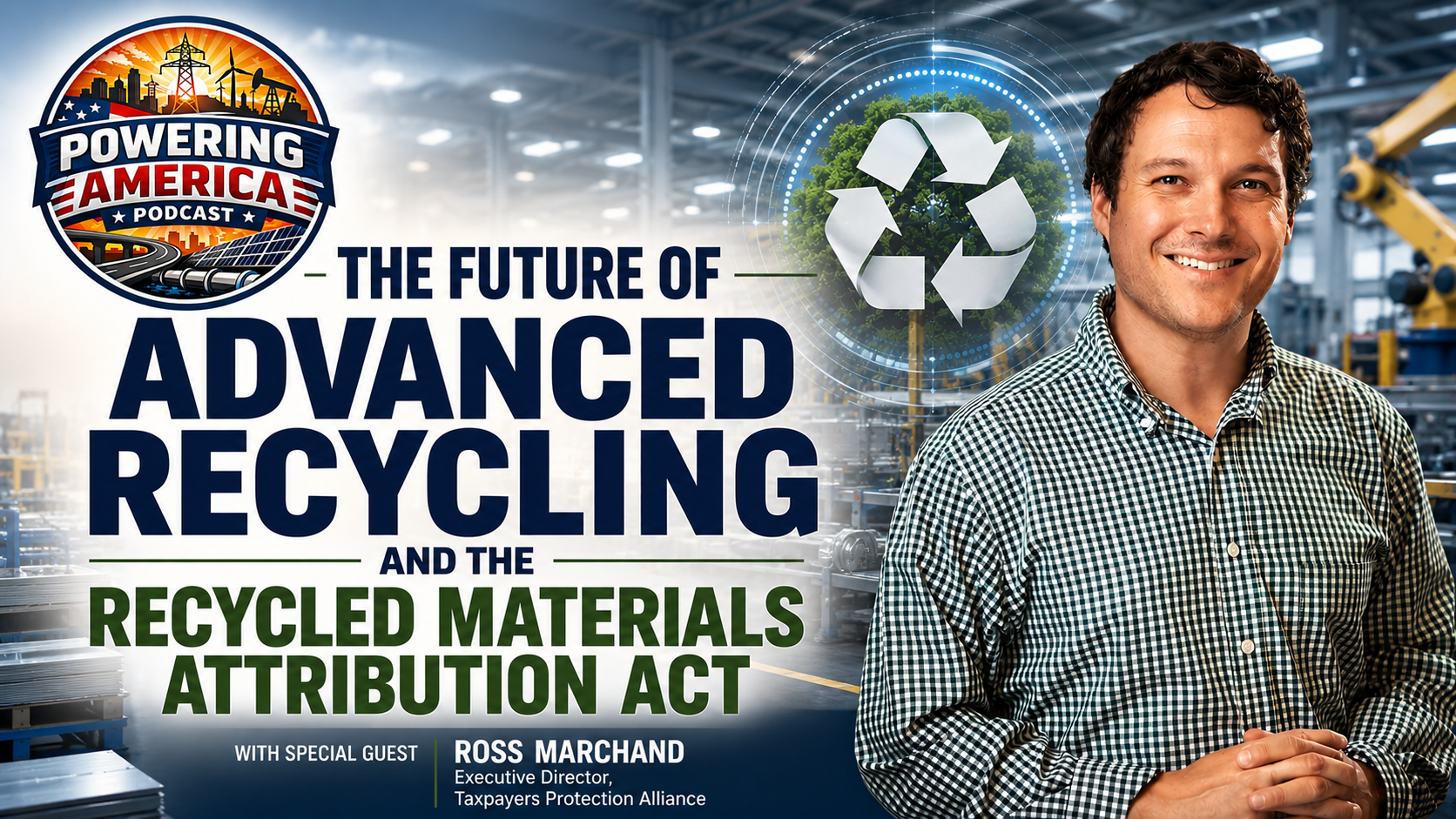
Powering America Podcast episode featuring Ross Marchand discussing Ross Marchand on the Future of Advanced Recycling and the Recycled Materials Attribution…

In the latest episode of the Powering America Podcast, Ross Marchand, Executive Director of the Taxpayers Protection Alliance, discusses the future of advanced recycling, focusing on the Recycled Materials Attribution Act. Marchand discusses advancements in recycling technology, the economic potential of increased recycling rates, and the regulatory challenges posed by state and federal guidelines. The conversation highlights the importance of a federal standard to promote truthful recycling claims and the economic benefits that could arise from a more efficient recycling system.

Ross Marchand on the Future of Advanced Recycling and the Recycled Materials Attribution Act

0:00 / 0:00

The Future of Recycling: Innovation, Economics, and Policy

The Future of Recycling: Innovation, Economics, and Policy

Ross Marchand, executive director of the Taxpayers Protection Alliance, discussed the evolution of recycling and the implications of new legislation in an interview on the Powering America Podcast. The conversation centered on the Recycled Materials Attribution Act and the current state of recycling practices in the United States.

Marchand explained that recycling has transformed significantly over the past few decades. He noted that older recycling methods relied heavily on manual sorting, which was inefficient and costly. "Now we have a lot more automation and a lot of new technologies like pyrolysis," he said. This shift has made recycling more efficient and capable of driving economic growth.

The discussion highlighted the economic potential of improved recycling practices. Marchand pointed out that outdated regulations have previously hindered recycling efforts, resulting in economic losses. He stated that if the government reduced its restrictions, the recycling sector could create approximately 200,000 new jobs and generate $50 billion in annual economic opportunities, particularly in plastics recycling.

Marchand criticized existing state and federal regulations, particularly in California, where stringent labeling requirements complicate the recycling process. He argued that these regulations create barriers for manufacturers wishing to communicate the recycled content of their products. The Recycled Materials Attribution Act aims to establish a federal standard that allows for truthful claims about recycled content, countering state-level restrictions.

The act has garnered bipartisan support, with lawmakers recognizing the need to address misinformation surrounding recycling. Marchand noted that both Democrats and Republicans are increasingly frustrated with the current regulatory landscape. "Democrats historically have been very pro-recycling, at least rhetorically," he said, while Republicans emphasize the need for a more business-friendly environment.

As for the current status of the Recycled Materials Attribution Act, Marchand indicated that it has been introduced but is awaiting further discussion and consideration in Congress. He emphasized the importance of establishing a federal standard to combat misinformation and facilitate recycling.

Opposition to the act primarily comes from state and local bureaucrats who may lose regulatory power. Marchand explained that these officials often seek to maintain strict regulations and control over recycling practices. He also noted that some environmental groups may oppose the act due to concerns about reduced litigation opportunities related to environmental standards.

Marchand expressed optimism about the potential for a recycling renaissance in the U.S. He argued that a lighter regulatory touch could benefit taxpayers and the environment, allowing for increased recycling rates and reduced strain on landfills.

The conversation also touched on the global plastic crisis and the U.S. role in addressing it. Marchand emphasized the need for the U.S. to lead by example in promoting effective recycling practices. He stated that while the U.S. contribution to the plastic crisis is often overstated, demonstrating successful recycling reforms could influence other countries to adopt similar measures.

Finally, Marchand reiterated the economic benefits of improved recycling, stating that it could lead to significant job creation and economic activity while also contributing to a cleaner environment. He encouraged listeners to visit the Taxpayers Protection Alliance website for more information on the topic.

For more details on recycling policies and innovations, visit protectingtaxpayers.org.

Interview Q&A

Q&A: The Future of Recycling: Innovation, Economics, and Policy

The Future of Recycling: Innovation, Economics, and Policy

Q: Can you introduce yourself and your organization?

A: I am Ross Marchand, the executive director of the Taxpayers Protection Alliance. We are a taxpayer and consumer advocacy organization dedicated to holding government accountable and promoting free market principles.

Q: How has recycling changed over the years?

A: Recycling has evolved from manual sorting and inefficient processes to more automated systems and advanced technologies like pyrolysis. This shift has made recycling far more efficient and cost-effective.

Q: What role does technology play in modern recycling?

A: New technologies have improved the efficiency of recycling operations. For example, automation and advanced sorting techniques allow for better handling of materials, reducing the need for manual labor and increasing overall productivity.

Q: What are the economic implications of modern recycling practices?

A: Improved recycling practices can lead to significant economic growth. For instance, if recycling rates increased, particularly for plastics, it could create 200,000 new jobs and generate $50 billion in annual economic opportunities.

Q: How do state and federal guidelines on recycling interact?

A: States like California impose strict labeling requirements that can hinder the recycling industry. The Recycled Materials Attribution Act aims to establish a federal standard that allows for truthful claims about recycled content, countering state-level restrictions.

Q: Are there political divisions regarding recycling regulations?

A: There is a growing bipartisan consensus on the need for clearer recycling standards. Both parties recognize the inefficiencies caused by misinformation and heavy-handed regulations, although historical trends show differing approaches under various administrations.

Q: What is pyrolysis, and why is it significant?

A: Pyrolysis is a cutting-edge technology that converts plastics into fuel in a controlled, heated environment with minimal emissions. It represents a significant advancement in recycling capabilities, particularly for materials that are difficult to process.

Q: What is the current status of the Recycled Materials Attribution Act?

A: The Recycled Materials Attribution Act has been introduced but requires further discussion among lawmakers. Its potential benefits need to be considered in light of existing state and local regulations.

Q: Who opposes the Recycled Materials Attribution Act?

A: Opposition primarily comes from state and local bureaucrats who want to maintain strict control over recycling regulations. These groups are concerned that a federal standard would diminish their regulatory power.

Q: What are the financial incentives for state regulators in this context?

A: State regulators may benefit from maintaining strict definitions and regulations, which can lead to increased funding through environmental lawsuits. A federal light-touch approach could reduce the number of lawsuits and limit their financial incentives.

Q: How can the U.S. lead in addressing global plastic pollution?

A: The U.S. can set an example by implementing effective recycling policies that demonstrate the benefits of sustainable practices. This leadership can influence other countries to adopt similar approaches to address the global plastic crisis.

Q: What are the job creation prospects associated with improved recycling?

A: Enhancing recycling practices, particularly for plastics, could result in the creation of 200,000 new jobs and $50 billion in economic activity, alongside environmental benefits.

Q: Where can people find more information on this topic?

A: For more information, individuals can visit the Taxpayers Protection Alliance website at protectingtaxpayers.org, where numerous articles on recycling and related issues are available.

Key takeaways

  • The new recycling is far more efficient and cost effective than what it used to be.
  • If the government just got out of the way and recycling rates were allowed to increase, it would actually create— in the case of plastics, for example— 200,000 thousand new jobs and $50 billion in increased annual economic opportunity.
  • What they're doing is they're trying to outlaw truthful claims that will tell customers, hey, this is partially or even fully recycled.
  • When you let a recycling renaissance really just kind of hit the ground running, you create all these economic growth opportunities, and that's really good for tax revenue.
  • This is a tremendous opportunity for economy and ecology. Recycling can take off. It could benefit taxpayers and customers.

About the guest

ross-marchand-taxpayers-protection-alliance

Ross Marchand

Executive Director, Taxpayers Protection AllianceTaxpayers Protection Alliance

Ross Marchand is Executive Director of Taxpayers Protection Alliance. Ross is an alumnus of the Mercatus Center MA Fellowship at George Mason University and a graduate of the University of Virginia School of Law. He has worked on a variety of legal matters, including the Alaska-Hawaiian airline merger and the United States Postal Service v. Konan Supreme Court case. He has also authored policy briefs on a variety of issues, including multiple analyses on the legal and policy issues facing the Food and Drug Administration. His work has appeared in numerous publications including The Wall Street Journal, National Review, Forbes, The Denver Post, and the Washington Examiner.

Full transcript

Show full transcript
[00:00] Speaker A: Welcome to the Powering America Podcast. I'm Brian Hyde. I'm joined today by Ross Marchand. He's executive director of the Taxpayers Protection Alliance. Ross, great to have you on the program. [00:11] Speaker B: Great to be back. [00:13] Speaker A: So for those meeting you for the first time, take a moment here to tell us a little bit about your background, about who you are and what you do. [00:20] Speaker B: Sure. Well, I'm the executive director of the Taxpayers Protection Alliance. We are a taxpayer and consumer advocacy organization dedicated to holding government accountable and free market principles. [00:33] Speaker A: Excellent. And we're going to talk today about something that I think may be on people's radar screens, and that is recycling. In particular, the Recycled Materials Attribution Act. But before we dive into that particular piece of legislation, um, can we talk a little bit about recycling in general? Uh, I'm trying to remember back when I was a kid, which was a little while back, I don't remember recycling being such such an item of emphasis. And I'm wondering, how has this changed over the years? [01:02] Speaker B: Right, so there's old school recycling and then there's the new recycling, and the new recycling is far more efficient and cost effective than what it used to be. So you look at 20 years ago and 30 years ago, the situation with recycling, a lot of the sorting of different products was manual, extraordinarily inefficient. And then you had even mechanical recycling, um, plastics were required to be separated by resin type, they had clean, shredded, melted, and remanufactured, it was an exceptionally costly and time-intensive process. Now we have a lot more automation and a lot of new technologies like pyrolysis. What happens as a result is that recycling is far more efficient, and it can actually generate economic growth on net and make the economy far more efficient and smoother than it used to be. [01:56] Speaker A: So is it just the technology that, that caused this shift? Because I know there was a time where, um, you know, we joked around about, hey, the recycling police are going to get after you if, uh, you know, you don't put things in the right bin or don't sort them appropriately. But, but now it seems like that's, that's kind of gone by the wayside. Um, tell me what changed. [02:16] Speaker B: Yeah, there's a lot more automation and things like sorting, and there's just greater understanding in general as to, for example, if we see a tiny amount of grease on a pizza box, what do we do? And now we can afford to be far less risk-averse about recycling in those edge cases, in those, you know, in those borderline cases that give people pause before putting that pizza box in the recycling bin. [02:40] Speaker A: So talk to me about what this means in terms of economic development. I'm curious, uh, you know, there was a time where I remember recycling operations opening up, but is this opening up even greater possibilities than what we saw previously? [02:54] Speaker B: Absolutely. And recycling used to be so inefficient that federal, state, local initiatives to increase recycling would actually result in economic loss and increased costs for taxpayers and customers. Now we have the opposite situation in that we are actually missing important chances to recycle at scale. And if the government just got out of the way and recycling rates were allowed to increase, it would actually create— in the case of plastics, for example— 200,000 thousand new jobs and $50 billion in increased annual economic opportunity. So this is a huge missed opportunity. But unfortunately, there are so many redundant state-level labeling rules and federal regulations restricting these technologies. [03:40] Speaker A: And I guess that's a good place to start. Is there a place where the state and federal guidelines for, you know, how to recycle where they cross, basically where there's common ground and they're not in competition with one another. [03:56] Speaker B: Right. Well, you have states like California, and unsurprisingly, they are very harsh and unforgiving in terms of what manufacturers can claim is a recycled product. Now, recycling depends on information that is accurate and timely provided to customers. If you can't convey to customers this is a recycled product, and if so, what percentage of this product is recycled, then you destroy the entire recycling industry. And right now in California, what they're moving to do is they're moving to say, uh, something called mass balance accounting is not going to be allowed, in that every single product, as a result of this proposal, is going to have to have these really granular and really time-intensive and onerous traceability requirements. Each and every product. It basically creates an unworkable mandate. If a company in California producing these products, or it wants to communicate to customers this product is recycled, They could know that a large percentage of that source material is recycled, but because they can't trace back individual products, each and every individual product that they produce, then no bueno, and they're not allowed to advertise in California. What we see with federal proposals, this Recycled Materials Attribution Act, is that would change all that. It would say to states like California, you can't dictate these heavy-handed requirements to the rest of the country. [05:24] Speaker A: You know, when you talk about heavy-handed requirements, immediately I'm thinking this kind of sounds like some of the green energy initiatives that we've heard. Some states, California, Colorado, you know, really take, you know, the green movement very seriously. Are we seeing a step back from some of those more onerous regulations, or is that a movement that still is very much a force to be reckoned with? [05:51] Speaker B: Very much a force to be reckoned with, unfortunately. You go to states like California and they call it the exact opposite of what it is. They say, look, we're just trying to further truth in recycling. But what they're doing is they're trying to outlaw truthful claims that will tell customers, hey, this is partially or even fully recycled. And in this environment, I mean, the government is pushing misinformation. And as a result, I mean, they are thwarting any potential for mass recycling that could actually save money and turbocharge charge economic growth. [06:24] Speaker A: And, and you had mentioned earlier, I think it was pyrolysis. Tell me a little bit more about that and, and how is that a game changer? [06:31] Speaker B: Yeah, this is a cutting-edge technology. So what you can do in the heated controlled environment without oxygen is you could take plastics— and by the way, the plastics recycling rate is very, very low, surprisingly low, it's less than 10%— you could, with pyrolysis, you could take these plastics in a heated controlled environment and you could turn it into things like fuel with very few emissions. Now, before, you know, again, old school inefficient recycling, the concern is that if you apply heat to things like plastics, it could create a lot of harmful pollution and emissions. And it was very time intensive and it was very costly. And it just, it didn't really make sense back then. But now we have that technology. And that's another area where the federal government is trying to play catch up and is trying to regulate that technology in a light touch way. [07:21] Speaker A: And I'm sorry to bring this into the political realm, but I can't help but feel like there's a, there's a fairly big difference between, uh, with the Trump administration in place and how they handle issues like this versus how the Biden and even the Obama administrations were. Um, is politics going to continue to play a role here? Is it going to be more stringent under some administrations and less stringent under others? [07:44] Speaker B: Absolutely. What you saw under Biden with technologies like pyrolysis is they were classified according to these very strict environment environmental regulations, and anything that used heat was regulated with really heavy-handed EPA rules. Now, the Trump administration, they're starting to back away from these heavy-handed rules. They're saying, "Look, if you have this innovative technology and it's producing less emissions than it did before, we don't need to apply the Clean Air Act. We don't need to throw thousands of pages of rulemaking and paperwork." at these technologies, because if we do that, then no one is ever going to use this technology and there are going to be all these foregone opportunities for efficient and environmentally friendly recycling. [08:32] Speaker A: And I guess I have to ask at this point, the consumer, the, the, the person, the citizen, the taxpayer, you know, what's in it for them with these stringent rules? You know, for instance, the EPA's regulations. Is it really delivering on a clean environment? Is it delivering on, you know, lowering the cost of business or cleaning up from pollution? I guess I'm having to wonder who wins. [09:01] Speaker B: Yeah, well, taxpayers definitely win out from a lighter touch approach because whenever you have out-of-control bureaucracy and you have the EPA enforcing these rules on technologies like pyrolysis, the bureaucracy just swells. So you saw this under Biden. Spending on bureaucracy, on new bureaucratic rules, I mean, just absolutely skyrocketed. So that's the number one way that taxpayers lose out. And fortunately, the Trump administration is trying to turn things around towards a lighter touch approach. But also, when you let a recycling renaissance really just kind of hit the ground running, you create all these economic growth opportunities, and that's really good for tax revenue. So taxpayers win out two different ways when you facilitate this efficient recycling process. [09:47] Speaker A: Let's take a little deeper dive too into HR 7502, the Recycled Materials Attribution Act. What can you tell me about its origination and what does it purport to do? [09:58] Speaker B: Sure. Well, we were just talking about these states like California, and they want to further these really restrictive labeling requirements. And what the Recycled Materials Attribution Act does is it says It says to states like California, you can't promulgate all this misinformation and confuse customers and keep the recycling sector on the ground. We are going to have a federal standard that legalizes completely truthful claims saying this product is at least partially recycled. So it eliminates a lot of the misinformation that's being forced onto customers by state bureaucrats. [10:41] Speaker A: And, and how has that been in terms of, um, is one party pushing back, you know, stronger than another? Or have, again, have they been able to find some common ground to say, you know what, this is workable, and, and get both parties on board? [10:54] Speaker B: This is an area where you are seeing some common ground, and I think that people from both parties, lawmakers across the political spectrum, are fed up with all this misinformation. And look, Democrats historically have been very pro-recycling, at least rhetorically. So the Democrats are realizing, hey, we have a 90% non-recycling rate for plastics. We could do so much better. And the Republicans are saying, you know, traditionally, stereotypically, the more pro-business party, they're saying there are all these heavy-handed rules and labeling requirements and that's holding back recycling. So we finally have some common ground. [11:33] Speaker A: So, Ross, I don't know if you had mentioned it. If you did, I may have missed it. Where does H.R. 7502 stand? Currently? Is it making progress or is it, you know, sitting in committee waiting for action? [11:45] Speaker B: Well, this is something that's introduced, but lawmakers really need to consider this and they need to discuss and consider the benefits of the federal standard, especially when there's so much state and local level misinformation. So lawmakers absolutely have their work cut out for them in considering this very important piece of legislation. [12:02] Speaker A: And I always have to ask, when it comes to legislation, you can learn a lot about something by who is opposing it, Are there groups or organizations that are lined up against the Recycled Materials Attribution Act? And who are they and why would they oppose it? [12:18] Speaker B: So who does this take power away from? State and local bureaucrats. So the Californians of the world, they want all the power in the world to dictate these really strict recycling requirements, these labeling requirements that holds back— again, holds back recycling. So all these bureaucrats in the California government, right, it just— it grows in power. They always want more and more power and they want to become the de facto national regulator. So you bet in a big way they are very much opposed to any sort of federal light-touch approach. [12:52] Speaker A: And I get what you're saying about, you know, the need for— once they've had power, they want to hang on to it. You know, it's protecting their turf, so to speak. Is there a financial incentive for state regulators? I'm just— I guess I'm trying to figure if there's something beyond just the power and control that goes along with this. [13:10] Speaker B: Sure. Well, the power and control comes first. You do have a lot of green groups, right? And the green groups get a lot of their money from lawsuits, environmentally-minded lawsuits, and they want the strictest definition possible. They want a situation where, um, even incremental progress is not good enough. But if you have clean slate, if you have a sweeping federal light-touch approach, what happens is a lot of those lawsuits will go by the wayside. And the trial lawyer lobby, they really don't like that. And the green groups that sue for a living, they really don't like that. [13:44] Speaker A: Okay, that makes sense. And I know, you know, organizations like the Center for Biological Diversity, you know, ostensibly they're protecting the planet, but it's also— that's— there's a ton of money that's at stake, you know, for them to keep doing what they're doing. At any rate, it's just curious for people who don't think beyond just, well, am I putting this in this recycling bin or that recycling bin? You know, like you pointed out here, there's a lot at stake here, both at the state and federal level, that sometimes is off our radar screens unless you're deeply involved in the issue. [14:18] Speaker B: Exactly. And this is a tremendous opportunity for economy and ecology. Recycling can take off. It could benefit taxpayers and customers. It could benefit the economy, and it can make the world a cleaner place. But you need to have the right rules in place. You need to have a light-touch approach. Otherwise, that is never going to happen. [14:39] Speaker A: And I have to ask about this because any time we talk about plastics, it seems like someone will bring up, well, what about the giant island of floating plastic, you know, out in the Pacific Ocean for places that are dealing with— I'll just call it pollution for lack of a better phrase. Can this deal with plastics that have been discarded that need to be cleaned up? I know, you know, we're doing our part in our country, but there are, you know, developing countries that maybe don't take these kind of things as seriously? Uh, do they render our efforts in vain? [15:12] Speaker B: It's very important the U.S. leads by example, and if we can show that these rules, these common-sense reforms, can increase recycling in a sustainable way that benefits everyone, then other countries will take note. Now, the plastic crisis is applied to the U.S. contribution. Our contribution to this crisis is highly overstated. That being said, we can absolutely lead by example in getting this global problem under control. [15:43] Speaker A: Well, and, and like you say, the— there's a prosperity angle here that, that maybe isn't as apparent for people who are more focused on the ecological concerns. But tell me again, in terms of, of job creation, um, we're not talking about just, you know, a few dozen jobs here and there, correct? [16:00] Speaker B: Right. And if plastics recycling gets off the ground, we're talking about 200,000 new jobs created and $50 billion in new economic activity. [16:11] Speaker A: And that's in addition to actually putting less strain and stress on landfills, etc. [16:19] Speaker B: Right, exactly. And a cleaner planet that has economic benefits as well, as well as just overall benefits to everyone. [16:27] Speaker A: Okay, so let's, let's tap people into where they could, could get some, some solid information on this. I guess the first thing we ought to do is maybe direct them to the Taxpayers Protection Alliance. I know you have written on this extensively. Where can people find your work? Where can they find your website? [16:42] Speaker B: We regularly write about this issue at protectingtaxpayers.org. [16:47] Speaker A: Okay, and, and they'll find not just one but actually numerous articles pertaining to this issue. Again, we were talking with Ross Marchand. He is a Executive Director of the Taxpayers Protection Alliance. Ross, thanks again for joining us on the Empowering America podcast. [17:04] Speaker B: Great to be back on your podcast.

Filed under