2026-09-22 · Open Markets Institute
Transportation Analyst Says UP-NS Merger Would Harm Shippers and Communities
with Arnav Rao, Transportation Policy Analyst — Open Markets Institute
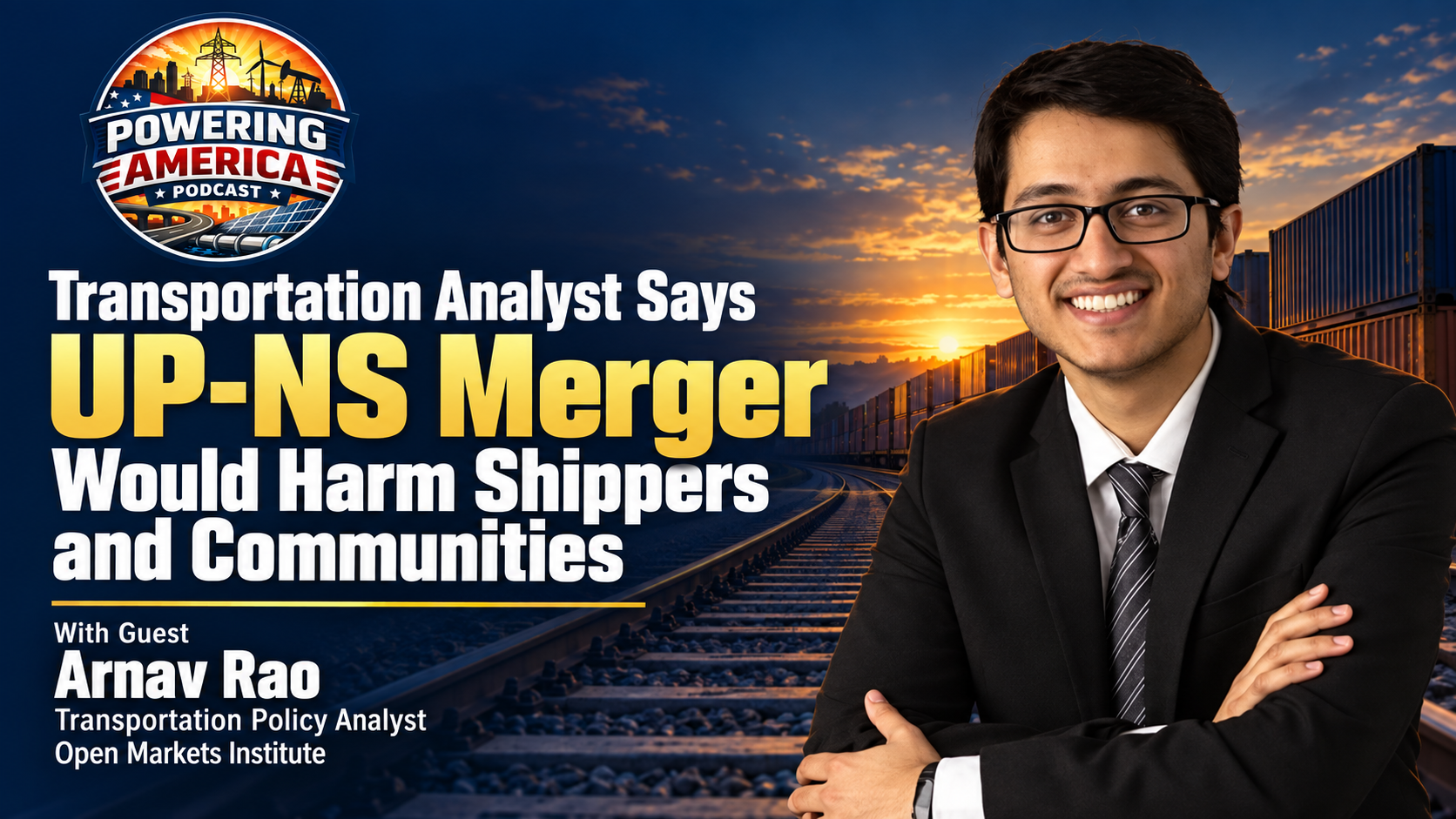
In the latest episode of the Powering America Podcast, transportation policy analyst Arnav Rao from the Open Markets Institute discusses the potential impact of the proposed merger between Union Pacific and Norfolk Southern railroads. Rao argues that the merger could harm shippers and communities by consolidating market power, increasing freight traffic, and exacerbating issues related to pricing and service reliability. He emphasizes the importance of a strong rail system for industrial growth and environmental sustainability in the United States.
Transportation Analyst Says UP-NS Merger Would Harm Shippers and Communities
Transportation Analyst Warns UP-NS Merger Could Harm Shippers and Communities
In a recent episode of the "Powering America Podcast," Arnav Rao, a transportation policy analyst at the Open Markets Institute, discussed the potential impacts of the proposed merger between Union Pacific Railroad (UP) and Norfolk Southern Railway (NS). Rao expressed concerns that the merger could adversely affect shippers and communities across the United States.
Rao emphasized the importance of railroads in the U.S. economy, stating that they are among the most efficient means of transporting goods. He noted that rail emits fewer greenhouse gases than trucks and is essential for moving bulk items such as chemicals, fertilizers, and construction materials. "If we want to have a greener climate, we want to start building electric vehicles or electric vehicle batteries, those things require moving iron, phosphate, and all of these subcomponents that are difficult or uneconomical to move on trucks," Rao said.
Union Pacific serves the western half of the United States, while Norfolk Southern operates in the east. The merger would create the first truly transcontinental railroad, a significant consolidation in an industry that has already seen a decline in the number of Class I railroads from over 30 to just six since deregulation.
Rao pointed out that while UP and NS argue that the merger will streamline operations and reduce truck traffic, he believes the reality may be different. "The real problem has been pricing power and abuse of market power," he said. He noted that railroads have raised prices significantly since the early 2000s, leading to stagnant volumes and a shift of traffic from rail to trucks.
He also highlighted the reliability issues within the rail industry. The shift toward precision scheduled railroading has resulted in longer trains and increased blocked crossings, which can disrupt communities. Rao cited data from the Federal Railroad Administration, indicating that Union Pacific accounts for more blocked crossing reports than all other Class I railroads combined. He warned that the merger could exacerbate these issues, with some communities potentially experiencing traffic increases of up to 400%.
Rao discussed the possibility of railroads becoming more involved in passenger transportation, noting that delays in Amtrak services are often caused by freight trains occupying the tracks. He expressed skepticism about the merger's potential to improve this situation, stating that the application did not adequately address the impact on passenger rail services.
Rising fuel costs could also play a role in the merger's implications. While railroads typically benefit from lower fuel costs compared to trucks, Rao pointed out that railroads often impose diesel fuel surcharges on shippers. This practice can diminish the advantages that rail should have over trucking, particularly for agricultural commodities where transportation costs are a significant factor.
Rao concluded by urging listeners to consider the broader implications of the UP-NS merger on competition, pricing, and community impacts. He advocates for a more equitable transportation policy that prioritizes fair competition and addresses the needs of shippers and communities alike.
For more information on transportation policy and related topics, Rao encouraged listeners to visit the Open Markets Institute's website.
Interview Q&A
Q&A: Transportation Analyst Says UP-NS Merger Would Harm Shippers and Communities
Powering America Podcast: Q&A with Arnav Rao
Q: Can you tell us about your background and work?
A: I am Arnav Rao, a transportation policy analyst at the Open Markets Institute. We focus on fair competition, anti-monopoly policies, and using competition policy to create equitable societies and stronger democracies. My experience includes working on the federal affairs team at Union Pacific, which informed my views on monopolistic rail systems.
Q: Why is rail still a powerful means of shipping in the U.S. today?
A: Rail is one of the most efficient transportation methods, emitting fewer greenhouse gases than trucks. It is essential for moving bulk items necessary for industrial capacity, such as chemicals and raw materials. A strong rail system supports industrial revival and the transition to greener technologies.
Q: What is the current status of the Union Pacific and Norfolk Southern merger?
A: Union Pacific and Norfolk Southern are two major Class I railroads, with Union Pacific serving the western U.S. and Norfolk Southern serving the eastern U.S. They aim to create the first truly transcontinental railroad, which would connect the coasts more directly than previous railroads.
Q: How would the merger affect shipping and the trucking industry?
A: The railroads claim the merger would create a seamless service that could remove millions of truckloads from roads. However, there is skepticism about this claim, as railroads have historically abused their market power, leading to higher prices and stagnant volumes.
Q: How do rail and trucking compare in terms of efficiency?
A: For long distances, rail is generally more efficient. However, railroads have raised prices faster than inflation, making it less attractive for shippers. Additionally, service reliability issues have arisen from cost-cutting measures in rail operations.
Q: What impact would the merger have on communities?
A: Communities may experience increased blocked crossings due to longer trains resulting from the merger. Union Pacific has a history of causing more blocked crossings than other Class I railroads, and the merger could exacerbate this issue.
Q: Is there potential for rail to be used for passenger transport again?
A: With the right regulations, there could be a revival of passenger rail. However, current freight operations often delay Amtrak trains, and the merger plans do not address improvements for passenger rail services.
Q: How are rising fuel costs affecting the rail industry?
A: Rising fuel costs could favor railroads since they consume less fuel than trucks. However, railroads often impose surcharges on shippers that exceed fuel price increases, reflecting their market power rather than benefiting from lower operational costs.
Q: How do increased transportation costs impact farmers?
A: Increased transportation costs significantly affect farmers, especially for commodities where rail transport is a large part of the final cost. Higher rail prices can strain farmers' profit margins.
Q: Where can people find more information about your work?
A: More information can be found on our website, openmarketsinstitute.org. We cover various topics related to competition policy, including transportation. My writings on transportation policy are also available through other news outlets.
Q: What are some of the challenges facing railroads today?
A: Railroads face challenges related to pricing power and service reliability. Cost-cutting measures have led to reduced capacity and increased vulnerability to disruptions, which affects their competitiveness against trucking.
Q: How has the operating model of railroads changed in recent years?
A: The shift to precision scheduled railroading has focused on stripping costs from operations, which has led to longer trains and reduced service reliability. This model has created challenges in meeting the needs of shippers.
Q: What concerns do you have about the future of rail transportation?
A: The merger could lead to increased market power for a larger freight rail company, potentially harming shippers and communities. Without commitments to improve service and capacity, the challenges facing rail transportation may persist.
Key takeaways
- “Even if we have a single line service, there's no guarantee that the railroad would pass those efficiencies on to shippers.”
- “Farmers' grain silos really feel the pinch from those increased costs.”
- “With trucking, shippers are able to really get a fine-grained, here's where my shipment is, here's when it's coming.”
- “Union Pacific accounts for more blocked crossing reports than all of the other Class I railroads combined.”
- “A strong rail system is really important for industrial revival.”
About the guest

Transportation Policy Analyst — Open Markets Institute
Arnav Rao is a Transportation Policy Analyst at the Open Markets Institute, where he researches the business practices and public policies shaping maritime trade and transportation. Before joining the institute, he worked for U.S. Senators Jack Reed and Jon Ossoff and former U.S. Representative Carolyn Bourdeaux, as well as in government affairs at Tesla, Union Pacific Railroad, and Zoox. Raised near Atlanta, Rao earned a B.S. in Public Policy with a minor in Law, Science, and Technology from Georgia Tech.
Full transcript
Show full transcriptHide transcript
Filed under