
Wednesday, December 31, 1969 · The Powering America Podcast
Powering America Podcast logo

Receive new episodes in your inbox.

← Powering America Podcast

2026-08-25 · Reason Foundation

Marc Scribner on Upgrading America's Outdated Air Traffic Control System

with Marc Scribner, Senior Transportation Policy Analyst — Reason Foundation
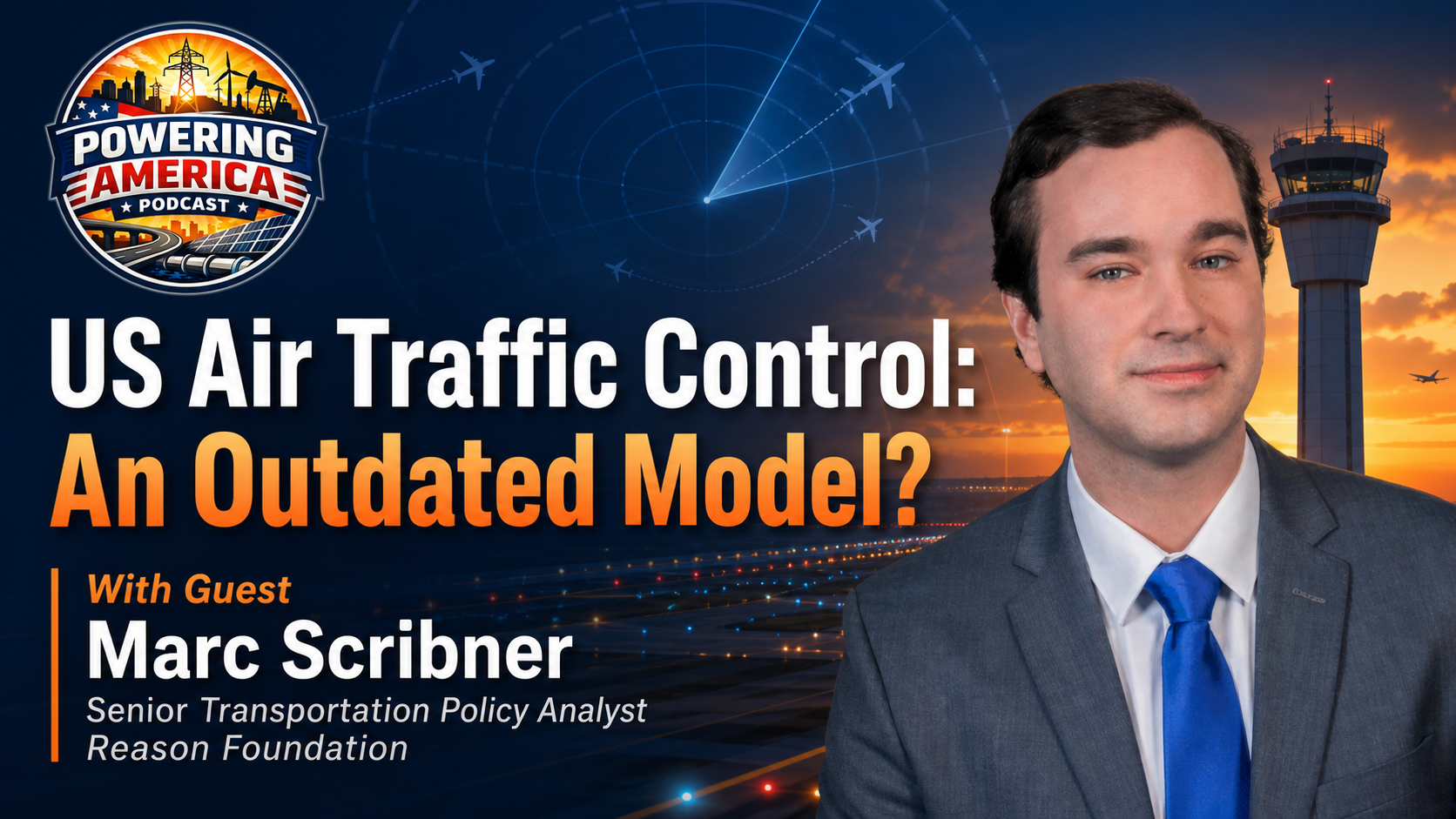
Powering America Podcast episode featuring Marc Scribner discussing Marc Scribner on Upgrading America's Outdated Air Traffic Control System — Reason Foundation

The Powering America Podcast features Marc Scribner, a Senior Transportation Policy Analyst at Reason Foundation, discussing the challenges of the U.S. air traffic control system. Scribner highlights deficiencies in the current model, which has not evolved since the 1950s, and contrasts it with Canada's successful separation of air traffic control from safety regulation through Nav Canada. He emphasizes the need for modernization and efficiency in U.S. air traffic management, noting that many countries have adopted more effective models.

US Air Traffic Control: An Outdated Model?

0:00 / 0:00

US Air Traffic Control: An Outdated Model?

U.S. Air Traffic Control Faces Challenges, Calls for Reform

The United States air traffic control system, a model adopted in the 1950s, is increasingly viewed as outdated and inefficient, according to Marc Scribner, a senior transportation policy analyst at the Reason Foundation. In a recent episode of the "Powering America Podcast," Scribner discussed the deficiencies in the current system and the potential for reform based on successful models from other countries.

Scribner highlighted that the U.S. air traffic control system was once considered the global standard, developed in response to past tragedies, such as the midair collision over the Grand Canyon in the late 1950s. The Federal Aviation Administration (FAA) operates the air traffic control system while also serving as the aviation safety regulator, a dual role that has led to conflicts of interest and chronic underfunding.

“Having a regulator also operate a service that it is tasked with regulating was a fundamental conflict of interest,” Scribner said. He noted that this model has resulted in delays in modernization and inefficiencies that affect air travel.

In contrast, Canada faced similar challenges in the early 1990s when it struggled with inadequate funding and obsolete infrastructure. The Canadian government responded by separating air traffic control from its safety regulator, Transport Canada. This led to the creation of Nav Canada, an independent, nonprofit user cooperative that charges cost-based user fees to aircraft operators. This model has allowed Canada to modernize its air traffic control system more efficiently than the U.S.

“Nav Canada doesn’t depend on annual appropriations from legislators,” Scribner explained. “That predictable revenue stream allows it to issue bonds to finance improvements.” He emphasized that while the U.S. system is safe, it is lagging in efficiency, which directly impacts travelers' experiences.

Scribner pointed out that the FAA's modernization efforts often take a decade or longer to complete, leading to outdated systems by the time they are operational. In contrast, Nav Canada can implement improvements in a fraction of the time while maintaining a high safety record.

The conversation also touched on the potential for increased automation in air traffic control, particularly with the advent of artificial intelligence. Scribner noted that while some automation is already being implemented, full automation of the air traffic control system is not imminent. Instead, the focus is on improving workflows to enhance efficiency and safety.

Scribner stated, “We do have increasing automation, especially outside the United States, where the latest technologies have been adopted.” He mentioned that the FAA is exploring a digital twin technology to simulate airspace systems for predictive planning, a project that Nav Canada has already completed.

As for the future of air traffic control reform in the U.S., Scribner indicated that there is currently little political momentum for significant changes. Past attempts to reform the system faced opposition, particularly from groups concerned about job losses among FAA middle management.

“While there are some members of Congress interested in fundamental governance reform, right now, the political appetite seems limited,” Scribner said. He noted that the FAA is currently focused on modernization efforts funded through congressional appropriations, which may not be sustainable in the long term.

Scribner concluded that the U.S. is increasingly an outlier in its air traffic control model, with 96 countries having adopted independent air navigation service providers. He argued that separating air traffic control from safety regulation is the most common and effective model globally, and the U.S. could benefit from similar reforms.

The discussion underscores the need for the U.S. to reevaluate its air traffic control system to enhance efficiency and meet the demands of modern air travel.

Interview Q&A

Q&A: US Air Traffic Control: An Outdated Model?

US Air Traffic Control: An Outdated Model?

Q: Can you tell us about your background?

A: I have been working on transportation policy from a free market perspective for nearly two decades. My focus has been mainly at the federal level, with some work on state transportation policy. My career themes include regulation and technology, particularly how innovative transportation technologies face regulatory challenges.

Q: What is the current state of air traffic control in the US?

A: The US air traffic control system has several deficiencies. The model, which was once the global standard, is now outdated. It was established in response to midair collisions in the late 1950s and has not evolved significantly since then. The system is still managed by the Federal Aviation Administration, which also serves as the safety regulator, creating a conflict of interest.

Q: How does the US air traffic control model compare to other countries?

A: Many countries have separated their air traffic control services from safety regulation. For example, Canada faced similar challenges in the early 1990s and reformed its system by creating Nav Canada, an independent nonprofit that charges user fees instead of relying on government appropriations. This has allowed Canada to modernize its air traffic control more efficiently.

Q: What are the benefits of Canada's air traffic control model?

A: Nav Canada has maintained a high safety record while improving efficiency and reducing costs. The independent model allows for predictable revenue, enabling quicker upgrades and modernization of facilities and technology compared to the US system, which can take years to implement changes.

Q: Did Canada's reform reduce bureaucracy?

A: Yes, while there were concerns about job losses, the reforms primarily reduced middle management positions rather than air traffic controllers. This restructuring has streamlined operations without compromising safety.

Q: Are there other countries successfully modernizing their air traffic control systems?

A: Yes, 96 countries currently have independent air navigation service providers separate from safety regulators. This model is becoming the global standard, with varying structures, including government corporations and private companies.

Q: Is there political support in the US for air traffic control reform?

A: Currently, there is limited political appetite for reform. While some members of Congress have expressed interest, the focus has been on modernization efforts through appropriations rather than structural changes.

Q: How is artificial intelligence being integrated into air traffic control?

A: Increased automation is being adopted, particularly outside the US. The FAA is exploring near-term applications of AI, such as a digital twin that simulates air traffic flows for predictive planning. However, full automation of air traffic control is not expected in the near future.

Q: What role will humans play in the future of air traffic control?

A: While technology will evolve to improve workflows and efficiency, the human role will likely shift towards supervisory functions rather than complete automation. Controllers will still be essential for ensuring safety and managing complex situations.

Q: What challenges does the FAA face in modernizing air traffic control?

A: The FAA struggles with funding and long timelines for modernization projects. This often leads to outdated technology by the time systems are implemented, hindering efficiency and effectiveness.

Q: What lessons can the US learn from other countries regarding air traffic control?

A: The US can learn from the successful separation of air traffic control from safety regulation seen in other countries. This model has proven to enhance both safety and efficiency, benefiting air travelers directly.

Q: What is the central purpose of air traffic control?

A: The primary purpose of air traffic control is to ensure the safe separation of aircraft to prevent collisions. This fundamental goal remains critical as air travel continues to evolve.

Key takeaways

  • The current US model that is breaking down, that was initially the global model.
  • The central purpose of air traffic control is to ensure safe separation between aircraft so they don't crash into one another.
  • The United States, for all its faults, is a very safe system, but where we are really falling behind is on the efficiency side of things.
  • Nav Canada doesn't depend on annual appropriations from legislators. It charges cost-based user fees to the aircraft that use the system.
  • The proof is in the pudding. What we've observed from Nav Canada, we've seen not only the maintenance of their high safety record, we've seen improvements in safety.

About the guest

Headshot of Marc Scribner, Senior Transportation Policy Analyst at Reason Foundation

Marc Scribner

Senior Transportation Policy AnalystReason Foundation

Marc Scribner is a senior transportation policy analyst at Reason Foundation. His research covers transportation, land use and urban growth, including infrastructure investment, transportation safety, regulation, privatization, public finance and emerging technologies such as automated vehicles and unmanned aircraft systems. He has testified before Congress on issues including highway funding, congestion management, public transit, freight rail, airport financing and air traffic control modernization. Before joining Reason Foundation in 2020, Scribner spent more than a decade at the Competitive Enterprise Institute. He holds bachelor’s degrees in economics and philosophy from George Washington University.

Full transcript

Show full transcript
[00:00] Bryan Hyde: Welcome to the Powering America Podcast. I'm Brian Hyde, and today I'm joined by Mark Scribner. He's a senior transportation policy analyst at the Reason Foundation. Mark, thanks for joining us today. Tell us a little bit about your background, a little bit about your story. [00:14] Marc Scribner: Well, great to be here with you, Brian. Yeah, sure. My background, I've been working on transportation policy from a free market perspective for going on 2 decades now. I've done a lot of work mainly at the federal level, but also on state transportation policy issues. And, you know, the general theme has been— if there's 2 themes to pick out of sort of my career, it's been regulation and technology. So always looking for, you know, the new transportation technologies that may be emerging and what kind of regulatory threats may exist, incumbents, especially if the incumbent is the government, often does not like these innovative technologies and approaches. So try to clear a path for that. And yeah, so I'm excited to be here and to talk air traffic control, which is a very— [01:18] Bryan Hyde: Where do you even start on a topic like this? I mean, anyone who's traveled by air takes it for granted that there's an orderly way to get them to and from where they're going, but there That doesn't mean it's not without challenges. Talk to me, first of all, about where is the US in terms of its air traffic control? Is it working like it's supposed to? Are there some deficiencies? [01:41] Marc Scribner: There are a number of deficiencies. And, you know, I think it's worth keeping in mind, though, that the current US model that is breaking down, that was initially the global model. And at the time when it was adopted, that was the state of the art. And the reason it was adopted Was you know as is in many cases in in response to tragedy there was a a midair collision catastrophe over the Grand Canyon in the late 1950s and then FAA spun up the the modern air traffic control system and countries around the world followed suit having experienced the the these you know catastrophic incidents with midair collisions and that's you know ultimately that's the central purpose of air traffic control is to ensure safe separation. between aircraft so they don't crash into one another. And the model, the basic model is we have an air navigation service provider function. That's the air traffic control system embedded in an aviation safety regulator. And that was the, you know, which is housed currently within the Department of Transportation. And that was the traditional model. And it worked well until it didn't. And a lot of what we saw, you know, around the world, um, we're experiencing here in the United States today, but other countries experienced it too. And we saw chronic underfunding because you were basically, uh, uh, becoming reliant on politicians for the, uh, appropriation of funds to, you know, purchase facilities and equipment to operate the system. And sometimes politicians you know, they have competing priorities, to, you know, be as nice as possible about it. But it's— it turned out that, you know, it was in the 1980s, people started to realize that having a regulator also operate a service that it is tasked with regulating was also a fundamental conflict of interest. So we started seeing, beginning with Airways New Zealand in 1987, the separation of the service provision of air traffic control from the safety regulation. And that is how, you know, we've seen that, you know, kind of take place around the world. And, you know, whereas here in the United States, it's still the old-style 1950s model of aviation safety regulator, FAA, also operating this core function that it is tasked with regulating. [04:28] Bryan Hyde: I'm just trying to imagine, you know, when, when they created the system, it sounds like it did a marvelous job of addressing the needs at that time. But man, the world has sure changed. So I guess it would stand to reason that there are some things that would, would likewise need to be updated or addressed. Talk to me about Canada. My understanding is that where the US is right now, This is actually familiar territory for Canada. What did they do when they faced a similar situation? [04:54] Marc Scribner: Yeah, so like the US today, Canada in the early 1990s was, you know, facing inadequate funding from their parliament. They weren't able to modernize their facilities and equipment. So they were dealing with a lot of obsolete infrastructure. And then they weren't able to hire and retain the number of air traffic controls at the skill level that they wanted to do to, you know, ensure that the system was both safe and efficient. And I think it's worth pointing out, the United States, for all its faults, is a very safe system. But where we are really falling behind is on the efficiency, you know, side of things. And there is a way, you know, we've learned we can do things Both safely and more efficiently. And when you do things more efficiently, that benefits the traveling public directly in ways that, you know, just saying that, you know, having your plane not crash into another plane, we kind of assume that sort of thing. [06:00] Bryan Hyde: Right. [06:01] Marc Scribner: But what if you want to get to your destination on time? We generally want both of those things when we're traveling by air. we're traveling at, by any mode. And so there's a way to do it both. And what Canada did, they adopted the separate model. So they separated air traffic control from the safety regulator, which is housed within Transport Canada, which is their transport ministry, transport department, similar to what the FAA is in the US. And they spun off air traffic control into an independent nonprofit user cooperative called Nav Canada. Now, Nav Canada doesn't depend on annual appropriations from legislators. It charges cost-based user fees to the aircraft that use the system. And that revenue stream, that predictable revenue stream, allows it to issue bonds to then finance improvements in one fell swoop. So a major problem with the FAA today is, you know, they were— and we're experiencing it right now with the current latest modernization effort. They say they have big plans. We have all these technologies and all these new facilities that we want to procure, but there just isn't the money to do it. So they start procuring it. And rather than, you know, completing that acquisition or construction within a couple of years, which is what Nav Canada is able to do and what many systems around the world are able to do that have modernize their institutions. FAA can take 10 years, 15 years, or more to replace a system. And the problem with that pacing is that by the time you're finished completing that acquisition of a given technology, they'll say a new radar system, it's already obsolete. So you're already starting from behind. And then you deal with practical problems like Well, that original vendor that sold you the system goes out of business. And then where are you finding spare parts? Well, you can't. So you're kind of— you have very skilled technicians, fortunately, that are able to hold the system together over time with kind of, you know, rubber bands and chewing gum. But it's not ideal, and it's certainly not what we'd expect for such a, you know, a 24/7 vital service, which is what air traffic control is. And I think, you know, the proof is in the pudding. What we've observed from Nav Canada, we've seen not only the maintenance of their high safety record, we've seen improvements in safety, and they're doing it at a fraction of the cost that they used to do things. So I think we can— Nav Canada, I think their reforms are now the kind of the gold standard globally. And we can see that you can both operate a very safe system while also improving efficiency that is getting at both of the things that air travelers care about. [09:13] Bryan Hyde: And Mark, as someone who also loves free market economics, I have to ask, by splitting the safety as well as the, you know, air traffic responsibilities, Did Canada end up with less bureaucracy than before, or did it just distribute it? I'm just trying to get a feel for, did it actually cut bureaucracy on their part? [09:35] Marc Scribner: Yes. So there were concerns, and there are always concerns. This is one of the main reasons why, you know, the United States hasn't gone down the path to reform is there's concerns about, you know, loss of government jobs. And You know, it's true, they did cut the workforce at Nav Canada, but it wasn't the controllers. It was the middle management. And that's where you saw when the United States had most recently about a decade ago were considering Nav Canada style reforms. One of the main opposition groups was the FAA Managers Association, which represents those middle managers at the agency. So Yeah. And, you know, I think out of self-interest, I understand that, but I don't think that's in the traveling public's interest. [10:26] Bryan Hyde: You had mentioned that, you know, Canada has done this. Are there other countries likewise that are kind of leading out on how to upgrade and stay, you know, ahead of the curve with their air traffic control? [10:40] Marc Scribner: Yeah. You know, the United States is actually, you know, increasingly an outlier in maintaining this, the kind of the post-World War II era model. To date, 96 countries currently have air traffic control provided by an air navigation service provider that is independent of the safety regulator. So there's a, you know, the most common model that we see is a government corporation. So the, you know, how you do it here is you'd have the air traffic organization with within FAA spun off into an independent company that is wholly owned by the government. And we see that, you know, that was the Airways New Zealand model that kind of kickstarted a lot of these reforms back in the '80s. And we see that's a common model in Europe with the exception of Italy and the United Kingdom, which actually have for-profit companies, private companies. The government does own some shares, of course, but that is a different institutional model than both Nav Canada and the government corporation model. But the basic idea to separate the provision of air traffic control from its regulation, that is now the most common model that we see around the world. And it's worked well. you know, everywhere. And I think the objections that we've heard, you know, in the United States, principally from the private jet lobby, don't really bear out when you look at the global experience. [12:27] Bryan Hyde: Yeah, I, you know, I tend to think of these things in terms of commercial flight. But when you bring up the private jets, I can see, you know, people want to look out for their own interests. Is someone leading out in terms of US Congress and this kind of reform, or is this just waiting for someone to pick it up? [12:46] Marc Scribner: Yeah, right now there really doesn't seem to be the political appetite. Like I mentioned, the last time it was, they were trying to push these reforms, you did have a champion in then chairman of the House Transportation and Infrastructure Committee, Bill Shuster, who's no longer in office. And while there are some members of Congress who've expressed interest in fundamental governance reform to air traffic control, right now, the Trump administration has embarked on its modernization effort where they're trying to basically get a bunch of congressional appropriations all at once and modernize as much as they can. And I think they're going to end up with some, some new systems, new facilities that will, that will benefit the traveling public. But we're already hearing, you know, warnings from both the FAA and Transportation Secretary Duffy that they don't have enough money to proceed. And that is the, the, the story that is, is sort of motivated everyone else around the world to move away from the US model and toward something where you can charge user fees that flow directly to the agency or the nonprofit, the government corporation, whatever, and then put them in the driver's seat of acquisition so they don't have to be dependent on the whims of of government appropriators, of congressional appropriators, of, you know, legislators. [14:30] Bryan Hyde: Mark, this is kind of an out-of-left-field kind of question, but I'm curious, with AI finding its way into so many different aspects of, you know, the workforce and so much industry, is it likely that we're going to see AI taking a bigger role in air traffic control, or are there some things that can only be, you know, effectively done with, with human minds and human accountability? [14:56] Marc Scribner: Yeah, I think you will see increased automation. And we do have, you know, we have been seeing increasing automation, especially outside the United States, where, you know, technology, the latest technologies have been adopted. With respect to AI specifically, though, I think a near-term application and one that the FAA is looking at right now is what they call a digital twin. So you basically— it would simulate the airspace system and traffic flows and all that and try to let them do some predictive planning. So what if we adopt this procedure at this time with this level of traffic? What might happen in the real world? That is a near-term function that the FAA is currently trying to acquire. They recently announced a a contract for that. That's something that Nav Canada completed a nationwide rollout 2 years ago. So they're already, you know, well ahead of the United States there. And yeah, I think that there are some near-term applications. Now, whether we're going to fully automate the air traffic control system, I don't see that happening anytime soon. But long run, I mean, I think the technology will evolve. That, yeah, to reduce the human role, or rather redirect the human role to something that's more purely supervisory rather than hands-on. I think that that is something that's likely. And in fact, that's sort of what we've seen with the acquisition, the uptake of automation technologies to date. is you're not necessarily replacing that controller. What you are doing though is improving their workflows so they can handle more movements efficiently and safely. So we're moving in that direction, but I think full automation is still, you know, not a near-term prospect. [17:07] Bryan Hyde: I appreciate you answering that. That would've kept me up tonight wondering what's next. But again, talking with Mark Scribner. Mark is a senior transportation policy analyst at Reason Foundation. And Mark, thank you for, uh, for spelling out some of the things going on with air traffic control. And thanks again for joining us on the Powering America podcast. [17:25] Marc Scribner: Thank you, Brian. It's my pleasure.

Filed under