Wednesday, December 31, 1969 · The Powering America Podcast
Powering America Podcast logo

Receive new episodes in your inbox.

← Powering America Podcast

2026-08-18 · National Taxpayers Union

Data Centers: Taxpayer Friend or Foe? Insights from Pete Sepp

with Pete Sepp, President — National Taxpayers Union
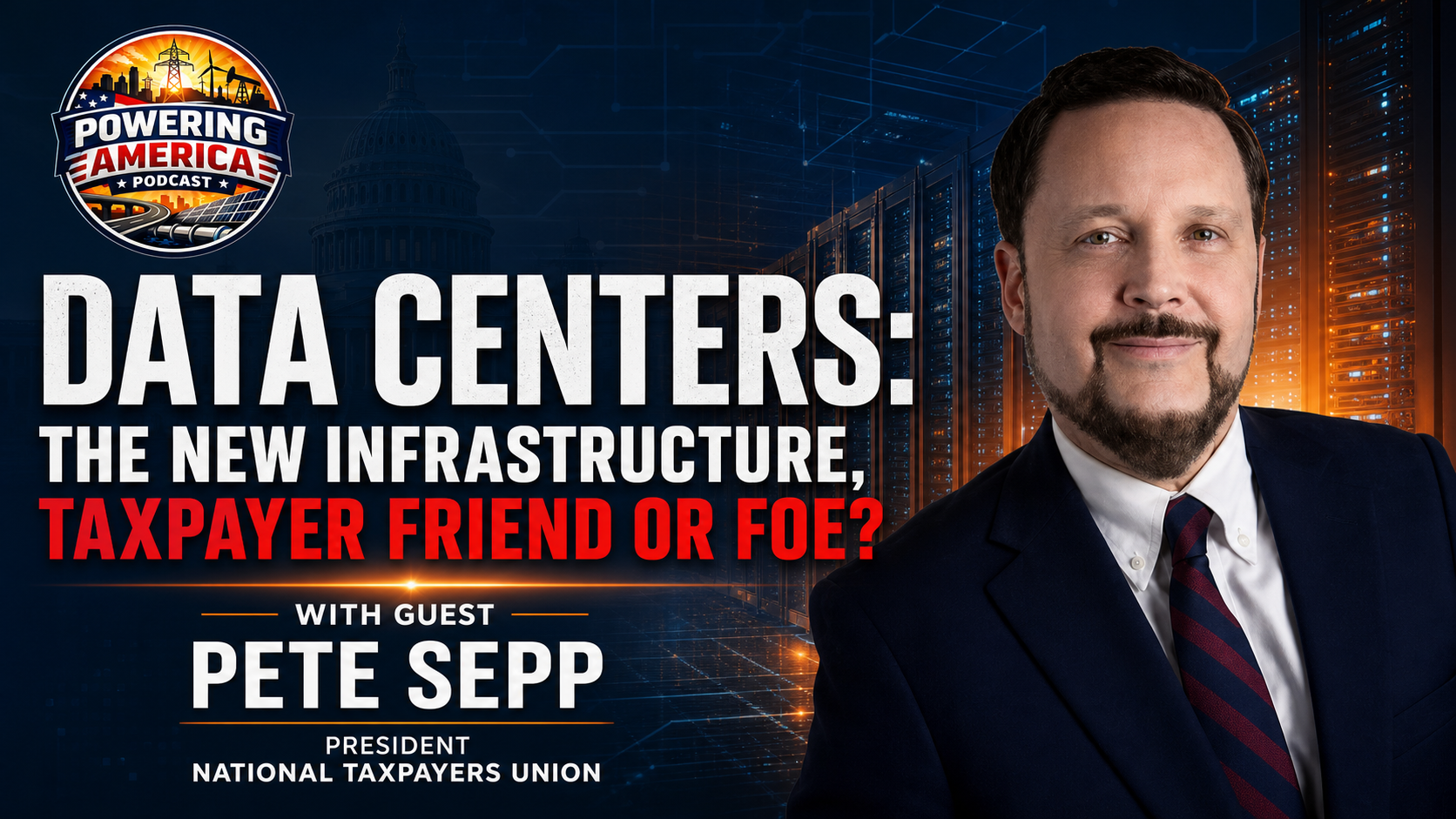
Powering America Podcast episode featuring Pete Sepp discussing Data Centers: Taxpayer Friend or Foe? Insights from Pete Sepp — National Taxpayers Union

In the latest episode of the Powering America Podcast, Bryan Hyde interviews Pete Sepp, president of the National Taxpayers Union, about the implications of data centers as a new form of infrastructure. Sepp discusses the economic impact of data centers on local tax bases, highlighting their role in contributing to public budgets and contrasting their benefits with areas that impose restrictions on their development. The conversation also addresses misconceptions about data centers and their relationship to taxpayer interests.

Data Centers: The New Infrastructure, Taxpayer Friend or Foe?

0:00 / 0:00

Data Centers: The New Infrastructure, Taxpayer Friend or Foe?

Data Centers: Infrastructure and Taxpayer Impact

In a recent episode of the Powering America Podcast, Pete Sepp, president of the National Taxpayers Union, discussed the evolving role of data centers in the U.S. economy and their implications for taxpayers. Sepp emphasized that data centers are becoming a crucial part of modern infrastructure, akin to roads and bridges, and he highlighted the complexities surrounding their impact on local economies and tax bases.

The National Taxpayers Union, founded in 1969, advocates for lower taxes, reduced government spending, and sensible regulation. Sepp explained that his organization focuses on identifying and addressing taxpayer concerns, particularly as policymakers navigate emerging issues like data centers.

Data centers serve as vital hubs for information, supporting everything from e-commerce to advanced technologies. Sepp noted that they are not merely sites for artificial intelligence but are essential for various aspects of the economy, including inventory management and digital storage. "Data centers are the new infrastructure for the rest of this century," he said.

Sepp pointed to Loudoun County, Virginia, as a prime example of how data centers can benefit local economies. This county, known as a data center hotspot, derives approximately half of its budget from these facilities, which fund essential services like schools and roads. In contrast, he described Montgomery County, Maryland, where local officials have imposed a moratorium on data centers. This decision has resulted in increased taxes for residents, illustrating how the absence of data centers can hinder economic growth.

The conversation also touched on misconceptions surrounding data centers and their tax implications. Sepp explained that while some local governments impose restrictions on data centers, these facilities can actually contribute positively to tax revenues. He emphasized the need for a nuanced understanding of how data centers compare to other industries regarding tax exemptions and incentives.

Sepp highlighted a study by tax policy expert Jared Walsack, which examined the treatment of data centers in relation to other businesses. He noted that while manufacturing equipment often receives sales tax exemptions without bureaucratic hurdles, data centers frequently face additional requirements. This inconsistency raises questions about fairness in tax policy.

The discussion also addressed public perceptions of data centers and the potential for shifting attitudes. Sepp acknowledged that while some communities resist data center development, providing accurate information about their economic contributions could foster more informed debates. He pointed out that data centers account for a small percentage of national electricity and water consumption compared to industries like agriculture.

Looking ahead, Sepp expressed hope for a more constructive dialogue regarding data centers and their role in local economies. He noted that as public awareness grows, there may be opportunities for more balanced discussions about infrastructure needs and taxpayer interests.

In addition to data centers, the National Taxpayers Union is focused on broader issues such as controlling government spending and advocating for taxpayer rights. Sepp mentioned ongoing efforts to pass the Taxpayer Assistance and Service Act, which aims to enhance protections for taxpayers dealing with the IRS.

For more information about the National Taxpayers Union and its initiatives, visit NTU.org.

Interview Q&A

Q&A: Data Centers: The New Infrastructure, Taxpayer Friend or Foe?

Data Centers: The New Infrastructure, Taxpayer Friend or Foe?

Q: Can you provide an overview of the National Taxpayers Union and your role?

A: The National Taxpayers Union was founded in 1969 to advocate for lower, fairer, simpler taxes, reduced government spending, sensible regulation, and economic freedom. As president, I develop strategic plans, serve as a primary spokesman, and identify key taxpayer issues.

Q: How does taxpayer interest in government policy fluctuate?

A: There is a baseline of taxpayer interest that shifts depending on current events. For instance, concerns about the federal income tax system peak around April 15, while property tax concerns arise during the summer. The interest in data centers varies based on local political circumstances.

Q: What should taxpayers understand about data centers?

A: Data centers serve multiple functions beyond just housing AI. They facilitate information storage and processing for various sectors, from personal data to business logistics. They represent a new form of infrastructure crucial for the information economy.

Q: Are data centers a financial burden or benefit for taxpayers?

A: Data centers can be net contributors to local tax bases. For example, in Loudoun County, Virginia, data centers account for about half of the county's budget, funding schools and infrastructure. In contrast, Montgomery County, Maryland, is banning data centers and experiencing increased taxes without the economic growth they could provide.

Q: What misconceptions exist about data centers and their impact on taxes?

A: There are misconceptions about the tax treatment of data centers compared to other industries. For example, while manufacturing equipment is exempt from sales tax in many states, data centers often face additional hurdles to receive similar exemptions, which is unfair.

Q: Do you foresee a change in public perception regarding data centers?

A: Public perception may improve as more factual information becomes available. Understanding the context of data centers' impact on energy and water use, compared to other industries, can lead to more rational discussions about their role in the economy.

Q: Is tax reform a partisan issue in the U.S.?

A: At the national level, tax reform is highly partisan. However, at state and local levels, tax issues can transcend party lines, especially as homeowners face affordability challenges. This may lead to more honest public debates about data centers and tax policies.

Q: What are some current priorities for the National Taxpayers Union?

A: One priority is to bring government spending under control, as excessive spending has contributed to national debt and inflation. We are also focused on taxpayer rights, advocating for reforms like the Taxpayer Assistance and Service Act, which has garnered bipartisan support.

Q: Where can people learn more about the National Taxpayers Union?

A: People can visit our website at NTU.org for more information about our initiatives and advocacy efforts.

Key takeaways

  • Data centers are the new infrastructure for the rest of this century.
  • Increased taxes without data centers, lower taxes with data centers. That's the bottom line.
  • There are misconceptions about policy at a very, very basic level.
  • If we put those things into perspective, we'll realize largely that data centers are getting the same and or sometimes even worse treatment than other industries.
  • At the national level, there is a lot of partisanship... At the state and local level, however, it is more complex.

About the guest

Pete Sepp

PresidentNational Taxpayers Union

Full transcript

Show full transcript
[00:00] Bryan Hyde: Welcome to the Powering America Podcast. I'm Brian Hyde, and today we welcome Pete Sepp, who is president of the National Taxpayers Union. Pete, I know that that title doesn't begin to do justice to what you do. Take a moment, if you would, and tell us just a little bit about who you are and what you do. [00:17] Pete Sepp: Sure. National Taxpayers Union was founded all the way back in 1969 to work for lower, fairer, simpler taxes, less wasteful government spending, sensible regulation, economic freedom at all levels. As president of the organization, I help to develop the strategic plans, also serving as a primary spokesman in addition to several other great folks. And I help to figure out what are the cutting-edge issues that taxpayers are most concerned about going into the future. And we have to stay ahead of that curve because policymakers could do very dangerous, Dumb things if we don't. [01:05] Bryan Hyde: I have to ask you, um, does the involvement of the U.S. taxpayer— does it historically ebb and flow, or, or do we find— is there a consistency in how many taxpayers are really involved in, in keeping track of policy or even helping shape policy? Sometimes it feels like— sometimes it feels like there's not a lot of interest, and sometimes it feels like, wow, people are united on this. [01:29] Pete Sepp: I think that there is a baseline of taxpayer interest and concern in all of government, but it shifts to various areas of government depending upon what's happening. Complexity of the federal income tax system naturally gets a little bigger press and a little bigger public concern around April 15th, or when property tax bills come out largely during the summer in most jurisdictions. People get concerned whether they're getting value for their local government out of those taxes that they pay. This data center issue that we're about to discuss is something that I see has no real way of being predictable as to where it's going to show up or when it's going to show up. It depends largely on local political circumstances. [02:24] Bryan Hyde: With, with that in mind, Let's talk a little bit about data centers, which are, I know, on a lot of people's radar screens. Maybe they're thinking as taxpayers, maybe they're just, you know, they don't know for sure what the data center means. But from a taxpayer's standpoint, what are some of the things we need to keep in mind when it comes to the current issues surrounding the creation and, you know, building and maintaining of data centers? [02:55] Pete Sepp: Well, the very first thing for all of us to understand is that data centers do lots of things. We like to think that, oh, this is where all that AI happens, where some nightmare scenario like The Terminator could come to life. That's really not the case. Data centers are warehouses, way stations, facilitators of all the information that now powers our economy. It is photos that you might keep in an internet account of your family. It's website maintenance for the local grocery store if you want to shop online. It is business traffic that you as a consumer may never see, but is vital to making sure that just-in-time delivery for inventories and whatnot keeps going the way it should. It's also housing computer power that will develop everything from new moon rockets to a new wristwatch. So it's really warehouses for the future, the information economy that includes AI. But there are many, many other things involved in it. And as a taxpayer, you have to understand that this is the future of infrastructure. You know, we think of infrastructure as roads, waterways, bridges, what have you. Data centers are the new infrastructure for the rest of this century. [04:36] Bryan Hyde: So let's talk about where does— where do people get it right and where do people get it wrong concerning what data centers mean, for instance, for their taxes? Are they a net drain on taxpayers or do they provide something of benefit to the taxpayers? [04:57] Pete Sepp: Yeah, they can actually be a net contributor to taxpayers. You know, we've discovered this in our own backyard here where National Taxpayers Union is located in the nation's capital. There's a county called Loudoun County, which is called basically the birthplace of data centers. No other place in the United States has as many data centers per capita as Loudoun County. It's barely 10 miles from where I'm speaking to you now. There in Loudoun County, the contributions of data centers to the local tax base now comprise something on the order of half of the county's budget. They are contributing to most of the new tax-funded programs that support schools or traditional infrastructure like roads. And so there, You are seeing a net benefit from data centers to the local tax base. Contrast that to where I live, Montgomery County, Maryland, also about 10 miles from where I'm speaking to you now. Their county council is banning data centers for a period of 2 to 3 years. They're actually working out those details. Well, I can tell you, Uh, nothing could be more in contrast to Loudoun County in terms of taxes. The county council has voted to take away a universal taxpayer credit against property tax, so every homeowner's taxes just went up by about $700. People will pay even more than that thanks to other tax hikes that the council is passing, primarily because There's no economic growth in the county where I live. And guess what? Data centers provided an opportunity to finally bring that economic growth to the county. And yet the council has gone backward and decided they don't want any of that. So increased taxes without data centers, lower taxes with data centers. That's the bottom line. [07:11] Bryan Hyde: I know there's a lot of misinformation or just misconceptions out there regarding data centers. And, and I'm curious, uh, what, what are some of the more, uh— you mentioned, you know, states that are, that are actually saying, okay, we're going to put a stop or a moratorium on data centers for a while. Are these some of the more extreme responses? I mean, I, first of all, I'd like to see what lines up with the actual reality, but secondly— [07:38] Pete Sepp: Yeah. [07:38] Bryan Hyde: It sounds like a lot of people may be acting on not so good information. and taking, you know, measures that may not be needed. [07:45] Pete Sepp: Yeah, that's right. And where you see it, I think, and this is both a red state and a blue state phenomenon, I don't actually see any ideological bent that says this part of the spectrum hates data centers, this part loves it. It's quite mixed up. But there are misconceptions about policy at a very, very basic level. One of the recent things we did was commission a paper by Jared Walsack, who is a very well-respected tax policy expert at the state level, been doing studies about various issues for years. And what he did was take a look at one area of policy toward business, sales tax exemptions, meaning that if a business buys equipment to make a good or provide a service, well, that equipment is exempt from paying sales tax because it's producing something that will eventually have sales tax charged at the cash register anyway. If you didn't provide that exemption, you would get a cascading or pyramiding effect to the point of something that works like a value-added tax. Consumers could not afford the final product if the initial thing that makes the product is not exempt from sales tax. Well, manufacturing equipment is exempt from sales tax by right in 41 states. The same type of equipment that data centers use to produce their kinds of goods and services— I guess you would call them that. It's information that moves through the system. Well, It's hit or miss out there in the states. There's something over 30 of these sales tax exemptions for data center equipment, but they are coming with all kinds of strings attached. If you're a manufacturer, you make automobiles, for example, and you need a giant conveyor belt. Well, if you buy that from another business, that's exempt by right. You don't have to apply to the government for the exemption. If you're a data center and you wanna buy new server racks to generate and house the information, well, chances are you're going to have to apply for it, and the government may or may not give you the exemption. That is unfair. They are the same types of inputs. They should be treated the same for tax policy. [10:32] Bryan Hyde: Do you see the tide turning anytime soon in terms of the public at the very least, getting a more nuanced view of what these data centers bring? Or is it always going to be a case of, you know, not in my backyard, that, you know, some people are going to push back against, you know, the creation of these kinds of centers? [10:55] Pete Sepp: Well, first I'll say, my county council in Montgomery notwithstanding, yeah, build it in my backyard. I'd really like my property tax relief back. I'm not sure how much longer I can afford to live where I am. But setting that aside, I do think that the more we introduce information like Jared's study into the debate to tell folks, yeah, there are sweetheart deals and subsidies out there for data centers, just like there are for big factories or shopping malls. They are not the norm. And so to have a rational discussion about tax policy toward data centers, energy policy, water policy, all of these things, we have to understand the context of what other industries, what other sectors of the economy get for tax preferences, tax exemptions, what they get for electricity prices and regulations, What they get for water use. If we put those things into perspective, we'll realize largely that data centers are getting the same and or sometimes even worse treatment than other industries. [12:16] Bryan Hyde: Interesting. Yeah, I mean, again, I guess depending on who you talk to, some people are like, oh gee, you know, the data centers are just running roughshod over everybody. But clearly there are ways that that this can be dealt with, that the, you know, keep the taxpayers in mind. You mentioned keeping, keeping water needs in mind. Um, generally speaking, are, are we— I'm talking about the nation as a whole— are we seeing more openness toward, uh, tax reform or tax relief, or is, is that still— is that pretty much a partisan issue? It's going to be this way with one party and You know, the opposite with the other. [12:58] Pete Sepp: At the national level, there is a lot of partisanship. It's very difficult to deny that. Just look at the One Big Beautiful Bill Act last year that passed, and there was no Democratic support at the federal level for that bill. At the state and local level, however, it is more complex. You know, when you're a homeowner, it doesn't necessarily matter who you vote for on the national ticket if you're having trouble affording where you live. And taxes are a big problem with affordability. So I think we're going to see some more honest public debates over things like data centers if we establish the baseline facts. If we say, okay, right now data centers account for maybe 4% of all electricity consumption in the United States headed towards 5%. The other 95% is driven by other types of industries and residents. Water use, same way. Agriculture uses 400, even 500 times more water right now than data centers, depending on the type of data center and what's being planted. You know, those are important facts to remember here, that still, even Even though we see data centers coming up in the news all the time, we see construction of them, and we see a lot of public protests over them, they just don't drive the main part of the energy economy or the water economy, and they're not going to in the future. [14:38] Bryan Hyde: Talk to me about what the National Taxpayers Union is focused on in addition to, you know, the data centers issue. What are some of the top priorities currently before your organization? [14:56] Pete Sepp: Well, here's a bipartisan one at the federal level. We have got to bring government spending back under control. We have seen spending in good times and in bad times in the name of helping to stimulate the economy. Well, it hasn't worked that way. In fact, it's put us even deeper in debt, has been a driver of inflation, which in turn, that arouses calls for more federal spending. We have got to break that cycle. Now, encouragingly, there's another issue we're working on, taxpayer rights when dealing with the IRS. There are all kinds of protections that we have lobbied for over the years. The latest is a package of reforms called the Taxpayer Assistance and Service Act. The Senate Finance Committee recently voted that out with a nearly unanimous consensus among Democrats and Republicans. Stands a good chance of getting enacted before the year is out if we keep up the pressure. [16:01] Bryan Hyde: Very nice. And, and for people who want to take a closer look for themselves at what the National Taxpayers Union is doing, Where can they find your website? [16:11] Pete Sepp: You can visit us at NTU, our initials for National Taxpayers Union, NTU.org. [16:19] Bryan Hyde: Again, we are talking with Pete Sepp. He is president of the National Taxpayers Union. And Pete, I appreciate you taking the time to especially pull back the curtain on, on some of the data center controversies. Thanks again for joining us on the Powering America podcast. [16:35] Pete Sepp: Sure, my pleasure.

Filed under