Show full transcriptHide transcript
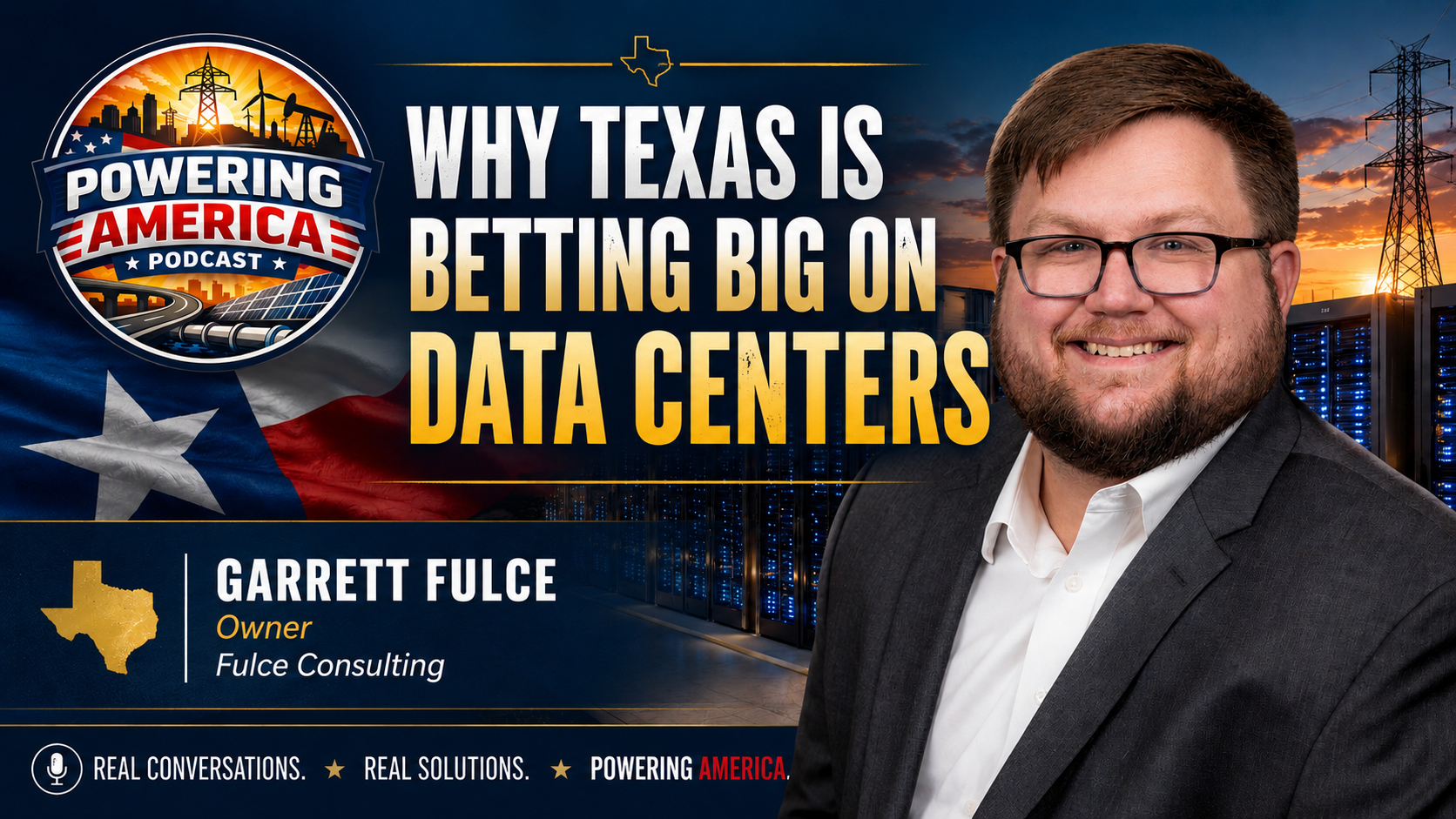
[00:00:00] Recording in progress. Welcome to the Powering America podcast. I'm Bryan Hyde. Today, I'm joined by Garrett Folse. Garrett is the, uh, owner of Folse Consulting and the host of Seeing Red, a Texas politics podcast, also a Young Voices contributor. And, uh, Garrett, great to have you on the program. Uh, before we delve into our topic, which is going to be a little bit about what, uh, other states and localities might learn about data centers from Texas, let's talk a little bit about your background, who you are, and what you do.
Yeah. So I've been working in politics on, on the campaigns and in the legislature and, you know, in DC f- uh, for my entire career, so for about 15 years now. Uh, born and raised Texan, sixth, seventh generation, depending on how you wanna count certain things. Uh, if you wanna get into that, but it skipped a generation at one point on one side, but I have it on the other, so it depends on how you wanna count it.
I think the seventh. Um, [00:01:00] and, you know, just been a Texas politico for the past few years. I started the podcast, uh, started the consulting company where I, you know, advise people, uh, candidates, uh, various entities on, you know, how to get their message across in Texas. And you know, I, I wanna preface our discussion today with the idea that right now data centers are on a lot of people's radar screen, um, and there's a lot of mixed, uh, reactions.
Um, some people are very nervous about data centers coming in. Um, I think a, a massive center was just announced in Utah that had, uh, you know, people almost up in arms over it, so a lot of different reactions. But the reason we have you on the Powering America podcast here today is to talk about, uh, Texas and how Texas either is or, or should respond to, to data centers.
And, and, and first we have to understand a little bit about the history of Texas. Um, you know, data centers are, I- as I understand it, the [00:02:00] next kinda big thing to come along in terms of they are gonna be a part of our world from this point moving forward. Talk to me about some things in Texas' past that, uh, that likewise were, were world changing.
Sure. I mean, obviously Texas is a, a world leader, uh, if not the world leader in oil and gas, both exploration, refining, uh, moving it around, uh, largely due now to the Permian Basin, but also because of other basins that were discovered earlier, like Spindletop in, uh, the, near the Beaumont area. And that boom, really, and that exploration was made possible by railroads that had been, you know, been crisscrossing Texas for, at that point, 30-ish years, uh, because of massive cattle drives and getting ex- uh, agricultural products to market, uh, and also just being where it's gra- geographically situated.
So Texas had invested [00:03:00] One of the companies had invested in railroads throughout Texas, and when the oil boom happened in Texas, it was really easy to get cheap oil to market on the East Coast. Uh, so Texas was ready, willing, able because it had that railroad network to then move the new product on. And in a lot of ways, the data center boom, and then also a, a part of that is also the, the kind of the microchip, uh, reshoring that's happening because of the CHIPS Act and because of other legislation, uh, is a major, uh, focus here in Texas as well.
There's a lot of, a lot of different companies coming to Texas to manufacture and then to, uh, use those manufacturing in, uh... sorry, in data centers. And talk to me about, uh, water. When, when, when people were settling Texas- Sure ... as, as Texas was becoming, you know, the republic that it is, um- Talk to me about how, how they, they approached their, their water problems.[00:04:00]
Not, not exactly a place where, where there's a ton of water, is it? No. So Texas, uh, the, the depictions of Texans are pr- of Texas are pretty accurate where it c- it can be really dry. Now, East Texas is very much like the rest of the s- the, the qu- the traditional South in that it's humid and there is a good amount of rain, but Texas is massive, as everyone knows.
And but a lot of the population centers are on that edge, so there's a lot of population where there isn't water. So there have been constant water fights in Texas, and part of that water fight's come to the fact that we have to dam the rivers in order to build reservoirs, what we call lakes. There... We only have one l- real lake in Texas, and we share it with Louisiana.
Um, and so all the rest of them are manmade reservoirs. So those are done for two reasons. One is water, but a big portion of that is flood control because when it rains in Texas, it really rains. I mean, we've had stories in the past year of major flooding in Texas, uh, on a [00:05:00] river that's does... in a part of a river that is undammed.
So, um, those floodwaters ripped, you know, m- carved Texas, and we had to figure out a way to keep that water. And that water fueled the booms that came because of oil and gas, because of cotton, because of, uh, railroads, because of whatever else has happened in Texas over the past 150 years. All those things have occurred because we had to end up finding water to f- to f- to, uh, was it thirst those people, to get those water
people, uh, their... drinking water, I guess. Keeping those people hydrated. So I, the reason I ask you this, I want to set the stage for, for talking about, uh, data centers, the point being that, uh, Texans have built in the past, and, you know, for, for, you know, the dams and, and things that came along, the, um, oil and gas production, the railroads, um- Texans found a way to build and make it a part of who they [00:06:00] were.
Now let's talk about, uh, data centers. I, I assume you're probably seeing some of the same back and forth that's happening in other parts of the country. Um, first of all, let's, let's talk a little bit about, uh, the prospect. Are there, are there plenty of data centers coming to Texas and, and what's the reaction of the people there?
Yeah. So currently Virginia's the leader when it comes to just number of data centers built by whatever metric is being used, I guess a number of servers versus buildings. Uh, Texas, when you account for things that have been announced, both in Virginia and Texas, will take the lead sometime in the next 10 years with billions upon billions upon billions, probably close to trillions now, in, um, announced projects.
Those announced projects, if they all come on board, would require an additional... w- would, would require quadrupling the amount of electric capacity, uh, in Texas, which is [00:07:00] possible. Uh, Texas, uh, is also, I believe, 'cause I know we're bigger than California, I believe we're the biggest energy consumer in the country.
Uh, but it probably isn't even close. So, you know, they are da- they are electric- electricity hogs. They're also, to a certain degree, water hogs, because it takes water to cool these massive centers down. Now, technology's come a long way since these centers first started popping up, and a lot of them now, uh, have what's called a closed loop technology.
So they do a one-time pull of water, and they don't have to pull in that much water o- on an ongoing basis because it's in a closed loop. The water doesn't evaporate out of the system. It's able to, you know, cool down the server farm, then lose its heat somewhere else and vice versa, or, and just keep that cycle going.
Uh, so water's less of a concern if, if that closed loop technology is on board. But there are also technologies now where that, uh, there... some of these p- uh, data [00:08:00] centers are able to produce more usable water than they take in, and that's because they are a- they don't have to use, you know, water w- uh, from the utility that's ready to be drinking.
It doesn't have to be... they don't have, they don't have to have drinking water. Um, so they can, because of that process, they can turn some of that water into potable water or water that's more able to be quickly used for drinking by, down downstream. So these are all considerations that are being taken and, you know, the reaction to it is this kind of...
the same thing you're gonna get from people all the time, where you're gonna have folks who are scared of new technology, who want things just to stay the same and they're kind of however they were and just everything's gonna just be okay, um, mentality. But So that's where a lot of the stuff comes from.
Then you have people who are just anti-big business or anti-technology for whatever reason, and they look for then an excuse to stop the policy that they [00:09:00] want to ta- you know, that they want to, to stop. Um, so, you know, you have that kind of weird coalition. I call it, I call it a farriers union 'cause farrier, farriers are the ones who, uh, sh- shoe horses.
Right. Uh, and there's the horseshoe theory of the far right and the far left coming together on certain things. So any time the far left and the far right are coming together, I call it a farriers union. Um, so you have that kind of group of the, the fringes coming together to, to push back on this, and I think it's...
You know, most people are okay with it. Uh, they don't want it to be next to their house necessarily, but they understand or they're starting to understand that this stuff isn't just the backbone of AI, it's the backbone of everything. All of our storage, video conferencing, e-commerce, everything to do with the modern internet and the data that it requires is because of these data centers, and that's why...
I mean, I think I saw the other day that Meta is, like, fully, like, betting on, [00:10:00] on this to the, to the point where, like, their executives won't be taking compensation unless they hit certain benchmarks that they think are gonna come about because of AI, uh, and because of the data that is fueled by it. So, you know, these are...
That's where these people are, the people with the... It's for people who are putting their big money on it, on a... And they're betting that, uh, this is going to be, like, the, the future. And I think that it's, you know, prudent for, for states where possible to if not outright facilitate, at least not hinder, uh, that development.
And, you know, a lot of this development happens in unincorporated areas, uh, w- so they're not in the cities, kind of out in the country. Uh, so people out in the country don't want, you know, their life disturbed, but you live out in the country because you don't wanna have restrictions on your property either.
So, you know, like, there's pros and cons to not having those, those restrictions. Well, yeah, and it sounds like it's not necessarily Luddites, you know, that are, they're anti-technology, but, but [00:11:00] there's some quirk of human nature that's like, "Ah, new. I don't understand this, and therefore I'm suspicious of it," or, uh, you know, something along that line.
And, and so they, they can't really sign on, on board. Um, what have you seen that, uh, has, has given you, um, the most solid footing to say, "You know what? Let's lean into this. This i- this is a good thing, and this is something that's, uh, that's gonna be with us, you know, moving forward"?
I see it... Uh, there's not one thing that I've seen except for just the explosion of the, the use Of AI on the corporate side of things. Um, you know, people talk about how they may not use it pr- that much, um, but when I'm looking at kind of passive conversations with folks, uh, outside of a corporate context or people who are talking about what they do at work, if I, if you actually ask them how they're using an AI at work or just to do stuff, [00:12:00] it, it's everybody, and they're doing it to one degree or another, and it's a, it's usually a lot more than they think, um, when you get really start actually having a conversation about it.
They may not, they may not have ChatGPT doing all their work for them, which is probably wise, but they are using tools along the way that are gonna, that are w- are working off this backbone, and I see it as this is going to be... It's a, it's a massive step in efficiency for a lot of work product, um, being able to be generated that it's going to be similar in my mind.
It's similar in my mind in scale and scope, uh, to just what the Industrial Revolution, um, did to, you know, eight- 17, 1800s, the Western world, um, in that there's that much efficiency gains, uh, on kind of thinking creative work, uh, that we just never really were able to do [00:13:00] with an assembly line type thing before.
Now we're w- th- with, with generative AI, AI and other tools that are being derived from it, like I th- I'm starting to see that. I think it's a worthwhile bet, and a lot of other people are ma- making that same bet. Well, and, and from what you had mentioned earlier, it sounds like this is historically when something comes along, whether it's transmission lines, whether it's pipelines, reservoirs, you know, railroads, whatever, th- there are the skeptics, there are the naysayers, and, and probably when the next big thing comes along you know, after AI, there will still be that.
But let's talk about, uh, Texas in particular seems to have, have found a way to, to make these things work and, and I'd, I'd love to explore what are some of the lessons that, um, other states could learn from how Texas has, has approached those objections to, to new technology coming along and, uh, what, where's a good place to start?
It comes, or, or a good place to start on, on, [00:14:00] um, I would say generally a lot of it comes to the culture of figuring it out. Like we talked about the dams and the w- water problems in the, from the past, but Texas is at the forefront of those transmission and pipeline fights. And because of that, we have a regulatory structure that takes into account homeowners, uh, property owners, and affected communities without giving them a veto So there's a realization that some people will be impacted one way or the other.
I don't... If somebody's, has a direct impact, I'm not going to say that they're wrong to be against it because, I mean, that's a different thing than the whole of a policy. And Texas has taken that, that lens of, uh, giving them a voice, allowing them, those folks have a voice, and some things have been, have been, um, killed or, uh, c- things have had to move.
Uh, I think [00:15:00] two examples come to mind, both having to do with trains. Uh, a high-speed rail project has been in the works for, uh, like in a lot of places for a number of years. It got some, m- made some ground in the past couple decades and then, uh, uh, people along the route in the kind of between Dallas and Houston were able to have effectively, I believe, killed it for the s- for the time being.
Uh, similarly in Austin, they passed a massive, what they call Project Connect bond, um, like several, several billion dollar bond that largely included a new, uh, light rail, commuter rail system that goes through downtown, and they've... The- there's been community pushback even since that bond passed, um, to a routing.
And some routing got, has been pushed around, um, and a good chunk, about, I think, 30 to 50% of that rail is currently not being pursued because of how it would impact certain communities, uh, along the, along the route. So that's one way, is you have to... [00:16:00] Like, unlike California, which gives a veto to basically any group, rather they're, uh, where they can give standing to basically anybody to bring a lawsuit, uh, that can put these kind of projects on hold for indefinitely, uh, Texas has figured out a way to give those people a voice in the process without giving them the veto, and I think that's a, that's probably the biggest thing.
Uh, the other major thing that should go un- that should be said is Texas isn't on the na- international grid, and so has less regulation when it comes to putting electricity, new electricity onto its grid. That isn't to say that it has no regulation from the feds, but it has less when it tank- when it take- when it comes to putting stuff on it, and that's important when you're talking about n- just reducing the number of permits necessary to get a new power plant up and running.
It sounds like there's a generational dynamic at work here, too, in that, uh, the people who first came to Texas as well as the people who continue to come to Texas and are, are, uh, you know, have built it up [00:17:00] over, over the last couple hundred years, um, they, they seem to have an attitude of, uh, they didn't come there because everything was, was done for them and, you know, it was a comfortable, cozy place to, you know, just rest.
They came there determined to, to make something of it and, uh, in other words, they're, they're not afraid of, of doing the work of building. Yeah, Texas isn't particularly, like the state of... Despite Texas meaning the word friendship in, uh, a Native American language, uh, it isn't a particularly friendly, uh, domain when it comes to the weather or the, uh, the, the top topography or anything like that.
Uh, it can be kinda hostile with the heat and hurricanes and tornadoes and, uh, uh, the hail storms. Um, it's a hard place to scratch out a living, but there's a lot to, there's a lot to be gained. Uh, so people always kinda looked who got here, saw that there was, that there was stuff to be gained, but it was gonna be a hard, hard row to [00:18:00] hoe.
And y- like, so like you said, uh, Texas has that kind of ethos that kind of self-perpetuates and then it attracts people with a similar frame of mind, plus the people who grew up here and have it from, you know, growing up in it. So yeah, there is kind of a, like, don't tread on me, like, come and take it a- attitude that just permeates the mentality of the, of the folks here for the most part.
Now, like every place, we're gonna have our naysayers and our, and our kind of people who are trying to pull us to do, do things the way they want, want, do things the way they want you to. Uh, but I think largely speaking, we've set up a regulatory environment that's predictable, that businesses can rely on that, you know, whether how stringent it is, like, there are...
Actually, Texas isn't rated as a particularly deregulated state. It just doesn't change its regulations all the time. So businesses are able to know what the regulations are going to be. [00:19:00] Uh, and when they sign a deal that's gonna take place in 5 to 10 years, those deals end up happening because there hasn't been a million different changes to the laws or regulator or whatever in that intervening, intervening time period.
So Texas is able to continue building. Well, it sounds like, uh, there's, there's a lesson by example of, uh, moving forward with confidence, not recklessness, but confidence and, uh, you know, a- addressing- Mm-hmm ... the new challenges as they arise. I can only hope that, uh, other states are watching Texas's example and, and, and may take a little bit of courage and confidence from that.
Yeah. I think, I think other states should always look at T- a Texas example, but I think, like you said, it, it's with confidence. It isn't with, you know, reckless abandon. Um, but the folks who built this state, some of them did have reckless abandon, and they took that risk, and the ones that survived to tell the tale-
were the ones that, you know, you know, we kinda look to, uh, to, in some [00:20:00] regard. So there is, you know, there's moving forward and there's sometimes you gotta have those people who are going to be a trailblazer, and Texas has never had a problem blazing trails. Again, we're talking with Garrett Folse. He is the owner of Folse Consulting.
He's also the host of Seeing Red, a Texas politics podcast, and a senior contributor at Young Voices. And, uh, Garrett, thank you so much for joining me today on the Powering America podcast. Thanks for having me, Brian