Show full transcriptHide transcript
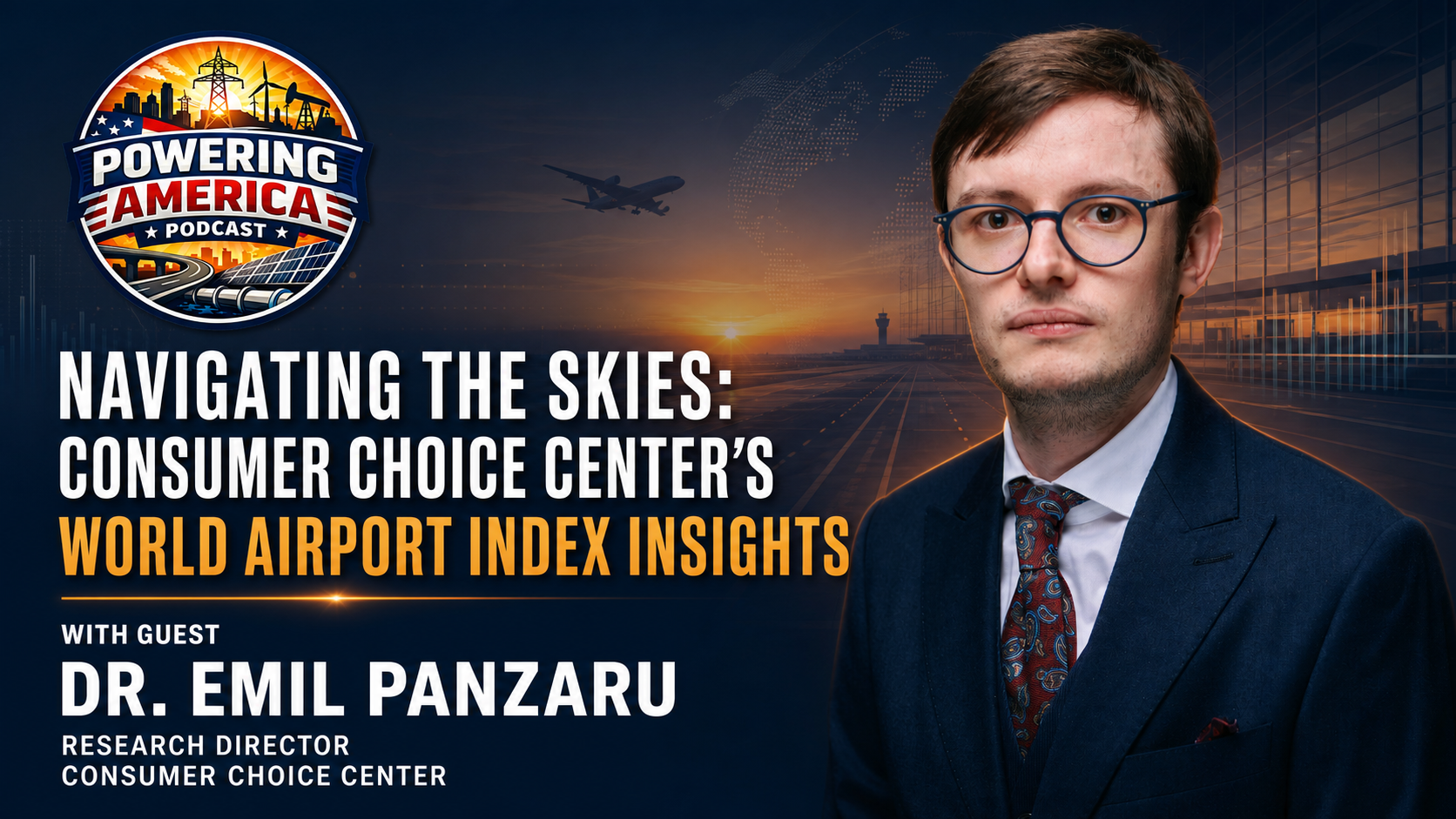
[00:00] Bryan Hyde: Welcome to the Powering America Podcast. I'm Brian Hyde. Today I'm joined by Dr. Emil Panzaru. He is Research Director for the Consumer Choice Center. Emil, it's wonderful to have you on the program. Take a moment, if you would, tell us a little bit about yourself and about your background.
[00:16] Dr. Emil Panzaru: Thank you very much for having me, Brian. So as you mentioned at the beginning, I work for the Consumer Choice Center, which is a public advocacy group that supports abundance, lifestyle choice, and innovation in consumer policy. We work in 100 countries around the world, including in the United States, and I work there as research director, which means I oversee quite a lot of what the CCC produces in terms of output of research. So policy primers, anything from policy primers to things that we want to show to policymakers to make a good difference in the world. I tend to look over it a bit like Jack Horton and finger in every pie in terms of what I look at.
[01:02] Bryan Hyde: You know, I think our topic today is going to be of extreme interest to anyone who travels internationally. My understanding is the Consumer Choice Center does an annual World Consumer Airport Index. Could you maybe set the stage for us by telling us about, first of all, what this study is and then why is it done?
[01:23] Dr. Emil Panzaru: Very much so. My pleasure. So this is the second edition of our world edition of the index. So it used to be just a thing for Europe, but then we realized that we could extend it for the rest of the world. So now for this latest edition, we're looking at 60 different airports across 14 different categories, from how much does it take to get there by car to the airport by car to Can you do ride-hailing? Is there an on-site hotel? What sort of services are waiting for you there? What sort of shops and restaurants, right? People care about duty-free shopping. They should know, they have a right to know what they can expect from restaurants or these sorts of things at their destination. So many, how crowded the area is. Is there a lot of passengers they have to fight through for the shops and restaurants to get anywhere? We know how tiresome connections are, you know, from terminals to gates. Oh my God, I have to take the shuttle bus, that shuttle bus, that big, big, big sort of monster truck type thing. Do I have to ride in one of those again? What do I do, right? Is it a smooth ride? Is it just a tunnel that I go through directly to the terminal? Bada bing, bada boom, everything done. So we really care about consumer comfort and choice and and safety during their time at every airport. It was summer, so we really wanted to get consumers a leg up to see, compare how do American airports fare compared to worldwide airports? What can they expect in worldwide airports? Are there any nasty surprises in terms of services or lack thereof? Nighttime curfews are important in that sense. Right. Very practiced outside of the United States, where certain countries will not allow certain runways or even the entire airport to run any sort of flights after 11 o'clock p.m. local time. What do you do? Right? Like it's pretty difficult. You're on a business trip. Have to plan the business trip around that. That's not very productive. Or you're trying to try to meet up with friends and family abroad. It's going to be a nightmare doing a really long flight. You have to organize everything around that. for nighttime restrictions. So the little things matter and they add up to the big things and the big things matter too.
[03:47] Bryan Hyde: You know, I've been looking over the World Consumer Airport Index for 2026 online and this is really comprehensive, but I have to ask you this. What surprised you the most about this year's index?
[04:01] Dr. Emil Panzaru: So we look at all these 14 categories, they kind of mentioned, you know, some of the examples in passing, but The thing that really surprised me was, I mean, Dubai's performance in terms of delays this year. So I think most listeners are aware that there is, there is an ongoing war in the region. The United Arab Emirates, where Dubai is based, is caught in the crossfires of that conflict between Iran, Israel, and the United States. So they're somewhere in between. They've had their main airport, Dubai International Airport, targeted by drones. Doing these attacks directly targeted by drones, and despite everything, when they did manage to to open up, they had zero percent delays when we measured them on the 30th of May 2026. I did not expect that. I absolutely did not expect that. That is quite incredible in terms of performance, and they managed still to be you know despite everything that happened. Despite all their problems, they still managed to score pretty well in terms of the overall performance that they had. I mean, they had around— they were 22nd overall in the rankings and around 10th among largest airports, which is this category that we measure for like airports above 47 million passengers. So, wow. Despite everything, that was quite impressive.
[05:27] Bryan Hyde: Yeah, that really is. I mean, I know that there are always unexpected circumstances, weather and so forth that can arise, but that's slightly more complicated and much more dangerous. Talk to me about some of the airports that stood out to you in this year's index and why they stood out.
[05:45] Dr. Emil Panzaru: Right. So for all our listeners in the US, my second surprise was actually how well LAX, LA International scored in the overall index. So it was 8th overall and like 3rd among the largest, right? You know, LAX doesn't necessarily have the best reputation, to put it sometimes lightly, in terms of the fact that, you know, consumers do always report it's very hard to get to. And that comes across in our index as well, like 30, 30 kilometers, quite a substantial amount of miles to get to the, to, to the airport. Not that great on-site airport, lack of rail connections to, to the airport compared to other airports that tend to have these sorts of things. Which means that in the horseshoe layout of LAX, kind of all combines to make it kind of congested and not very— not always the best experience for consumers. But the interesting thing about our index is, besides the fact that we're comparing to other airports which might be faring even worse, is that this year we wanted in our statistical methods to really capture the fact that we don't just want to grade some airports great because they do very badly or very poorly or great in some one category alone. So you want it to reflect like, what do consumers really prioritize and what do you— what do these— are these airports capable of delivering? So certain airports which provide quite a lot of services overall score quite well, even though they might have certain blemishes, which explains why LAX is quite high.
[07:24] Bryan Hyde: I know that we don't want to play up, well, and this was the worst airport, but let's talk about the best and worst in terms of this index. We'll try not to bag too much on the ones that came out on the lower end of the scale. But for those who do travel internationally, what are the airports they should be happy they're traveling to? What are the ones they might want to take a, take a breath and fortify their courage before they go ahead and book the flight?
[07:48] Dr. Emil Panzaru: Okay, I started off with good surprises, so I'm going to be the pessimist and talk about some great ones. And among those, unfortunately for Germany, is Frankfurt Airport, that is one of the largest hubs in Germany, which has had a lot of operational issues. They were really, they were really, really eager to have these sorts of connections between Terminal 3 and the other terminals. Terminal 3 has just been opened, and they wanted to have a Skyline train connecting these terminals instead of buses or all these sorts of things to make people's lives easier. Supposed to, you know, carry around 4,000 passengers. Well, it broke down and it doesn't work. And that's just the start of infrastructure problems for Frankfurt Airport. I mentioned that Terminal 3 is done. Well, Terminal 3 was supposed to be done like years ago at this point, and they've still been struggling with it. They had a rodent infestation the previous year that we looked at this, and a mouse chewed through cables and led to delayed flights, which is probably the worst sort of anecdote you want to hear in an airport. Like, you know, my dog ate my homework, my mouse chewed my cables. And that interrupted flights. So that is unfortunately for poor Frankfurt not so great performance. And there are also other things at Frankfurt in terms of organizational delivery. I was there very recently at the end of July. And I was waiting to get my bags delivered after the flight, my checked-in bags. And the screen just flickers at baggage reclaim and says you've got 2 hours to wait for baggage Delivery. I did a double take. What? And then it switched to 45 minutes. Just 45 minutes. What again? And I just sit there for 45 minutes until they deliver my baggage, which I mean, it's kind of I haven't experienced that before, unfortunately. Of course, to balance things out for Germany, Düsseldorf is our top airport and has been for for quite a number of times now. They they rank among the the best. They are quite a small airport, but despite that, they have. a lot of competition on sites for the types of airlines that they deliver on. So like they have literally hundreds of destinations and 67 airlines and 171 destinations that people can fly to, which is quite a lot. But yeah, it's quite amazing because that compares even strongly to other major airports in the United States. Like some, some US airports have much fewer airlines than they actually service. So for instance, uh, to take something like Atlanta Hartsfield-Jackson, so one of the largest, only 28 airlines compared to 67 from Düsseldorf. And Düsseldorf is a small airport. That's quite, you know, Düsseldorf is a Mighty Mouse punching above its weight. So we were happy to see it come back among the best.
[10:57] Bryan Hyde: I can't imagine the complexity that it takes to run, you know, an airport large or small. But you were mentioning these top airports. We're talking, what was it, 40 million, 44 million passengers a year?
[11:13] Dr. Emil Panzaru: Yeah. Yeah.
[11:14] Bryan Hyde: That's a lot of people to be moving through. If you break that down, even divide by 365, That's a ton of people.
[11:20] Dr. Emil Panzaru: And that's, you know, those are the small airports in our index. We're not talking about behemoths like Hartsfield-Jackson or all these like major, major, major places with like hundreds of billions of people. Wow.
[11:38] Bryan Hyde: Let's switch over to— let's come to America and talk about American airports. What do they do well and what could they do better?
[11:47] Dr. Emil Panzaru: I already mentioned one of them, like no nighttime curfews. So that's, that's a very big, big plus for, for American airports. Uh, the other thing is generally very good ride-hailing services, all these sorts of integrated apps that they do. Um, one thing, one sore spot that, that, uh, is surprisingly sometimes the lack of competition. So among airlines. So we measure that by looking at percentage of seats that the biggest airline offers compared to like total capacity. So like in the case of Atlanta, since I mentioned that, Delta Airlines covers 75% of all seats offered. That's huge. That allows Delta to just dominate that airport. American Airlines does the same, even more, 85% for Dallas-Fort Worth. So that, you know, and that metric in our index is sort of the one that correlated the most to what consumers wanted because competition essentially allowed consumers to have their best pick of where they want, which airport they wanted to choose to have like the type of flights and connections that they wanted. So if it's just one, Airline dominates an airport, that really shrinks possibilities. You just have to depend on what Delta or American Airlines have to offer.
[13:16] Bryan Hyde: Emil, you talked about, you know, the delay in baggage claim, and I know that's a huge concern for anybody traveling. Am I going to get to the same place as my luggage? Who comes out on top in terms of who— what airports have the best record for getting people's baggage to them correctly and maybe even doing it in a timely fashion. We could also take a look at who are, who are some of the worst offenders not being able to do that.
[13:44] Dr. Emil Panzaru: In terms of wait times and these sorts of things, we've looked at security wait times, we've looked at average delays, which of course can also influence baggage reclaim. And, you know, just looking at the top 5 with our index is going to give you a pretty good idea of who performs very well in these, these respects overall. I mentioned Dubai, you know, 0% delays. Wow. And particular airports that also have a reputation for good service, like Singapore's Changi, for instance, they have a very, very good reputation for these sorts of things.
[14:17] Bryan Hyde: And among the worst offenders, as far as if you're going to travel with baggage, maybe travel light, what are the airports that you should be cautious? About.
[14:29] Dr. Emil Panzaru: I already, I already mentioned poor Frankfurt, but there are also the other ones at the bottom of our list, like London Stansted, that I've had poor experiences with, uh, uh, Punta Cana in the Dominican Republic. These sorts of airports that have trouble because in the case of Punta Cana, though, it is a private, private airport. There are essentially 2 airports and you have to like manage between A and B on the spot. There's no like clear delineation there. It can get very, very unclear to everyone traveling at that point. So that's a sort of minus, you know, bad, not very clear layout for connections can always trip you over, of course, on any trip and trip anyone operating there as well. As you said, it's a complex affair. If one thing goes wrong, there's going to be a daisy chain of effects making most things wrong, which is why for the worst airports on the list, those bottom ones, they kind of correlate with like worst performance overall, like across the board in multiple things.
[15:36] Bryan Hyde: It sounds like there would be strong incentive for all of the airports to kind of learn from one another what works and what doesn't. Do they sometimes copy one another's systems or say, we want to standardize, you know, like they you know, like the systems that they're using? And if they don't, why wouldn't they?
[15:55] Dr. Emil Panzaru: Right. I think, uh, I think they don't do as much of that as they should simply because the— I mean, this is one of the gaps that our index is designed for, which is why— which is that people don't really know what's happening in other countries because there are different regulatory frameworks. So different ways that these get— things get regulated. You know, in Europe, you've got some regulation around baggage— about baggage size and so on. or these sorts of environmental regulations that put limits on like fuel capacity and so on influences fleet capacity locally, which influences airport space and parking space for a car, for, for airplanes and, and so on, which then again influences delays and logistics around that and so on and so forth. And all these things sound like things that sound like all these factors, can we really put them together? It turns out you can. Statistically, but it's quite difficult. And then you need to present it in a way that everyone could understand and relate to and be able to make, you know, valid comparisons where they're comparing the same thing. They're not comparing apples with oranges. And also that they just, you know, sometimes people just don't know. They just don't realize that things might be different. They might be different in other states within the United States, and it might be different outside of the United States. They might not know either. And part of why we came up with the index is precisely for that, so that both policymakers and consumers, you know, get ideas. You know, things might be different. They might be better someplace else. Delta doesn't have to have 75% of Atlanta Hartsfield-Jackson. You could have different airlines. You could, you could use apps for like airplanes the way that Europeans do, or Europeans could realize that, you know, Nighttime curfews have not disturbed, you know, Americans at all or other countries. And, you know, Japan doesn't really operate with this, or, you know, or, you know, how do people handle these things in Korea where they might handle traffic across, you know, several peninsular areas? How do people come up with answers in different parts of the world and what can we learn from them? Are they translatable? Maybe yes, maybe no, but it's worth knowing to know that they are translatable or not.
[18:15] Bryan Hyde: What's the key takeaway from this World Consumer Airport Index for this year?
[18:20] Dr. Emil Panzaru: It's the fact that airports continue to break records in terms of number of millions of people flying. We've seen that at Heathrow. We've seen that in other places around the world. We've seen that at Dallas-Fort Worth. We've seen that in the US. We've seen it in Atlanta. We've And despite this much traffic, despite there being an ongoing war in the Strait of Hormuz closing and therefore fuel being more difficult and aircraft becoming quite aged in terms of their rollout, which could cause also issues in terms of repair time. Despite all that, things are, things are looking up. The best airports continue to adapt and survive. You know, they, uh, they are really weathering the storm. They've had such a hard time during COVID and things seem to be coming back and even coming back stronger.
[19:17] Bryan Hyde: And where, where can people access this, this report from the Consumer Choice Center?
[19:23] Dr. Emil Panzaru: Sure. So it's available on our website. You're going to see there also a dashboard so you can navigate the data for yourselves and on the webpage for World Consumer Airport Index, where we've got everything listed and more. We've got the database and the full reporting methodology there, as well as the breakdown, like which airports were in focus, the about research, and more about how we measure the way we measured, including nerdy formulas for everyone if they want to check that out. They're really, really curious and dying to know. what the Ivanovich distance method is in statistics, they can figure that out there. You've got the fancy math. You've got the explanation for all the factors. What do we mean by ride-hailing? What do we mean by distance? What do we mean by easy connection? What does that mean? You've got all that explanation and more in the report itself.
[20:23] Bryan Hyde: Again, we have been visiting with Dr. Emil Panzaru. He is research director at Consumer Choice Center. Thank you so much for joining us today on the Powering America podcast.
[20:34] Dr. Emil Panzaru: Thank you so much for having me.