Wednesday, December 31, 1969 · The Powering America Podcast
Powering America Podcast logo
← Powering America Podcast

2026-04-21 · Polar LNG

Joel Riddle on the Economic Impact of the Polar LNG Project: Part 2

with Joel Riddle, CEO, Polar LNG — Polar LNG
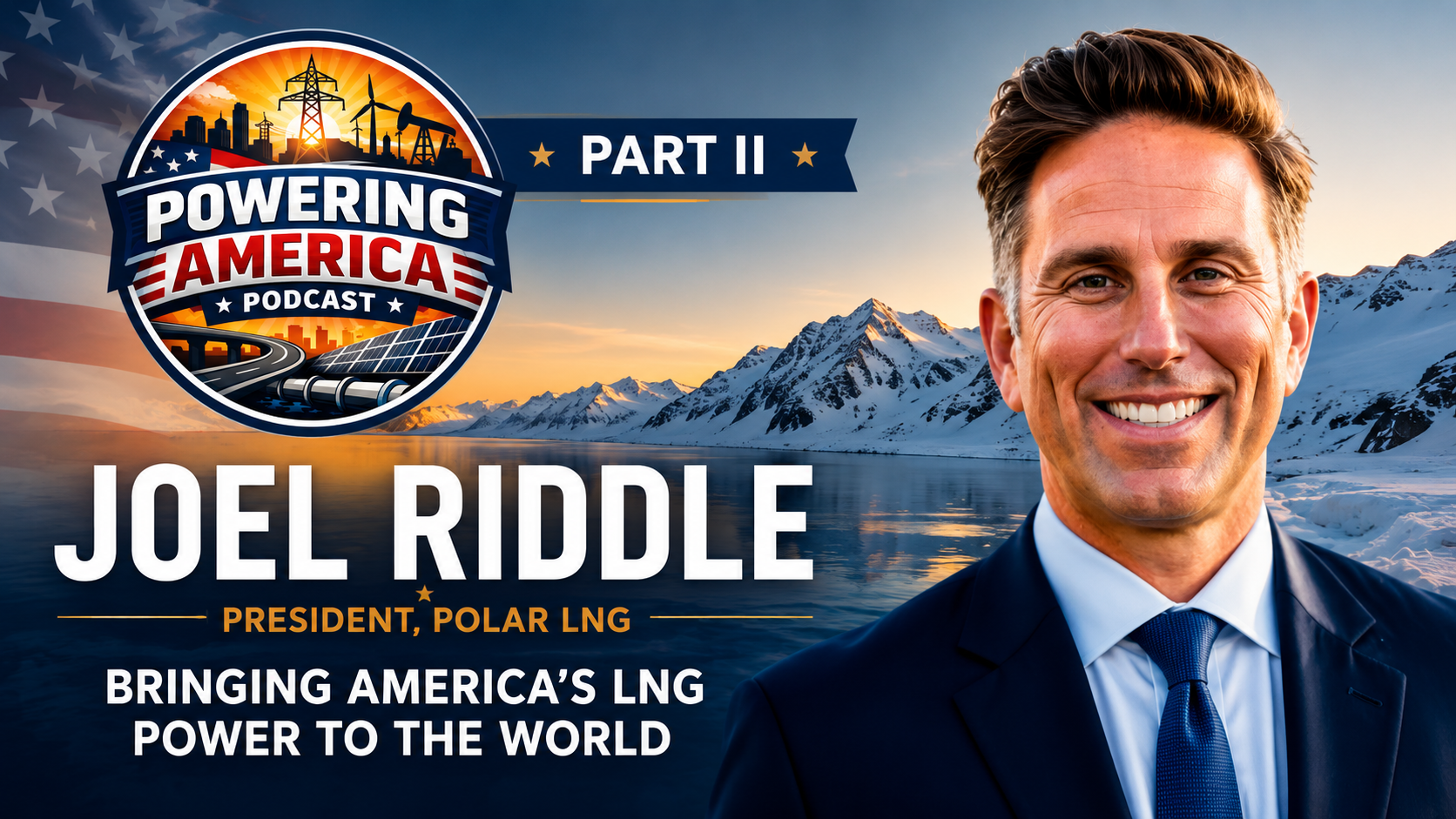
Powering America Podcast episode featuring Joel Riddle discussing Joel Riddle on the Economic Impact of the Polar LNG Project: Part 2

In the latest episode of the Powering America Podcast, Joel Riddle, CEO of Polar LNG, discusses the economic and strategic implications of the Polar LNG project in Alaska's North Slope. Riddle emphasizes the potential for job creation, tax revenues, and the project's role in enhancing U.S. energy dominance and Arctic leadership. He outlines plans for significant capital investment and infrastructure development, aiming for a financial decision by mid-2027 and project completion by 2030.

Part 2: Joel Riddle Discusses Economic Impact of Polar LNG Project

0:00 / 0:00

Part 2: Joel Riddle Discusses Economic Impact of Polar LNG Project

Polar LNG Project Aims to Boost Alaska's Economy, National Security

ANCHORAGE, Alaska — The Polar LNG project, led by CEO Joel Riddle, is poised to significantly impact Alaska's economy and national security, according to Riddle in a recent interview. The project, which focuses on monetizing natural gas from the North Slope's Proto Bay region, aims to generate substantial tax revenues and create thousands of jobs.

Riddle emphasized that the development of the Polar LNG project will yield immediate financial benefits for the state of Alaska and its First Nations communities. "When you monetize the gas coming out of the Proto Bay region, that's gonna immediately generate tax revenues and royalties," he said. The influx of wealth is expected to flow into local communities, creating both direct and indirect job opportunities.

Drawing parallels to the economic transformation seen in Midland, Texas, during the shale revolution, Riddle envisions a similar future for the North Slope. "My vision is that in 25 years, this area in and around Proto Bay has the opportunity with additional tax revenues, with additional royalties, with additional jobs," he stated. He believes the project will bolster not only the population but also the overall economic activity in the region.

Wider Economic Implications

The economic influence of the Polar LNG project extends beyond Alaska. Riddle noted that the project's success could uplift other initiatives in the North Slope region, generating additional revenue for the state. "Anytime you have a state doing well financially, that's a good thing," he said. The project is expected to attract workers from established oil and gas hubs across the United States, including Pennsylvania, Louisiana, Texas, and Arkansas.

Riddle highlighted the potential for thousands of new jobs, both direct and indirect, as the project progresses. He anticipates an investment of $8 to $9 billion in the first phase of the project, which could create a substantial number of employment opportunities in Alaska.

Strategic Importance in the Arctic

The Polar LNG project also plays a crucial role in strengthening the U.S. position in the Arctic. Riddle pointed out the Trump administration's focus on energy dominance and Arctic leadership, stating that the project aligns with these strategic objectives. "We think this project with Polar LNG checks the box on both of those strategic objectives by this administration," he said.

The project will utilize six icebreaker ships to transport LNG from the Proto Bay area, facilitating year-round navigation in the Arctic. This capability has implications for U.S. Coast Guard and military operations, which Riddle plans to integrate into the project's framework. "We will only be using that ice channel one out of every five days," he explained, allowing for additional operational time for the Coast Guard and military.

Collaboration with Other Projects

Riddle clarified that Polar LNG's project is not in competition with existing initiatives like the Alaska LNG project. Instead, he described it as complementary. "We want A-K-L-N-G to succeed," he stated, noting that Polar LNG aims to shoulder the burden of building new gas processing infrastructure at Proto Bay. He believes this collaboration will accelerate the development of the Alaska LNG project and other potential projects in the region.

The reserves at Proto Bay are estimated at 40 trillion cubic feet of gas, with Polar LNG's first phase projected to commercialize only a fraction of that. "We're only taking one-fourth of the gas reserves from Proto Bay to commercialize phase one of our project," Riddle said, indicating ample room for future developments.

Future Milestones and Community Engagement

Looking ahead, Riddle outlined key milestones for the Polar LNG project. The company aims to make a final investment decision by mid-2027, with a target to deliver phase one by 2029 or 2030. He anticipates scaling production from 7 million tons of LNG to 21 million tons by 2034.

Riddle encourages public engagement and invites interested parties to visit the newly launched Polar LNG website for more information. He plans to meet with Alaskan communities to discuss the project further, emphasizing the importance of local involvement.

As the Polar LNG project progresses, its potential to transform Alaska's economy and enhance national security remains a focal point for Riddle and his team.

Interview Q&A

Q&A: Part 2: Joel Riddle Discusses Economic Impact of Polar LNG Project

Powering America Podcast: Joel Riddle Discusses Economic Impact of Polar LNG Project

Q: What is the primary economic case for developing the North Slope gas and the new LNG model?

A: Monetizing gas from the Proto Bay region will generate tax revenues and royalties for the state and First Nations people. This development will create both direct and indirect jobs, benefiting local communities.

Q: Can you provide an example of how similar projects have impacted local economies?

A: The Shell Revolution in the Permian Basin transformed Midland, Texas, over the past 25 years. I envision similar economic development in the Proto Bay area, with increased tax revenues and job creation leading to improved quality of life.

Q: How will the economic benefits of the Polar LNG project extend beyond Alaska?

A: A financially strong Alaska will uplift other projects in the North Slope region, generating additional tax revenues. This project will create job opportunities across the U.S., particularly in established oil and gas regions like Pennsylvania, Louisiana, and Texas.

Q: What is the expected direct investment for the Polar LNG project?

A: Phase one of our project is estimated at $8 to $9 billion in direct investment, which aims to create thousands of new direct and indirect jobs in Alaska.

Q: How does the Polar LNG project relate to U.S. national security and Arctic leadership?

A: The project aligns with the Trump administration's goals of energy dominance and Arctic leadership. It will enable year-round navigation, which has implications for the Coast Guard and military operations in the Arctic.

Q: How does Polar LNG plan to work with existing projects in Alaska?

A: Polar LNG's project is complementary to the A-K-LNG project. We will invest in common user infrastructure, upgrade facilities, and create year-round navigation, which will support A-K-LNG and accelerate its progress.

Q: What are the estimated gas reserves in the Proto Bay area?

A: Proto Bay is estimated to have 40 trillion cubic feet of gas. Phase one of our project will commercialize approximately 10 trillion cubic feet, leaving ample reserves for other projects.

Q: What does success look like for Polar LNG in the future?

A: Success includes building at least three liquefaction trains and producing 21 million tons of LNG. This would generate significant revenue for Alaska and create a thriving economic environment in the North Slope.

Q: What milestones should we watch for regarding Polar LNG?

A: The next major milestone is to finalize a financial investment decision by mid-2027, targeting $8 to $9 billion in capital. We aim to deliver phase one of the project by 2029 or 2030.

Q: What is the long-term plan for expanding LNG production at Polar LNG?

A: After phase one, we plan to scale production from 7 million tons to 14 million tons by 2032, and then to 21 million tons by 2034, with potential for further expansion beyond that.

Q: Where can people find more information about Polar LNG?

A: Interested individuals can visit our website at polarlng.com, which includes key project facts and contact information for inquiries.

Q: Will you be engaging with the community in Alaska?

A: Yes, I will be in Alaska next week to meet with local communities and engage with the public as we move the project forward.

Key takeaways

  • When you monetize the gas coming out of the Proto Bay region, that's gonna immediately generate tax revenues and royalties for the state and for the First Nations people.
  • That economic development is gonna be a huge opportunity to bolster not just the population, but the economic activity.
  • This project will also uplift other projects that are looking to be developed in that North Slope region.
  • We want to see that project succeed. Matter of fact, we have the same goal, and that same goal is to accelerate US energy dominance.
  • We want to be the team that unlocked this stranded gas in the North Slope.

About the guest

Joel-riddle-polar-lng

Joel Riddle

CEO, Polar LNGPolar LNG

Joel Riddle is president and CEO of Polar LNG, an Alaska-focused energy company developing a nearshore liquefied natural gas export project on the state’s North Slope. Riddle has more than 25 years of experience in the global oil and gas industry and previously served as CEO of Tamboran Resources, where he helped lead development of natural gas resources in Australia’s Beetaloo Basin.

Full transcript

Show full transcript
PAP Joel Riddle Pt 2 [00:00:00] Welcome to the Powering America Podcast. I'm Brian Hyde, and this is part two of our conversation with Joel Riddle, president of Polar LNG. Joel, let's pick up with some of the national security and economic considerations that come with your project. Let's talk about the, the primary economic case for why it, it makes sense to develop that North Slope Gas and, and this, this new LNG model. Yeah, I mean first, first of all, when you monetize the gas coming out of the Proto Bay region, uh, that's gonna immediately generate tax revenues and royalties, uh, for the state royalties for the First Nations people. Uh, that is, you know, that is a function of when you have a demand center sitting there right at Proto Bay. That is the immediate impact. Uh, and um, in addition to that, uh, that wealth will now flow into the local communities and there'll be [00:01:00] in both direct and indirect jobs that will come out of that, uh, development as well. You've seen this in other areas. Uh, when the Shell Revolution started taking off in the Permian Basin in Midland, Texas, you know. I remember, you know, 25 years ago, Midland, Texas was nowhere near where it is today. And, um, my vision is that in 25 years, you know, this area in and around Proto Bay has the opportunity with additional tax revenues, with additional royalties, with additional jobs that are gonna be created. Uh, that economic development is gonna be a huge, uh, opportunity to bolster not just the population, but the economic activity. That, again, it's not just direct activity, but it's indirect activity. And for anyone, uh, that's listening, you know, go walk around Midland, Texas today. It is, uh, [00:02:00] it's boom, it's, it's booming. The reason it's booing is because of the last 25 years of the Shell Revolution, uh, that has created, uh, the economic, uh, environment, uh, for new jobs to thrive, uh, for people to have uplift their quality of life. Um, that same kind of thing can happen in the North Slope, uh, in the decades ahead. Again, we're talking with Joel Riddle, he's the president and CEO of Polar, LNG. Um, Joel, talk to me about, obviously in, in the PTO Bay area, they're on the North slope. This will create a lot of opportunity in Alaska, as you mentioned, you know, through, through taxes and royalties, the, the, the state can get that's great opportunity. How does, uh, how does the economic, uh, influence or economic, uh, benefits, um, how does it spread out to other aspects of the American economy? I mean, first, anytime you have [00:03:00] a state doing well financially, that's a good thing. And, and one thing that this project will do, it not only will be, uh, a direct impact on, uh, to the bottom line of the finances for the state of Alaska with the, in the form of tax revenues and royalties. This project will also uplift. Other projects that are, that, again, we're looking to be developed in that North Slope region. Uh, and then those projects will generate additional revenue, tax, revenues and royalties back into the state of Alaska. Um, the reason this matters for the US is because, you know, this will create a huge opportunity for new jobs. To be, um, you know, come from all different parts of the us, particularly in the areas that are, [00:04:00] uh, focus areas for oil and gas today, in and around the us, places in Pennsylvania, places in Louisiana, places in Texas, Arkansas. Um, these are the sweet spots where oil and gas is today. And this is an opportunity for these workers in these hotbeds. Uh, in and around the US to have another hotbed take off in the north slope of Alaska. And when that happens, those are good high paying jobs that will, you know, have a hit on the bottom line. It would be a bottom line impact on creating new jobs here in the us. That's something I'm very passionate about. It's something I've lived, uh, in my career, uh, is bringing in billions of dollars of direct investment, uh, most recently in Australia. We're gonna be doing that, uh, [00:05:00] in the next five years in, in, in Alaska. Uh, the phase one of our project is eight to $9 billion. That's direct investment. My hope is that we'll create thousands of new direct jobs and potentially thousands more of indirect jobs in, in Alaska. And that's good for not only Alaska, but that's good for. The US of a, uh, in, in being able to create jobs, uh, and create new opportunities for people in the oil and gas space, in and around, uh, again, these existing areas in Pennsylvania, Louisiana, Texas, and others. So from an economic standpoint, I mean, you, what you're describing sounds very promising. Let's talk about it from a strategic standpoint. Um, there's been a lot of interest in the Arctic, you know, not just from the US but, but others over the last few years. Um, how, how does this strengthen the US' position in the Arctic? Well, look, you know, the Trump administration has been very clear. Uh, [00:06:00] and on two big policies. One is around accelerating energy dominance, and two is around accelerating arctic leadership. And we think this project with polar LNG checks the box on both of those strategic objectives by this administration. On the Arctic leadership side, again, we will be using the six icebreaker ships. Will be used to transport LNG out of the Proto Bay area, but one of the most important things that we have the opportunity to unlock is a direct ice channel that will allow, you know, 24 7, 365 days out of the out of the year. Navigation. So year-round navigation is a huge thing, uh, that has Coast Guard implications, that has military [00:07:00] implications. And again, one of the things that we're gonna be working with this administration on is not just. Accelerating the LNG project, but working with the Department of War, working with the Coast Guard to provide an opportunity to, uh, for them to integrate their operations into our operations. So for example, we will be using this ice, this ice channel that will create the. Year-round navigation, we will only be using that ICE channel one out of every five days. So there's another four days out of every five days that can be used for, um, for benefit for the Coast Guard. Benefit for the. For the US military. Um, and those are conversations we're gonna be having, uh, quite a bit on with the administration in the months ahead as the way we can integrate [00:08:00] our project to create, uh, you know, an opportunity for these other departments to have this strategic focus around this Arctic leadership policy that the Trump administration is focused on. I know that, uh, a lot of us grew up, uh, you know, hearing about the Alaska pipeline and I'm, I'm assuming that there's probably plans, if not an actual pipeline for, for LNG in Alaska. Does Polar LNG compete against, uh, against those other projects or does it, does it, uh, work with them? Uh, I wanna be absolutely clear on this one. Uh, we look at Polar LNGs project being very complimentary to the A-K-L-N-G project and the 800 mile pipeline that is being progressed. Uh, the way this project is complimentary is really three things. One. We're gonna be shouldering the load on building new common user [00:09:00] infrastructure for gas processing at Proto Bay. That is our ambition. That is the capital that we're gonna be investing, is to create that foundation. Uh, around build out of new gas processing facilities at PTO Bay two, we'll be upgrading, uh, the West Dock, which sits 10 miles north of PTO Bay. And three, as I mentioned previously, we're gonna create year-round navigation, uh, to PTO Bay area. This, these three initiatives. Will require capital that we're gonna spend, but that's capital that A-K-L-N-G does not have to spend. So in a lot of ways, uh, what we're doing will not just be complimentary to A-K-L-N-G, but it will help accelerate that project. We want A-K-L-N-G to succeed. Matter of fact, we have the same goal and that same goal is to [00:10:00] accelerate US energy dominance. And put new l and g on the market at a time where the world market is in desperate need for new supply. Um, so we want to see that project to succeed. And the last point I'll just hit with hit on is when you look at the reserves at Proto Bay, there's four 40 trillion cubic feet of gas. Uh, that's estimated to be, uh, available to be commercialized at PTO Bay phase one of our project is 7 million tons of new LNG. And if you consider a 20 year time life. On that 7 million tons that works out to around 10 TCF or 10 trillion cubic feet of gas required. So we're only taking one fourth of the gas reserves from Proto Bay to commercialize phase one of our project. So there's a lot of head room here, uh, for [00:11:00] other projects to, again, after. We have blazed a trail for other projects to succeed. And it's not just a K, l and G, it's additional data center projects that we'll be looking to develop with, you know, gas powered, uh, gas powered electricity. Again, a project that can, can, um, provide, uh, support from the foundation that we're gonna lay with polar LNGs project. So we want to operate with an abundance mentality where. All the projects that come behind us succeed because that's good for Alaska, it's good for the people of Alaska. Joel, let's talk about, uh, you know, look into your crystal ball, look into the future, you know, um, five years, 20 years. What does success look like Once polar, LNG is operating success is very simple. One is we want to see minimum of three liquefaction trains [00:12:00] being built. The North slope of Alaska, which will be a massive demand center, uh, for that part of Alaska. Uh, we want to see that 21 million tons online and producing, uh, and that. Big, uh, revenue stream that will go into from, that will come from the gas production out of PTO Bay will be converting to revenue in the form of tax taxes, new taxes, and new royalties for Alaska and the people of Alaska to. Um, to uplift the economic, uh, environment there in the North slope. I'd like to see again, a million people living in the North Slope, much like what is happening, uh, on the Russian side of the, of the Arctic. Um, and in general, I want to see the opportunity where. 10 or 20 years from now, we are the team that, uh, [00:13:00] unlocked the stranded gas in the North slope. And that is one part of one chapter of this big book. Again, that started with John Rockefeller. And there's many more chapters to go with, uh, this industry. But we would like to humbly, you know, be part of the, one of the chapters. Uh, we want to be the team that have unlocked this, uh, this strand of gas and. 21 MTPA, uh, new LNG is flowing into the market and serving the benefit, not just of the US but of all of us' allies in Asia and in Europe. What are some of the milestones that, uh, we should be watching for, I mean, this, now it's on our radar screen. I know I'm gonna, I'm gonna be paying attention from here on out. Uh, what are some of the things we should be watching for regarding Polar, LNG? First big milestone that we're gonna be working day in and day out on is to deliver a financial, a financial investment decision [00:14:00] on this phase one of our project. Again, targeting eight to $9 billion of new capital. Uh, we will like to move forward with that final investment decision by midyear of 2027. Um, and that's where we would have majority of our permits at hand. That eight to $9 billion of new capital raised offtake agreements signed, uh, on the l and g that we'll be delivering in phase one. And then obviously the gas sales agreements signed. We wanna bring all that together, uh, by middle part of 2027. And then that would put us on a trajectory to deliver phase one of this project, uh, in 20 29, 20 30. Uh, and so that's when, that's the target for phase one. And then the idea is to take this technology and have these incremental liquefaction trains get built in Texas and rolling these off [00:15:00] like a conveyor belt once every two years from say, 2030 and beyond. So, 2032, we would look to scale from 7 million tons of LNG to 14, and then from. Two years after that in 2034, we would scale from 14 MTPA to 21 MTPA. So by 2034, this project would deliver, uh, a total capacity of 21 million tons of new l and g. Um, and then we'll see where we are within. There would be potential after that to obviously add more trains as, uh, as we scale, uh, from 21 MTPA and beyond. One final question for you, and that is for people who want to know more, uh, where would you direct them? Polar ling g.com uh, is our website. That that website is live now after our launch yesterday. Uh. There's lots of information out there. Uh, you know, our corporate [00:16:00] presentation has been uploaded, uh, containing key facts on our project. We also have, uh, contact emails for anyone having questions. Um, you know, we have a full team, uh, that will, um, their sole job will be com, you know, engaging with the public, engaging with the community. Uh, so I would encourage everyone, uh, to go check out the website. And, um, you know, I will be in Alaska next week and I look forward to meeting the people in Alaska when I'm there next week as well. So I'm gonna be getting around and, uh, meeting people, uh, as we move this project forward. Uh, so I'll be out in the, in the community quite often. Again, we have been visiting with Joel Riddle, he's the president and CEO of Polar, LNG. Joel, thank you so much for your time. Pleasure talking with you today. Thank you very much. Pleasure speaking to you as well.

Filed under