Sunday, May 24, 2026 · The Powering America Podcast
Powering America Podcast logo
← Powering America Podcast

2026-04-15 · Polar LNG

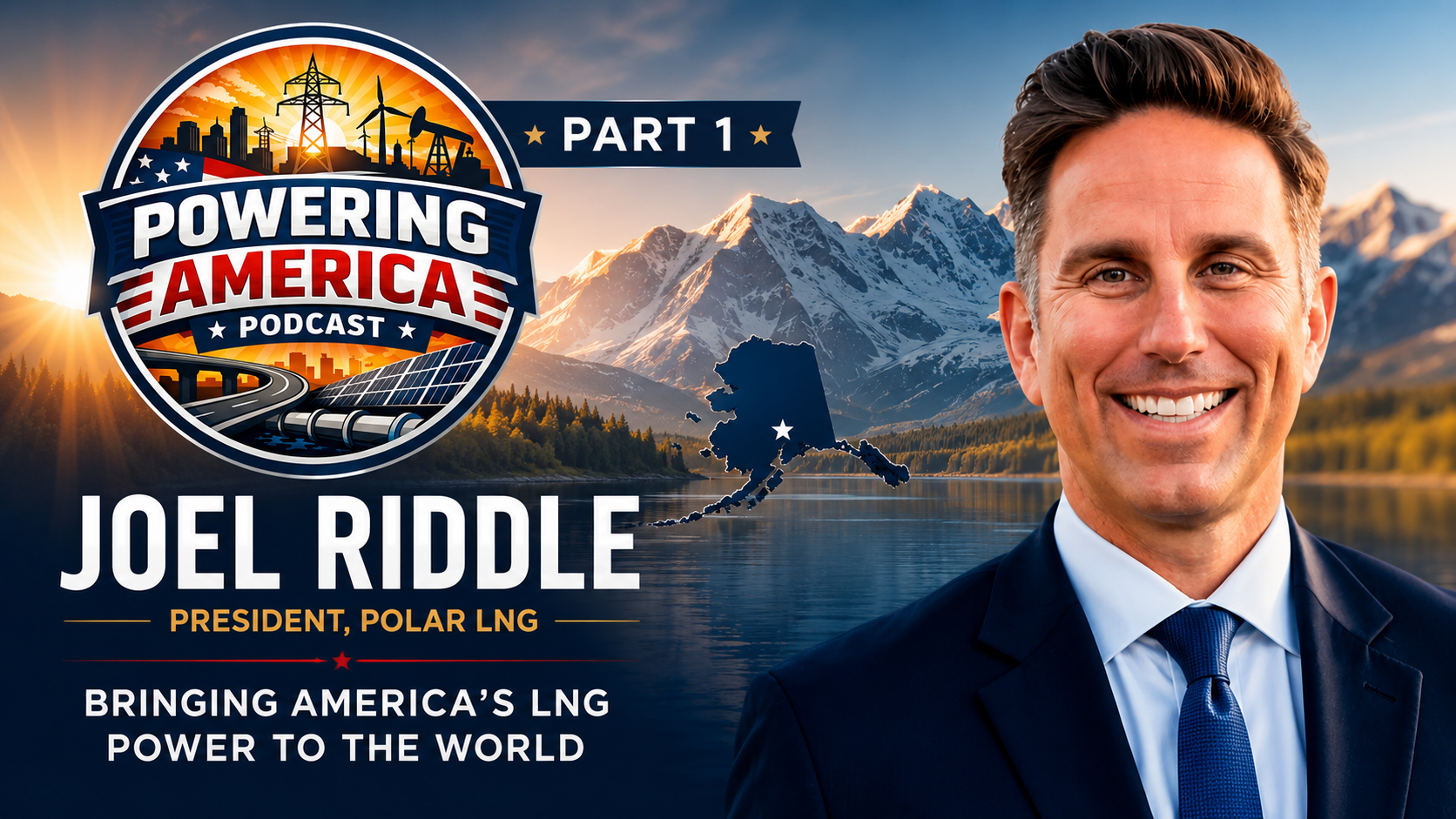
Joel Riddle on Polar LNG's Impact on U.S. Energy Security

with Joel Riddle, CEO — Polar LNG

Joel Riddle on Polar LNG's Impact on U.S. Energy Security — Joel Riddle, Polar LNG

In the latest episode of the Powering America Podcast, host Brian Hyde interviews Joel Riddle, CEO of Polar LNG. Riddle discusses Polar LNG's ambitious project in Alaska, which aims to produce 21 million tons of liquefied natural gas (LNG) annually by 2030. He highlights the project's potential to enhance U.S. energy security, especially in light of recent disruptions in global LNG supply, and emphasizes the importance of community support and infrastructure development in the North Slope region.

Joel Riddle Discusses Polar LNG's Role in U.S. Energy Security

0:00 / 0:00

Joel Riddle Discusses Polar LNG's Role in U.S. Energy Security

Polar LNG Aims to Boost U.S. Energy Security with Alaska Project

ANCHORAGE, Alaska — Joel Riddle, CEO of Polar LNG, discussed the company's ambitious plans to develop one of the largest liquefied natural gas (LNG) projects in the United States during a recent episode of the Powering America Podcast. The project, located in Alaska's North Slope, aims to produce 21 million tons of LNG annually, with the first phase set to deliver 7 million tons by 2029 or 2030.

Polar LNG's project is positioned to fill a significant gap in the global LNG market, especially following recent disruptions in supply from Qatar. Riddle noted that an attack on LNG facilities in the Persian Gulf had removed 20% of the world's LNG supply from the market, creating an urgent need for new sources. "What I see is this being an opportunity that's in perfect alignment with the Trump administration's focus around energy dominance," he said.

The project benefits from a unique opportunity to acquire equipment originally intended for the Russian Arctic LNG project, which was halted due to U.S. sanctions. Riddle explained that Polar LNG will purchase this equipment at a discount, allowing for a faster construction timeline. The company also plans to acquire six LNG icebreaker ships that were similarly intended for the Russian project.

LNG, or liquefied natural gas, is natural gas that has been cooled to a liquid state for easier transport. Riddle emphasized that this technology allows for the efficient movement of natural gas to markets in Asia and Europe, where it serves as a primary energy source.

Riddle, who has spent 30 years in the oil and gas industry, described his journey to Polar LNG as one driven by a passion for overcoming challenges. He previously worked for major companies like Exxon and Chevron, as well as smaller firms, and has been involved in developing significant gas deposits in Australia. He sees the North Slope's stranded gas as a major opportunity that has yet to be fully unlocked.

The North Slope currently has a population of about 10,000, a stark contrast to the million people living in similar geographic areas in Russia. Riddle attributes this disparity to the lack of development in Alaska compared to the Russian Arctic. He aims for Polar LNG to serve as a catalyst for broader economic growth in the region, potentially leading to a population increase and the establishment of additional industries, such as AI data centers.

Riddle envisions a future where the North Slope becomes a hub for energy production and technological development. He expressed a commitment to aligning the project with the needs of local communities, stating, "If we do that, we will get the support we need among the community."

The Polar LNG project is not only about energy production but also about creating opportunities for Alaskans. Riddle believes that successful development will pave the way for other projects in the region, ultimately transforming the North Slope into a significant player in the global energy landscape.

As the project moves forward, Polar LNG aims to establish a foundation for future developments, ensuring that the benefits of the LNG project extend beyond its immediate goals. Riddle's vision for the North Slope includes a thriving community and a robust economy, with the potential for a million residents in the coming decades.

The Polar LNG project represents a strategic initiative to enhance U.S. energy security while addressing global supply challenges. As the company prepares to advance its plans, Riddle remains focused on the long-term impact of the project on both the local community and the international energy market.

Interview Q&A

Q&A: Joel Riddle Discusses Polar LNG's Role in U.S. Energy Security

Powering America Podcast: Joel Riddle Discusses Polar LNG's Role in U.S. Energy Security

Q: What is Polar LNG and what are its goals?

A: Polar LNG is one of the largest new liquefied natural gas (LNG) projects planned in the U.S. over the next five years, with a total capacity of around 21 million tons of LNG produced per year. The project aims to deliver 7 million tons in its first phase by 2029 or 2030.

Q: How does Polar LNG plan to expedite its project timeline?

A: The project can accelerate its timeline due to exclusive rights to purchase equipment originally intended for the Russian Arctic 2 project, which was halted by U.S. sanctions. This equipment is already 50% built and will be brought to Alaska.

Q: Can you explain what LNG is?

A: LNG stands for liquefied natural gas. It is a technology that condenses vaporized natural gas into a liquid form by reducing its temperature to minus 260 degrees Fahrenheit. This allows for easier transportation on specially designed ships.

Q: What recent events have impacted the global LNG supply?

A: An attack on LNG facilities in Qatar recently removed 20% of the world's LNG supply from the market. This situation has created an opportunity for U.S. projects like Polar LNG to fill the gap.

Q: How does Polar LNG align with U.S. energy policy?

A: Polar LNG aligns with the Trump administration's focus on energy dominance by accelerating new LNG projects that can support energy security for U.S. allies in Asia and Europe.

Q: What is Joel Riddle's background in the energy industry?

A: Joel Riddle has 30 years of experience in the oil and gas industry, working for both large companies like Exxon and Chevron and smaller entrepreneurial ventures. His passion lies in tackling industry challenges.

Q: What challenges does the North Slope present for LNG development?

A: The North Slope has a small population of about 10,000 people, which contrasts with the Russian Arctic, where a million people live. The disparity is due to decades of LNG resource development in Russia, which has led to population growth and commerce in that region.

Q: What is the vision for the North Slope's future?

A: Riddle envisions significant development in the North Slope, potentially increasing the population to one million over the next 10 to 20 years. He aims to create a foundation for various projects, including AI data centers and other LNG initiatives.

Q: How does Polar LNG plan to support local communities?

A: Polar LNG aims to align its operations with the best interests of Alaskan communities. By focusing on local needs, the company hopes to gain community support and ensure success for both its project and other developments in the region.

Q: What legacy does Riddle hope to create with Polar LNG?

A: Riddle hopes to create a legacy not only for Polar LNG but also for future projects in the North Slope. He aims to foster an entrepreneurial spirit that can tackle significant challenges in the oil and gas industry.

Q: What opportunities does Riddle see for the LNG market?

A: Riddle sees the current gap in the LNG market as an opportunity for U.S. projects to become key players in global energy security, providing much-needed supply to allies in Asia and Europe.

Q: What other projects are being considered in the North Slope?

A: In addition to Polar LNG, other projects being considered include AI data centers and another LNG project called A-K-LNG, which could benefit from the infrastructure developed by Polar LNG.

Key takeaways

  • Polar LNG is one of the largest new LNG projects that are gonna be built in the US in the next five years.
  • What you just mentioned was very unfortunate, because with the conflict and that the attack on the facilities in Qatar that took 20% of the world's LNG supply off the market.
  • There's an incredible opportunity for us to use this window for the US to be the hero in this story.
  • Stranded gas in the North Slope has been one of the key industry challenges, and a lot of companies have tried to commercialize that gas.
  • What we're looking to do with Polar LNG's project is to be that first rotation on kick starting a very significant development.

About the guest

Joel Riddle

CEOPolar LNG

Full transcript

Show full transcript
[00:00:00] Welcome to the Powering America Podcast. I'm Brian Hyde, and today I'm joined by Joel Riddle, who is President of Polar LNG. Joel, welcome to the podcast. Tell us a little bit about your background and exactly what polar LNG is. Great. So Polar, LNG is one of the largest new LNG projects that are gonna be built in the US in the LA next five years. Uh, it is a project that has a, will have a total capacity of around 21 million tons of LNG produced per year. Uh, the intention is to build this 21 MTPA project in the north slope of Alaska. Phase one of our project will be delivering 7 million tons, and our target is to get that online producing LNG by 20 29, 20 30, so extremely accelerated timeline. The [00:01:00] reason we can accelerate and have the speed to market. Uh, is due to the fact that we have, uh, we'll have the exclusive right to purchase equipment that was originally planned, uh, to be installed in the Russian Arctic two project, but because of the Trump administration's sanctions on that project, it's provided an opportunity for polar LNG to purchase that equipment at a discount and bring that equipment, which is already 50% built. To the north slope of Alaska and to get that project, uh, in the fully constructed and online, uh, to produce that 7 million tons of LNG in Alaska by 20 29, 20 30. The other element. Of this project, which is incredibly, uh, you know, sort of a a, a real positive for our company is that we will also have the [00:02:00] opportunity to buy six LNG icebreaker ships. That, again, was originally planned to go in and support. Russian Arctic two project, and instead we will be part of the polar LNG story. Um, so, you know, Joel, let me, let me back up for just one moment here. 'cause I just wanna make sure that, that, uh, for anybody who's going LNG, what, uh, what exactly does that mean? Um, let's, let's make sure we, we have, uh, a clear understanding. This is liquified natural gas. Is that correct? Correct. That's what LNG stands for. And for everyone not familiar with LNG, it is a, uh, it's a technology that's been developed for many decades that, uh, condenses the vaporized gas that you might, everyone, uh, really understands to a very condensed form, uh, that. Essentially is a process to, to reduce the temperature down to minus 260 degrees Fahrenheit. [00:03:00] And when you do that, that gas, uh, transforms to a liquid. To a highly condensed liquid, and that, uh, allows that liquid to be transported on specially designed ships around the world. And then there's a process called Regasification that takes it from liquid form to the original gas form again. That gets distributed in areas, um, in, in places like Japan and Korea that use natural gases as primary form of energy. Now I have to ask this because this will play into our conversation as, as we talk about, uh, polar LNG, but um, I recently saw an LNG facility in the news, and it was not in a good sense. It was, I believe, located, uh, in one of the, um, states along the Persian Gulf and it had recently been attacked by Iran and, and. People were rightly very concerned about this. Talk to me about, uh, what is the problem that Polar, LNG is, is trying to solve? Um, [00:04:00] both for the United States as, as well as for Alaska? Yeah, the, what you just mentioned, uh, was very unfortunate, uh, because with that, with the conflict and that the attack on, uh, the facilities in Qatar that took 20%. Of the world's LNG supply off the market, and it's gonna take years to get that supply, uh, back on the market. Um, and you know what the opportunity exists now is for projects out of the us, uh, particularly projects like Polar, LNG, to accelerate and fill the gap. That has been created, uh, by these facilities going down in Qatar. Um, and what I see is this being an opportunity that's in perfect alignment with the Trump administration's focus around [00:05:00] energy dominance, uh, particularly e energy dominance as it relates to accelerating new LNG out of the US that can support. Energy security for the, for the US allies in Asia, in Europe, um, simply because there's 20% less LNG supply on the market today than it was three weeks ago. Um, and so there's an, there's an incredible opportunity for us to use this window, uh, for the us uh, to be, you know, sort of the hero in this story. The hero that's going to move forward with new LNG and put that new LNG cargoes on the market to ensure that, uh, there's energy security for all of the allies that the US has in Asia and, and in Europe. And Joel, I have to ask you, um, what brought you to, to the helm of this particular project with Polar [00:06:00] LNG? Look, uh, I've been in the industry, in the oil and gas industry for about 30 years. Uh, half of my career I spent working for large. Oil companies like Exxon and Chevron in, you know, technical, operational and executive roles. Uh, other half of my career I've spent working for smaller companies, uh, in a more entrepreneurial type role. Um, that's really my passion. Um, I, what I look for in the industry are challenges that industry has not. Been able to unlock until now. Um, and that's what really 12 years ago, drove me to move my family around the world to Australia where we have been focused on developing one of the largest Shell gas deposits in the world called the Beta Lou Basin. I remember when I joined the company in 2013, [00:07:00] um, you know, a lot of folks thought I was crazy. To kinda walk down that path. But I have this interesting part of my personality is when someone tells me I can't do something, that just drives me even harder. Right? And um, and now, you know, 12 years later, the Bloo Basin will be going into first production this year and then, you know, I would, I would say the 25 foot putt. That existed when I joined in 2013. Has now, um, you know, you know, we've made the 25 foot putt, so to speak, and now the putt for the guys that come, you know, after in Australia is now, you know, kind of a two to three foot putt. And I'm looking to do the same thing here in this opportunity, uh, the last. Three decades. You know, stranded gas in the North Slope has been a, one of the key industry challenges. Um, [00:08:00] and a lot of companies have tried to commercialize that gas. Uh, I feel like with this opportunity, uh, to adopt some of the best technology on the planet around development of LNG in the Arctic region again. 25 foot putt. This is a, it's a big challenge, but, you know, this is what I, you know, this is what I, I live for is, is these kind of opportunities, uh, is to, you know, do things where a lot of the people in our oil and gas industry have had these challenges in time. We saw it started out with John Rockefeller back in, you know, many years ago. Um. You know, in l and g, uh, Sharif Suki was one of the pioneers of l and g. You know, he. It was him against the world to get l and g into the world markets. And, you know, [00:09:00] he deserves a lot of credit. There's a lot of shell pioneers out there, uh, that participated in the Shell Revolution. Um, Scott Sheffield is one of 'em. He is the previously the CEO of Pioneer. What we're going to do for polar, LNG is gonna create some legacy, um, not just for polar LNG, but also for the people that are gonna come around my project and that have this entrepreneurial, it's us against the world type spirit. Uh, and that's exactly what we, it's gonna take to have success in this, in this project. I mean, the way that you have described this, Joel, there are, there are some real opportunities. You know, in, in the sense that, you know, 20% of the world's LNG supply just came off the market. There are also some pretty considerable obstacles for those who aren't familiar with the North Slope and, and the work that goes on there. Uh, paint the picture for us about to the conditions that, that have to be overcome in order to, to utilize, you know, the resources that are, that are found there. [00:10:00] Yeah. Yeah, that's a great point. Um, the North Slope is, is in, at, at current state, uh, it, the population's about 10,000 people. And so, you know, when you look at the similar type geography on the Russian side, it's about a million people living up in the Arctic. Uh, the reason why there's such a disparity, uh, is because. On the Russian side of, of the Arctic, you know, they have been very focused on developing LNG resources for the last couple of decades. And what has happened is as the LNG projects have gotten developed, um, there's a lot of development that followed behind that, including population growth commerce. Military application. Um, and so it always takes kind of a trailblazer to start and create the first turnover [00:11:00] of a development. And what we're looking to do with Polar LNGs project is to be that first rotation on kick starting. Uh, a, a very significant development, not just in LNG, but there's other, uh, projects that are being looked at in the North Slope where AI data centers, I think everyone's talking about there's not a better place in the planet to put an AI data center than the North slope of Alaska. And the key limitation is ensuring there's common user infrastructure around gas. Powering these, these data centers, and again, what we were gonna be doing in the, in, in the years ahead is creating that foundation for other projects to succeed. Uh, the data center projects, there's another LNG project called A-K-L-N-G. We want to do things that elevate. Those projects, uh, that create opportunities for [00:12:00] Alaskans to work, not just for our project, but for these other projects as well. Um, because one of the key parts of our company is to be laser focused on doing what, um, is in the best. Um. You know, kind of in the, what I would say is aligned with what is good for Alaska and its people, uh, and the local communities there in the northern, in the, uh, north Slope region, and. If we do that, we will get the support we need among the community. And with that, we will have success not just in polar LNG, but for all these other developments that are coming in. My vision in 10 or 20 years is for, there'll be a million people living up there right now, there's 10,000. Um, but I wanna see this development take off where. This becomes the next hotspot, uh, for oil and gas. It becomes the next hotspot for big development [00:13:00] happening, not not just in the us but in the world. We are talking with Joel Riddle, president of Polar LNG. Please join us for part two of our conversation. And Joel, thanks for joining us on the Powering America Podcast. Thank you very much.

Filed under