Wednesday, December 31, 1969 · The Powering America Podcast
Powering America Podcast logo

Receive new episodes in your inbox.

← Powering America Podcast

2026-11-03 · The Commonwealth Foundation

Gordon Tomb Discusses the Costly Reality of Green Energy Mandates

with Gordon W Tomb, Senior Fellow — The Commonwealth Foundation
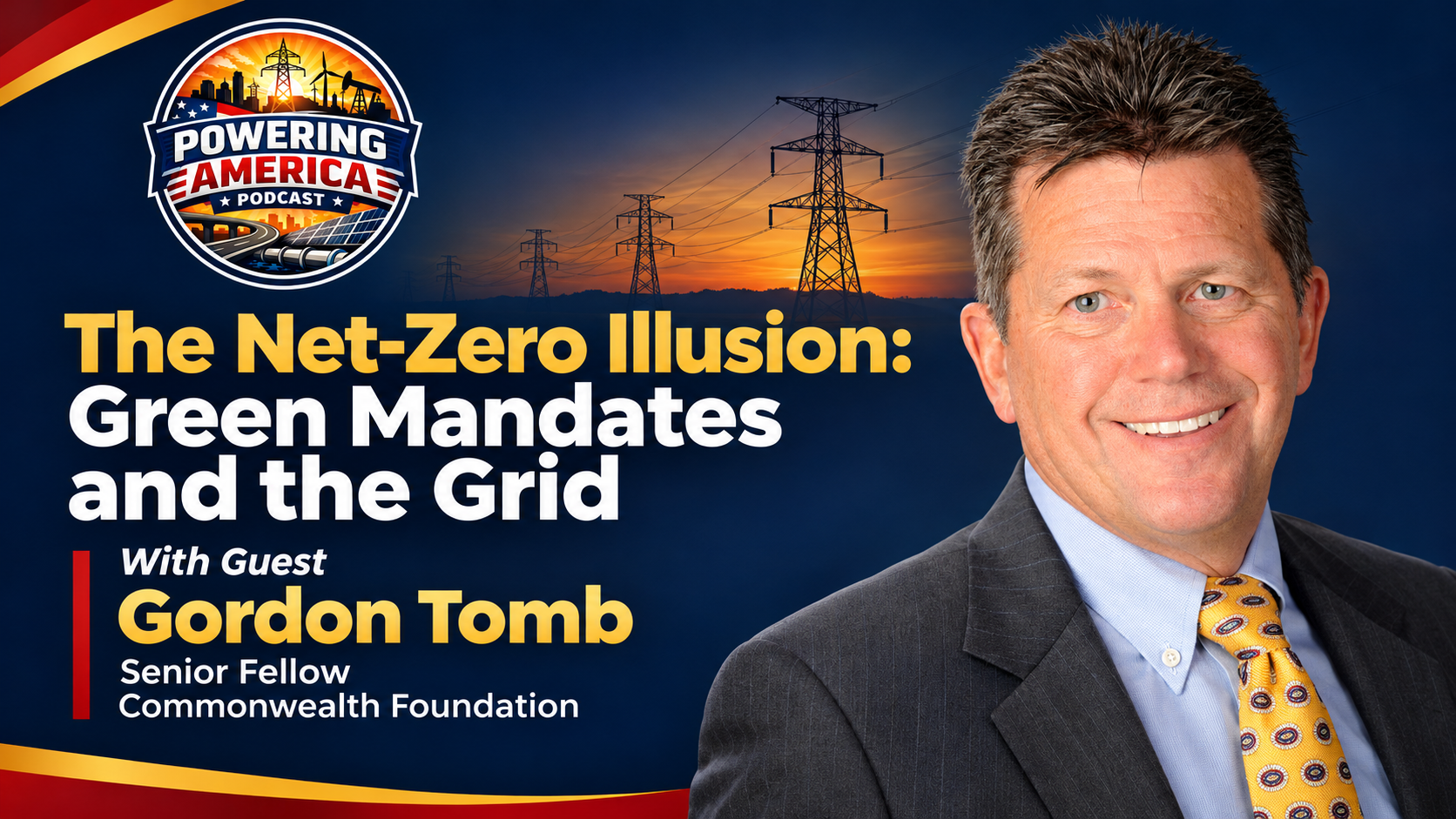
Powering America Podcast episode featuring Gordon W Tomb discussing Gordon Tomb Discusses the Costly Reality of Green Energy Mandates — The Commonwealth Foun…

In the latest episode of the Powering America Podcast, host Bryan Hyde interviews Gordon W. Tomb, a Senior Fellow at the Commonwealth Foundation, about the implications of green energy mandates on electricity prices and reliability. Tomb discusses Pennsylvania's Alternative Energy Portfolio Standards, which require a percentage of electricity to come from renewable sources, and critiques the effectiveness and economic impact of such policies. He argues that fossil fuels and nuclear power remain the most viable energy sources for affordable electricity, while highlighting the political challenges in shifting energy policy.

The Net-Zero Illusion: Gordon Tomb on Green Mandates and the Grid

0:00 / 0:00

The Net-Zero Illusion: Gordon Tomb on Green Mandates and the Grid

Gordon W. Tomb Discusses the Costs of Green Energy Mandates on the Powering America Podcast

In a recent episode of the Powering America Podcast, Gordon W. Tomb, a senior fellow at the Commonwealth Foundation, discussed the impact of green energy mandates on electricity prices and reliability. The episode, hosted by Bryan Hyde, aired on [insert date], and highlighted concerns regarding the effectiveness and economic viability of renewable energy sources.

Tomb, who has extensive experience in the energy sector, explained that green energy mandates require electricity providers to source a certain percentage of their energy from renewable sources. In Pennsylvania, for example, the Alternative Energy Portfolio Standards mandate that at least 18% of electricity must come from renewable sources, including solar and wind energy. According to Tomb, these mandates have resulted in significant costs for consumers, with Pennsylvania residents facing a projected $700 million in expenses by 2025.

"The purpose of this was to help these technologies develop," Tomb said, referring to the initial intentions behind the mandates. "But at this point, of all the electricity generated in Pennsylvania, only 4% comes from so-called renewable sources. After 20 years and billions of dollars, what is the point?"

Tomb criticized the political motivations behind the continuation of these mandates, suggesting that they are often supported by politicians seeking donations from environmental groups. However, he noted a growing pushback against these policies due to rising electricity prices and concerns about reliability. He pointed to recent actions by politicians like Massachusetts Governor Maura Healey, who has shifted her stance on energy policy in response to high electricity costs.

Despite the intentions of green energy initiatives, Tomb argued that the costs have outweighed the benefits. "It's totally irrational," he said, emphasizing that many politicians are beginning to recognize the need for a more pragmatic approach to energy policy.

Tomb also addressed the reliability of various energy sources, stating that fossil fuels, particularly coal and natural gas, remain the most effective means of generating electricity. He expressed concern about the lack of political leadership to support the development of these resources, as well as nuclear power, which he believes has significant potential.

"Nuclear energy is a wonderful source of energy," Tomb said, recalling his own experiences working at the Three Mile Island plant. He highlighted the cleanliness and efficiency of nuclear power compared to fossil fuels and renewables.

As the conversation shifted to the role of data centers in the energy landscape, Tomb noted that while they require reliable energy, blaming them for high energy prices is misguided. He attributed the rising costs to poor public policy rather than the energy demands of data centers.

Tomb concluded by advocating for a rational approach to energy policy that considers the benefits and costs of all energy sources. He emphasized the importance of allowing experts to make informed decisions about energy generation, which he believes should include a combination of fossil fuels and nuclear power.

The discussion underscored the complexities of energy policy and the challenges associated with transitioning to renewable sources. As states like Pennsylvania continue to grapple with the implications of green energy mandates, the debate over the best path forward for affordable and reliable electricity remains a pressing issue.

Interview Q&A

Q&A: The Net-Zero Illusion: Gordon Tomb on Green Mandates and the Grid

Powering America Podcast: The Net-Zero Illusion

Q: Who is Gordon W. Tomb?

A: Gordon W. Tomb is a Senior Fellow at The Commonwealth Foundation, a free market think tank based in Pennsylvania. He has a background in energy, having worked as a newspaper reporter, in the nuclear power and electric utility industry, and as a management consultant in the oil and gas sector.

Q: What are green energy mandates? Can you provide an example?

A: Green energy mandates require consumers to purchase a certain percentage of energy from renewable sources, such as solar and wind. In Pennsylvania, the Alternative Energy Portfolio Standards mandate that electricity sellers provide at least 18% of their electricity from renewable sources.

Q: What has been the financial impact of these green energy mandates in Pennsylvania?

A: The green energy mandate in Pennsylvania has cost electricity customers approximately $700 million in 2025 alone, totaling about $3 billion over the life of the program. Despite this investment, only 4% of electricity generated in Pennsylvania comes from renewable sources.

Q: Is there political pushback against these green energy mandates?

A: Yes, there has been increasing pushback against green energy mandates, primarily due to rising electricity costs and concerns about electricity shortages. Some politicians, including those from traditionally supportive parties, are beginning to question the effectiveness of these programs.

Q: What are the best fuels for generating electricity today?

A: The best fuels for generating electricity currently are fossil fuels, particularly coal and natural gas, along with nuclear power. The U.S. has about 100 nuclear plants, but there is potential for more development in this area.

Q: Why hasn't political leadership shifted to support more reliable energy sources?

A: Political leadership has been slow to adapt due to entrenched beliefs in green energy and the influence of environmental groups. There is a gradual realization that effective energy policies must prioritize reliable and affordable energy sources.

Q: How do data centers impact energy needs?

A: Data centers require reliable and affordable energy to operate efficiently. However, some politicians blame data centers for high energy prices, despite the fact that many large data centers have not yet been built.

Q: What are the limitations of wind and solar energy?

A: Wind and solar energy have lower power density ratios compared to fossil fuels and nuclear energy. For instance, wind and solar produce about 3.5 units of energy for every unit invested, while coal produces 10 to 1, and nuclear can produce up to 100 to 1. Additionally, wind and solar require significantly more land and resources.

Q: What advancements are being made in nuclear technology?

A: Advances in nuclear technology, such as small modular reactors, hold promise for providing reliable energy. Nuclear power is seen as a clean and efficient energy source, with significant potential for growth.

Q: What are the implications of Governor Shapiro's energy proposals in Pennsylvania?

A: Governor Shapiro's proposals could increase the state's reliance on green energy, potentially leading to a $155 billion increase in electricity bills over ten years, effectively doubling household electricity costs. There is skepticism about the feasibility of these proposals.

Q: What direction should policymakers take regarding energy sources?

A: Policymakers should adopt rational, clear-headed thinking that recognizes the benefits and costs of all energy sources. A balanced approach combining fossil fuels and nuclear power is recommended for effective energy policy.

Q: What does Gordon W. Tomb hope for in energy policy?

A: Tomb hopes for policies guided by rational thinking that allow experts to make informed decisions about the best energy sources, emphasizing a combination of fossil fuels and nuclear power.

Key takeaways

  • “The stated purpose for this particular program, which was initiated in 2004, more than 20 years ago, was to give these energy sources a foothold, a kind of a boost so that they could develop and gain market share.”
  • “At this point, of all the electricity generated in Pennsylvania, 4% comes from so-called renewable sources. After 20 years, and billions of dollars. What is the point?”
  • “It's totally irrational. And as I mentioned, people are starting to back away from it.”
  • “The energy breakthrough that will take the world into the 21st century will almost certainly be political, not technological.”
  • “Wind and solar will take 10 times and more, in some cases, 10 times the land for to produce the same amount of energy that traditional sources take.”

About the guest

Gordon W Tomb

Senior Fellow — The Commonwealth Foundation

Full transcript

Show full transcript
[00:00] Bryan Hyde: Welcome to the Powering America Podcast. I'm Brian Hyde, and today I'm joined by Gordon Tom, who is a senior fellow with the Commonwealth Foundation. Gordon, welcome to the show. [00:09] Gordon W Tomb: Thanks for having me. Appreciate the opportunity. [00:12] Bryan Hyde: Let's take a moment here and have you give us a little bit of your background. Tell us about who you are and what you do. [00:17] Gordon W Tomb: Okay. Well, first of all, the Commonwealth Foundation is a free market think tank based in Pennsylvania. We focus on— we advance policies with free market, you know, based on free market principles. That's the short version. My background's largely in energy. I started out covering energy as a newspaper reporter a long time ago. I spent time working in the nuclear power and electric utility industry for almost 20 years, tracked the oil and gas industry as a management consultant, and more recently have been writing and researching subjects around energy and climate change for, for think tanks. [00:59] Bryan Hyde: Well, and that's, that's a good jumping-in point for us to talk about green energy mandates and other impediments to affordable energy. And anybody who's paid their, their cooling bill for the summer, or some are paying their heating bills now as the weather starts to cool off, can appreciate nothing is as cheap as it once was. Talk to me a little bit about green energy mandates. For if someone was struggling to think about what does that look like? What are some examples of green energy mandates that we've seen within the last, you know, couple of decades? [01:29] Gordon W Tomb: Well, for instance, requiring customers to buy a certain amount of green energy, from green energy being mostly solar energy, wind energy. In Pennsylvania, for example, and Pennsylvania is by no means the only state with these kinds of mandates, but specific to Pennsylvania, there's something called the Alternative Energy Portfolio Standards, which means in Pennsylvania— that's bureaucratic lingo for requiring sellers of electricity to sell at least 18% of their electricity from renewable sources, so-called renewable sources. And in Pennsylvania, for the purposes of this program, renewable is defined as solar, wind, biomass, and several others. But mainly there's energy sources that cannot profitably operate in a free market. So they get subsidies and they're politically favored in that way. So that is one example of a green energy mandate. [02:40] Bryan Hyde: And, you know, I'm not trying to oversimplify here, but it sounds like for the privilege of knowing that you're doing your part, to help green energy, you know, supply our needs, you get to pay a lot more. [02:53] Gordon W Tomb: Well, yes. Here's the thing. The stated purpose for this particular program, which was initiated in 2004, more than 20 years ago, was to give these energy sources a foothold, a kind of a boost so that they could develop and gain market share. And, and the underlying premise of all that is that green energy is good. But if you want to go down that rabbit hole, there's very little evidence or virtually no evidence that they actually do anything environmentally beneficial. But that's a whole other conversation. In this case, this green energy mandate has cost Pennsylvanians— and there's about 6 million electricity customers in Pennsylvania, about 13 million people. But, you know, customer— a customer could be a family. 6 million electricity customers, and they don't even know how much they're paying because nobody talks about it. But in 2025, this program cost Pennsylvania customers $700 million. Wow. Over the life of the program, it's been $3 billion. It just keeps getting more expensive. And here's the thing. So like I said, the purpose of this was to help these technologies develop. Well, at this point, of all the electricity generated in Pennsylvania— and by the way, Pennsylvania is the largest generator of electricity of all the states and exports the most electricity to other states— of all the electricity generated in Pennsylvania, 4% comes from so-called renewable sources. After 20 years, and billions of dollars. What is the point? These programs make no difference, no positive difference, and make no sense. [04:48] Bryan Hyde: So someone has to have raised a flag by this point to say, hey, this is costing more than it's worth, or we're not getting the return that we were told we were supposed to. How does the political opposition to this stack up? Are you seeing a lot of people You know, pushing back? [05:05] Gordon W Tomb: Well, it's— there's been, um, more recently there's been more of a pushback. Uh, for a long time these programs have been allowed to continue because of politics. One moment, I gotta close my door. My dog's barking. I don't know if you could hear that or not. [05:23] Bryan Hyde: Nope, nope. Go right ahead. [05:24] Gordon W Tomb: She was asleep until my wife came. Okay. So for, for a long time, these programs have been allowed to continue for political reasons. There are people, mainly of the Democratic persuasion, who believed— I think some of them actually believed that they were good programs. They served a purpose. Others did it just because they could get political donations from environmental groups, environmental extremists, I call them. But there's been more and more pushback on these programs because of the costs, because of the costs, because of what they cost and how they raise electricity prices. And actually, in some areas, because they have forced reliable sources out of the market. And now we're having in some areas electricity shortages. or at least the prospect of electricity shortages. So it's become more and more of a political issue. I think it was the— yeah, it's the Wall Street Journal just today had an editorial called The Northeast Climate Revolt. It's in today's Wall Street Journal. And it talks about how people like Governor Maura Healey of Massachusetts a few years ago when she was attorney general, blocked pipeline projects. Today, she's now writing letters to President Trump asking him to facilitate the construction of the expansion of a pipeline system because electricity prices are so extraordinarily high up in New England. [07:05] Bryan Hyde: So is it safe to say that despite the good intentions of these green energy mandates, the cost, I guess the juice hasn't been worth the squeeze, I guess is one way of putting it? [07:18] Gordon W Tomb: Right. Absolutely not. It's totally irrational. And as I mentioned, people are starting to back away from it. People like Governor Healey in Massachusetts, even Governor Hochul in New York, is starting to be more open, we're told, to, for instance, natural gas pipelines. Nonetheless, in Pennsylvania, just recently, just this year, in their annual report, on their alternative energy program, they continued to promote, quote, the realization of a net-zero electricity grid by 2050. And that means like no fossil fuels being used to generate electricity by 2050. That is language from la-la land because it's not even physically possible. And if it were possible, you would destroy the economy doing it. So it makes no sense. Reality at some point kicks in. And even in places like Germany, where they were the world's model, right, for green energy, they're having a reaction to it because of the deleterious effect on the economy. [08:32] Bryan Hyde: So let's talk about what are the best fuels when it comes to generating electricity? [08:39] Gordon W Tomb: Well, today the best fuels continue to be fossil fuels, coal and natural gas, mainly coal and natural gas, and then nuclear power. We're behind in this country in developing nuclear power, even though we probably have the most, the greatest number of plants, unless in China. China may actually have more at this point, I'm not sure. But we have about 100 plants in this country We ought to have more than that because we had 100 plants 20 years ago, you know. But so anyhow, there's plenty of resources to generate affordable electricity. What we don't have is the political leadership to allow it to happen. [09:22] Bryan Hyde: And I have to ask, why hasn't the political leadership changed, you know, with the times, or at least come to the realization that it's got to feel safe for somebody to say, okay, this didn't pan out the way that we had anticipated. You know, let's, let's make sure we're at least securing, you know, supplies of affordable energy. It doesn't sound like anybody's stepping up to do that. [09:44] Gordon W Tomb: Well, you're making a good point. There's an— there was an economist. He's, he's passed away some years ago, but an economist and writer named Jude Wanniski wrote a book and published a book in 1978 called The World Works— The Way the World Works. And I was just looking at his chapter on energy. This is back in the late '70s. He closes the chapter on energy by saying, the energy breakthrough that will take the world into the 21st century will almost certainly be political, not technological. We're well into the 21st century, still looking for the political breakthrough. Now, I don't know if there's going to be like a sudden breakthrough. Probably not. That's not the way things usually work. But there is— there will be And there has been a gradual realization that we got to get real about developing energy resources that make sense. [10:41] Bryan Hyde: So I have to ask the, you know, we hear a lot of talk about data centers and AI these days. Does that exacerbate the situation or the need for, you know, stores of reliable energy? [10:52] Gordon W Tomb: Yeah, data centers definitely require reliable energy and affordable energy, of course, to make— let So that they're economical. What data centers have become recently, however, is the political football and the latest boogeyman. People, certain politicians, are blaming data centers for high energy prices. Well, they're not even— the large data centers they're talking about haven't even been built. So how could they be the cause of high energy prices? That's bogus. The reason for high energy prices is poor public policy that these very politicians themselves are responsible for. And they're trying to divert attention away from their own, their own policies. [11:32] Bryan Hyde: What are some of the biggest reasons that wind and solar fall short? I mean, on the one hand, it sounds like a reasonable thing. I live in south-central Idaho. The wind always blows here. But even so, you know, people will honestly admit it's still not a viable way to be generating electricity. [11:50] Gordon W Tomb: Exactly. And The writer, one of the people who most succinctly explains this is Robert Bryce. Bryce wrote a book, go back, oh, maybe 15 years ago now, a dozen years ago. It's still worth reading, called Power Hungry. I think the subtitle was something along the lines of Real Energy Sources of the Future. But he talks about his so-called law of power density. And he shows how the law of power density talks about how much electricity you get out of a particular source of energy for every unit of energy put into the process of production. Wind and solar, you get about 3.5 units of energy for every unit of energy put into the process. 3.5 units. That sounds pretty good, right? Over 3 times. But it's a pittance compared to what other sources of energy produce. The ratio for coal, for example, even not taking into account recent improvements in the coal technology, the ratio for coal is 10 to 1. That's 10 to 1 compared to 3.5 to 1 for wind and solar. For oil and natural gas, it's 30 to 1. 30 to 1 compared to 3.5 to 1. So it's 10 times more. Nuclear, it's 100 to 1. And with advanced nuclear technologies, I'm sure it'd be even more than that. So to quote Bryce on this, on this subject, he says that these ratios of power density helps us understand why wind and solar energy cannot, will not ever be able to power our society. In addition to their incurable intermittency and dependence on the weather, they require too much land and other resources. I've seen numbers from people like— well, actually, his name just escapes me now. He works at the Manhattan Institute. But in any event, wind and solar will take 10 times and more, in some cases, 10 times the land for to produce the same amount of energy that traditional sources take. 10 times the land, 10 times the amount of steel and concrete. So it's just not practical, and they're not gonna be practical. [14:24] Bryan Hyde: You know, [14:24] Gordon W Tomb: the law of physics says so. [14:25] Bryan Hyde: That 100-to-1 ratio for nuclear energy is— that's very intriguing. And, you know, it's been close to— I mean, it's coming up on 50 years since Three Mile Island. So a lot of the anti-nuclear sentiment, I think, has settled. The technology certainly has improved. Tell me about your thoughts about small modular reactors or other advances in nuclear technology. Can nuclear energy pick up, you know, the pace here in providing those reliable stores? [14:54] Gordon W Tomb: Yeah, nuclear energy is a wonderful source of energy. I— my own personal history is I worked in and lived in my first half of my life in coal country, and I had a lot of friends who worked in the coal industry. coal-fired power plants. And then I moved to central Pennsylvania to work at a nuclear power plant, Three Mile Island, to be precise. I worked there after the accident doing public affairs and media relations. And I was just, I was always interested in nuclear power as a subject because I just get interested in things like that. But when I went to the plant, the nuclear plant to work, I was just struck about how clean it was because I was used to power plants. I even drove coal trucks while I was in college. But there's always dust with coal and dirt. And I grew up in a— my parents' house was heated by coal. And so I knew all about the downsides of coal. And then I found nuclear power was just so clean. And I took my father who had worked in a nuclear power plant, took him on a tour of the plant. nuclear plant one time, and he just couldn't get over how clean the place was. But yes, nuclear has held much promise for decades now, and it still holds promise. And ultimately, there's just no doubt in my mind that it'll ultimately be the dominant energy source. [16:21] Bryan Hyde: So, but it sounds like Governor Shapiro in Pennsylvania, rather than admitting to the obvious, well, you know, these green energy sources pale in comparison to the fossil fuels and nuclear, etc. Sounds like he's doubled down, though, on green energy. [16:38] Gordon W Tomb: Well, he has proposals right now. How serious he is in pursuing them, I don't know. He speaks to a lot of audiences, which means that he sometimes speaks out of both sides of his mouth. And I know he has a lot of interest in pacifying environmental extremists who contribute to his campaigns, the campaigns of his party. But if Shapiro were to implement his programs, that would actually increase the state's dependence on green energy. The estimate, current estimate, is that they would increase electricity bills by $155 billion over 10 years, doubling household electricity bills. So it's, I don't think that's ever gonna happen because politically, I don't think you could get it over the, over the hump. But that's his proposal. [17:31] Bryan Hyde: Gordon, if there was a particular solution that you would like to see addressed by policymakers, what would ideally be the direction you'd like to see them go? [17:42] Gordon W Tomb: I think the general principle would be to have policy guided by rational, clear-headed thinking. In other words, recognizing the benefits and the costs of all energy, of all energy sources, and then allowing people who actually know what they're doing to make decisions on what's the best energy source to use. And right now, the way things stand, it would be a combination of fossil fuels and nuclear power. [18:12] Bryan Hyde: Again, we are talking with Gordon Tom. He is a senior fellow at the Commonwealth Foundation. Gordon, thank you for shining the light on this issue, and thanks for joining us on the Powering America podcast. [18:22] Gordon W Tomb: Thanks for having me.

Filed under