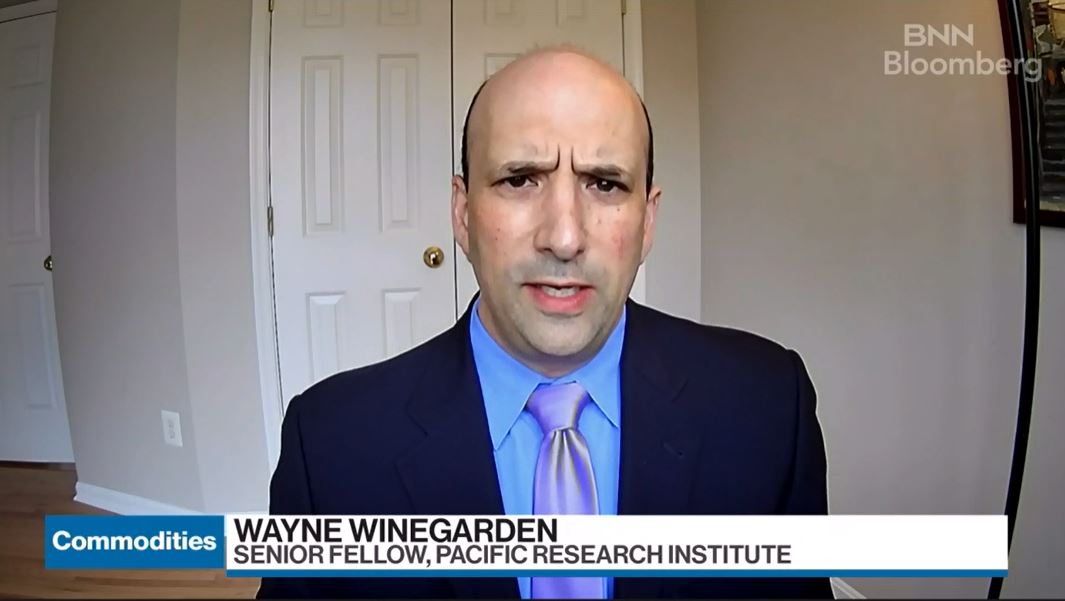
Wayne Winegarden
Senior Fellow, Business and Economics, Pacific Research Institute
Wayne Winegarden is a senior fellow in business and economics at the Pacific Research Institute and director of the organization’s Center for Medical Economics and Innovation. An economist and policy analyst, Winegarden focuses on healthcare, energy, taxation, and macroeconomic policy issues and has written for outlets including Forbes, The Wall Street Journal, USA Today, and Investor’s Business Daily. He previously worked as an economist in Hong Kong and Washington, D.C., and earned his Ph.D. in economics from George Mason University.
Topics
Appearances (2)
2026-11-17
Why California's Grid Is Straining: PRI Experts on Policy Costs and Nuclear PowerCalifornia's soaring energy costs have economic and regulatory roots, including a 100% renewable-grid mandate by 2045 that has doubled electricity rates relative to the national average, say Wayne Winegarden and Kerry Jackson of the Pacific Research Institute. The panel unpacks how state mandates for a 100% renewable grid by 2045 have doubled electricity rates relative to the national average, the hidden systems-level costs of solar and wind generation, and the vital role that Small Modular Reactors (SMRs) can play in providing affordable, reliable, and zero-carbon baseload power.
2026-05-20
Energy policy and coal's continuing role, with Wayne Winegarden of the Pacific Research InstituteWayne Winegarden, a senior fellow at the Pacific Research Institute, discusses energy policy and the ongoing importance of coal in the U.S. energy landscape on the Powering America Podcast. He highlights the complexities of energy costs in California, the role of coal as a dispatchable energy source, and the challenges posed by regulatory pressures that limit investment in coal. Winegarden emphasizes the need for a balanced energy strategy that includes coal, natural gas, and nuclear power to ensure grid reliability while addressing environmental concerns.
Notable quotes
“Without affordable energy, you don't have prosperity.”
“When those costs go up, the cost for everything else goes up too.”
“Coal still plays a very prominent role in keeping the world running today.”
“We have to do it realistically.”
“The ultimate problem is... it's harmful kind of to those companies, is gonna prevent them from being, having the capital they need.”
“The market will do a better job... because if we allow individual companies, individual entrepreneurs to experiment, to succeed and reap the rewards or fail and pay the consequences, then the market will do a better job.”
“"When you're talking about electricity rates that are twice the national average, as we've increased our share of solar and wind, you've seen that direct correlation that prices have gone up right along with it."”
“"It's a policy-created imbalance. Demand is not naturally outstripping our supply; it's a policy creation where we artificially inflate the cost of production."”
“"Comparing nuclear to solar, you actually have fewer lifetime emissions with nuclear than you do with solar."”
“"We've created a bit of a Rube Goldberg structure, trying to plan a very complicated system by taking into account only one goal."”
“"SMRs give you that ability to commoditize nuclear. You actually would be producing in a specific plant and bringing it on-site, capturing the efficiencies of mass production."”
“"You don't need to rewire the grid because you can site SMRs where retiring plants already have transmission lines."”