2026-08-11 · National Taxpayers Union
Advanced Recycling and the Recycled Materials Attribution Act
with Thomas Aiello, Vice President of Federal Affairs — National Taxpayers Union
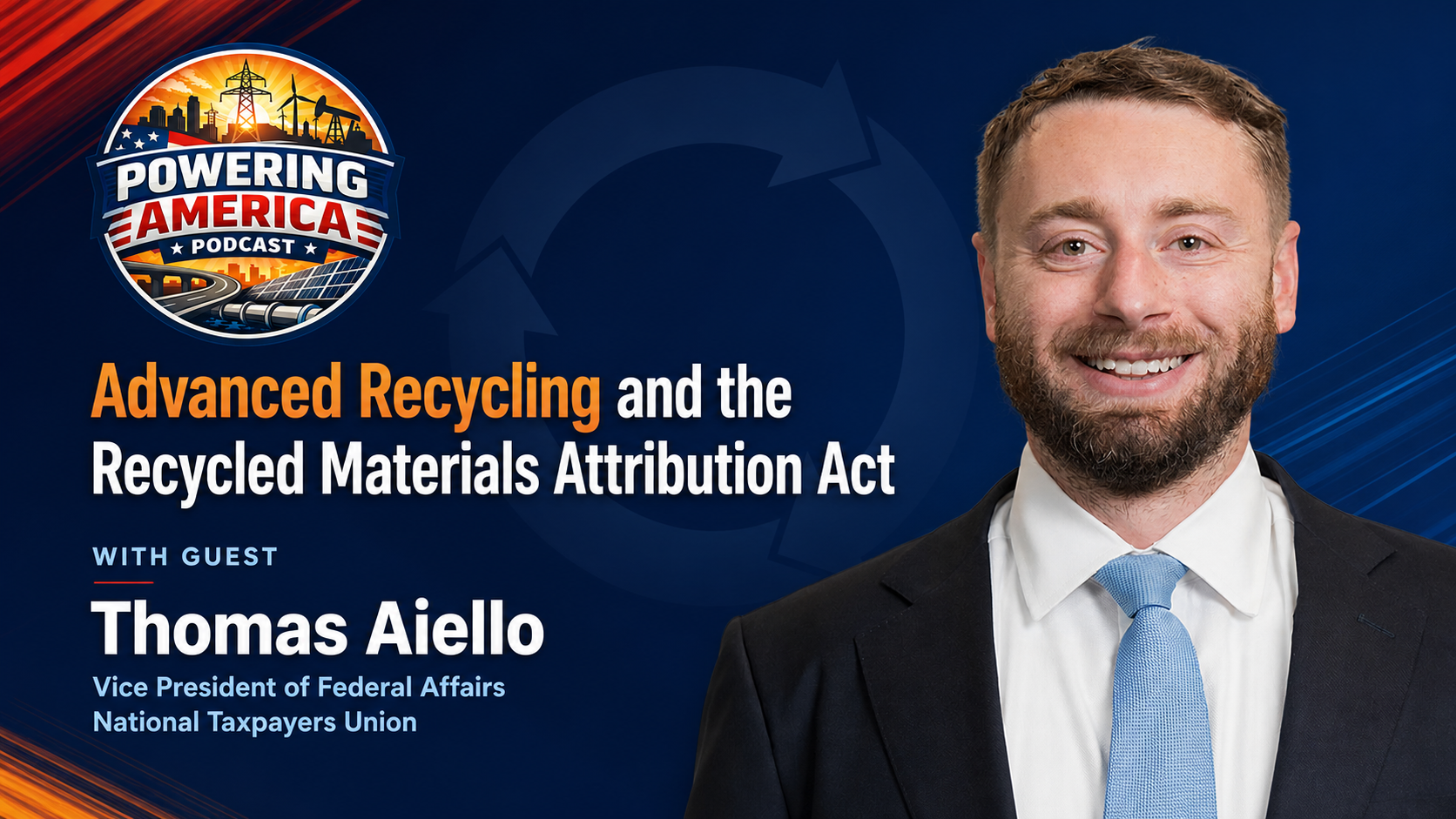
In the latest episode of the Powering America Podcast, Bryan Hyde speaks with Thomas Aiello, Vice President of Federal Affairs at the National Taxpayers Union. They discuss the challenges of recycling in the U.S., the need for federal standards, and the proposed Recycled Materials Attribution Act, which aims to streamline regulations for recycled materials. Aiello emphasizes the importance of advanced recycling technologies and the potential economic benefits of improving recycling rates.
Advanced Recycling and the Recycled Materials Attribution Act
Thomas Aiello Discusses Recycling Legislation and Taxpayer Interests on Powering America Podcast
In a recent episode of the Powering America Podcast, Thomas Aiello, Vice President of Federal Affairs at the National Taxpayers Union (NTU), discussed the intersection of recycling policies and taxpayer interests. Aiello emphasized the need for clearer regulations and standards in recycling to benefit both the environment and taxpayers.
Aiello, who has been with NTU for nearly six years, highlighted the organization's long-standing commitment to advocating for taxpayer interests on Capitol Hill. Founded nearly 60 years ago, NTU focuses on promoting lower taxes, limited government, and reduced regulations. Aiello noted the growing national debt, which is nearing $40 trillion, as a pressing issue that requires immediate attention.
"People have so much going on in their lives," Aiello said, explaining why taxpayers may not actively advocate for their interests. He pointed out that many individuals do not closely examine where their tax dollars go, which can lead to a disconnect between taxpayers and policymakers.
Recycling Challenges in the U.S.
Aiello addressed the current state of recycling in the United States, noting that there is no federal standard governing the practice. With approximately 7,000 municipalities handling recycling differently, confusion among consumers is prevalent. He cited statistics indicating that only about 10% of plastic waste is actually recycled, with the majority ending up in landfills or being incinerated.
"The more we can get landfills reduced and the more we can recycle, the less taxpayer burden there will be," Aiello stated. He stressed that the regulatory landscape plays a significant role in recycling efficiency and emphasized the need for federal involvement to standardize practices.
The Role of Advanced Recycling
Aiello discussed advanced recycling technologies, which he believes could significantly improve recycling rates. Advanced recycling involves breaking down plastics through processes like pyrolysis, which can yield new products without the use of fire. He argued that redefining advanced recycling as manufacturing, rather than incineration, would incentivize businesses to invest in recycling facilities.
Currently, about half of U.S. states classify advanced recycling as incineration, which imposes stricter regulatory requirements. "If you treat it as manufacturing, the regulations are significantly lower," Aiello explained. He expressed optimism that changing this classification could lead to a substantial increase in recycling capabilities, potentially allowing for the recycling of up to 50% of plastics.
Legislative Efforts
Aiello highlighted two key pieces of legislation currently under consideration. The first is the Recycled Materials Attribution Act (RMAA), which aims to establish a federal standard for recycled plastic content in packaging. This bipartisan bill, co-sponsored by 12 Republicans and 12 Democrats, seeks to alleviate compliance burdens on businesses that currently navigate varying state regulations.
The second piece of legislation focuses on defining advanced recycling as manufacturing. Aiello believes that bipartisan support exists for this initiative, despite some opposition from environmental groups who are critical of plastic use.
"There's such a hostility towards plastic," Aiello noted, acknowledging the challenges in garnering support for legislation that promotes plastic recycling. However, he maintained that there is a growing recognition across party lines of the need to improve recycling rates.
Conclusion
Aiello concluded the discussion by reiterating NTU's commitment to advocating for policies that benefit taxpayers. He encouraged listeners to engage with the organization through its website, NTU.org, and to follow its efforts on social media.
As the conversation around recycling and taxpayer interests continues to evolve, Aiello's insights underscore the importance of clear regulations and innovative solutions in addressing the challenges facing the recycling industry in the United States.
Interview Q&A
Q&A: Advanced Recycling and the Recycled Materials Attribution Act
Powering America Podcast: Advanced Recycling and the Recycled Materials Attribution Act
Q: Who is Thomas Aiello?
A: Thomas Aiello is the Vice President of Federal Affairs at the National Taxpayers Union, the oldest taxpayer advocacy organization in the United States, which has been active for nearly 60 years.
Q: What is the mission of the National Taxpayers Union?
A: The National Taxpayers Union advocates for pro-taxpayer policies, including lower taxes, limited government, fewer regulations, and addressing the national debt, which is approaching $40 trillion.
Q: Why do you think taxpayers do not advocate for themselves more?
A: Many taxpayers are preoccupied with their daily lives, such as work and family responsibilities, and may not closely track where their tax dollars go. This disconnect can lead to a lack of engagement in advocating for their interests.
Q: What is the current state of recycling in the United States?
A: Recycling efforts in the U.S. are hindered by a lack of federal standards, resulting in confusion among consumers. Approximately 10% of plastic is actually recycled, while the majority ends up in landfills or is incinerated.
Q: How does taxpayer funding relate to recycling?
A: Taxpayer funding supports recycling centers and landfills. Reducing landfill waste through increased recycling can lessen the financial burden on taxpayers.
Q: What is advanced recycling, and why is it important?
A: Advanced recycling involves innovative processes, such as pyrolysis, to convert plastics into new products. It has the potential to recycle a wider range of plastics compared to traditional methods, which could significantly reduce landfill waste.
Q: What legislative efforts are underway to improve recycling?
A: Legislation is being considered to redefine advanced recycling from being classified as incineration to manufacturing. This change would lower regulatory barriers and encourage investment in advanced recycling facilities.
Q: What is the Recycled Materials Attribution Act (RMAA)?
A: The RMAA is a bipartisan bill that aims to create a federal standard for recycling, simplifying compliance for businesses that currently face varying state regulations regarding recycled plastic content in packaging.
Q: How would the RMAA benefit businesses and consumers?
A: By establishing a single federal standard, the RMAA would reduce compliance costs for businesses and provide more certainty, potentially lowering costs for consumers.
Q: What challenges does advanced recycling face in gaining bipartisan support?
A: While there is general recognition of the need for improved recycling, opposition arises from some Democrats due to a broader hostility towards plastics. However, there is bipartisan support for certain recycling initiatives.
Q: How can people learn more about the National Taxpayers Union?
A: More information about the National Taxpayers Union can be found on their website at NTU.org, as well as on their social media platforms like Facebook and Twitter.
Q: What other issues does the National Taxpayers Union address?
A: The National Taxpayers Union advocates on various issues impacting taxpayers, including housing, energy, healthcare, and other policies that affect taxpayer interests.
Key takeaways
- “We advocate for keeping more of your hard-earned money in your pocket, less going to Washington.”
- “The more we can get landfills reduced and the more we can recycle, the less taxpayer burden they will be.”
- “If you treat it as manufacturing, it's treated as any other type of factory or manufacturing plant.”
- “Unfortunately, the way the regulations have been changed over the past 40 years, it makes it basically impossible to build anything.”
- “If we're only recycling less than 10% of all our plastic, it might feel good, but if it's just going into the landfill, it defeats the whole purpose.”
About the guest

Vice President of Federal Affairs — National Taxpayers Union
Thomas Aiello is Vice President of Federal Affairs at National Taxpayers Union. In this role, Thomas works to promote pro-taxpayer policies in the halls of Congress and within the Trump Administration. Prior to rejoining NTU, Thomas was a Director at the DCI Group where he specialized in ally development and leveraged his close relationships with think tanks and advocacy groups to advance client objectives. Before that he spent five years for limited government and lower taxes on the Government Affairs team at NTU. He’s also completed internships on K Street and in the United States House of Representatives for two members from his home state of New York. Thomas holds a bachelor's degree in Economics and Political Science from American University in Washington, DC. Originally from Long Island, New York, he enjoys staying up to date on local issues and rooting for the Yankees, Rangers, and New York Jets.
Full transcript
Show full transcriptHide transcript
Filed under